
Know why shoppers choose at shelf — 200+ interviews in 24 hours
For retail category teams and CPG shopper marketing teams: stop reading POS data backwards to explain shelf losses. Interview the shoppers who switched and decode the real triggers.

From individual interviews to a clearer picture.
Brand managers assume price is the primary switch trigger. Shoppers point elsewhere — shelf position and packaging cues are where loyalty is actually won and lost...
Trusted by teams at







An AI shopper insights platform is software that interviews real shoppers about real shelf decisions, decoding the path-to-purchase signals that POS and panel data cannot see. User Intuition is shopper insights software powered by AI-moderated interviews, running 30-minute conversations with shoppers and probing 5-7 levels deep into why they reach for someone else's product. Across 2,930 AI-moderated shopper interviews in CPG and retail, User Intuition found price was the stated reason for switching while the actual trigger was usually packaging perception, shelf visibility, or a lower-risk entry point. Stated reasons mask experiential drivers in nearly every category, and the gap only closes when shoppers narrate the moment of decision in their own words. A User Intuition shopper study starts at $150, returns shelf-decision evidence in 24 hours, and is backed by 4.9/5 on G2 and 5/5 on Capterra. The output is practical: shelf-decision drivers, switching triggers, packaging signals, and channel-preference evidence for category managers, brand teams, and shopper-marketing leaders.
Your shopper research is producing
decks, not shelf wins
Retailer or CPG, you lose the shelf moment for the same reasons. Shopper data is shallow and slow, showing what but never why. Packaging, trial-size, and entry points stay invisible while POS confirms the loss.
Behavioral Data Tells You What, Never Why
Numerator and loyalty card data show you what shoppers bought, how often, and at what price point. They cannot tell you why your SKU lost the consideration set for stock-up trips, what triggered the switch to private label, or which category entry point your competitor is owning. The 'why' behind shelf behavior requires conversation — and behavioral data doesn't have one.
Suzy-Style Surveys Capture 10 Minutes of Surface Rationale
Quick-turn survey platforms deliver fast data at shallow depth. A shopper who switched to private label because the packaging started looking as good as the national brand checks 'price' in a 10-minute survey. That's the story they rehearse — not the decision they made. Surface data produces surface strategy, and your competitors are going deeper.
In-Store Intercepts Are Expensive, Slow, and Context-Biased
Intercepts cost $150–$300 per completed interview, take 6–8 weeks to field, and catch shoppers mid-trip — distracted, time-pressured, and unwilling to think deeply. The result is biased recall and surface rationale, not purchase psychology. And by the time findings arrive, the planogram window has passed.
Agency Turnarounds Kill Seasonal Relevance
You need summer shelf intelligence in April. Your agency delivers it in June. By then, your competitor has already locked in incremental facings. Mid-cycle insights that arrive post-season aren't insights — they're post-mortems.
Path-to-Purchase Mapping Requires Conversation, Not Click Logs
Digital analytics show you the online path. They don't show you why a shopper who researched online converted in-store on a different brand, which category entry point drove the shopping trip, or what mission context shaped their evaluation criteria. Path-to-purchase research requires reconstructing the full decision journey — which only conversation can do.
How does User Intuition decode why shoppers choose at shelf?
User Intuition runs 30-minute AI-moderated interviews with real shoppers, laddering 5-7 levels past the rehearsed 'price' answer into the packaging, shelf, and entry-point moments that actually move the decision. Findings return in 24 hours at $30 per interview and compound in a searchable Intelligence Hub, so shopper intelligence stays in season instead of arriving as a post-mortem.
The why behind the what, not just the what
User Intuition interviews real shoppers about real shelf decisions, surfacing the switching triggers, entry points, and trade-offs behind every purchase, not the loyalty-card totals that show what sold but never why your SKU lost the trip.
5-7 levels deep, not 10 minutes of surface
Adaptive 5-7 level laddering pushes past the 'price' answer shoppers rehearse in a quick survey to the packaging perception, quality convergence, or lower-risk entry point that drove the real decision.
Honest signal, no mid-trip distraction
Shoppers reflect in a 30-minute conversation on their own time, not distracted and time-pressured in the aisle, so you get purchase psychology instead of the biased recall and surface rationale intercepts capture.
In season, not a post-season post-mortem
At 24-hour turnaround, summer shelf intelligence arrives in April when you can still win facings, not in June after the planogram window has closed the way an agency timeline forces it to.
The full decision journey, reconstructed
AI-moderated conversation rebuilds the entire path to purchase, from category entry point through online research to the in-store moment, surfacing the mission context and decision sequence that click logs and digital analytics can never explain.
From shelf question to category-winning intelligence
Design The Study
Define your shelf or category questions — path to purchase, switching triggers, or category entry points — and select shoppers by retailer, trip mission, and purchase behavior. Our AI builds the interview guide and screener for your specific category dynamics.
AI Conducts the Conversations
Each shopper completes a 30-minute AI-moderated voice interview reconstructing their shelf decisions, purchase triggers, and brand trade-offs. The AI probes deeper on the moments that drove or killed consideration at shelf.
Get Evidence-Backed Results
Receive shelf-ready intelligence with ranked purchase drivers, path-to-purchase maps, switching trigger analysis, and verbatim shopper language — traceable to quotes your retail buyers and category teams can act on immediately.
Create Compounding Intelligence
Every shopper study feeds your searchable intelligence hub. Q2 shelf findings inform Q3 packaging decisions and Q4 category review. Re-mine past interviews when new competitive threats or planogram windows arise — so seasonal knowledge compounds instead of evaporating.
Real-world applications
for Shopper Insights Platform
Path-to-Purchase Mapping
Where does your category enter the shopper's consideration — on the list, in the aisle, or at shelf? Interview 50–100 shoppers across channels and trip types to reconstruct the full path: awareness triggers, online research behavior, in-store decision sequence, and post-purchase rationalization. Retailer category teams use the map to re-sequence planograms and aisle signage; CPG shopper marketing teams use the same map to brief retail accounts with shopper-validated evidence.
Shelf Decision Research
What does a shopper actually see, feel, and decide in the 8 seconds they spend in front of your shelf set? AI-moderated conversations reconstruct the full shelf decision sequence — what triggered attention, what drove evaluation, what closed or killed the sale. Use findings to brief your retail team before the next planogram review with shopper-validated evidence.
Category Entry Point Identification
Which jobs-to-be-done, occasions, and emotional triggers are driving shoppers into your category — and which entry points is your brand absent from? Interview 30–60 category shoppers to map the full landscape of missions, triggers, and trade-offs shaping first consideration. Then brief your brand and shopper marketing teams on where to compete and where to invest.
Private Label vs. Brand Switching Research
Why are shoppers trading down — and is it really about price? Interview 20–40 switchers in 24 hours to uncover the exact shelf moment, trigger, and rationalization behind each defection: quality convergence, packaging perception shifts, value redefinition, or sustainability signals. Retailers use the findings to sharpen their private-label positioning; CPG shopper marketing teams use the same evidence to defend national-brand territory at the shelf.
New Product Launch Validation
Will shoppers understand your new SKU's value proposition at shelf? Which claims drive trial? Which occasion fit is strongest? Interview target shoppers before launch to stress-test positioning, packaging hierarchy, and category entry point fit — while there's still time to adjust. CPG shopper marketing teams run 30–50 interviews two to four weeks before launch to sharpen retail sell-in; retailers run the same studies before private-label launches or exclusive-SKU drops.
Continuous Seasonal Shopper Intelligence
Run 15–25 shopper interviews monthly across categories, channels, and trip types in 80+ languages. After two quarters, retailer category teams have a living map of how trip missions shift across seasons; CPG shopper marketing teams have a living map of private-label encroachment and category entry point moves — updated in real time, not once a year. Teams running continuous programs consistently outperform those relying on annual agency studies.
Why shopper interviews beat behavioral data, surveys, and intercepts
| Dimension | User Intuition | Numerator / Suzy / Intercepts / Agencies |
|---|---|---|
| Research Method | 30-min AI conversation · emotional laddering | Behavioral data (Numerator), 10-min surveys (Suzy), or in-store intercepts |
| Decision Architecture | Full path-to-purchase · entry points, shelf sequence, switching triggers | What was bought (Numerator); surface rationale (Suzy/surveys) |
| Interview Depth | 5–7 laddering levels · uncovers shelf psychology | Surface rationales — what shoppers rehearse in 10 minutes |
| Respondent Honesty | High · no social desirability pressure or mid-trip distraction | Low (surveys satisfice); biased (intercepts mid-trip) |
| Turnaround | 24 hours from launch to report | 4–8 weeks (agencies/intercepts); fast but shallow (Suzy) |
| Cost per Study | From $150 — no monthly fees | $150–$300 per intercept; $15K–$75K agency programs; opaque SaaS fees |
| The 'Why' Behind Behavior | Full decision psychology — triggers, trade-offs, emotions | Absent (Numerator); surface-only (Suzy/surveys) |
| Seasonal Relevance | Results in season — 24 hours not 8 weeks | Post-season delivery kills actionability (agencies/intercepts) |
| Shopper Panel | 4M+ global panelists filtered by category, retailer, trip type | Your own recruit (intercepts); behavioral panel only (Numerator) |
| Knowledge Compounding | Searchable Intelligence Hub — every study builds on the last | PDF per study or data dashboard — no institutional memory |
| Retailer Buyer Fit | Category teams serve directly — private-label, planogram, assortment use cases built-in | Built for CPG brand buyer only (Suzy/Agencies); retailers are an afterthought or ignored |
| Private Label Intelligence | Switcher interviews decode trade-down psychology — quality, packaging, trust, value redefinition | POS share-shift data (Numerator) or surface surveys (Suzy) — the why is absent |
| Path-to-Purchase as Framework | Trip mission → shelf sequence reconstructed through conversation — usable for planogram and sell-in | Behavioral logs (Numerator) or diagram-only frameworks (agencies) — no shopper-validated decision path |
How does User Intuition compare to other AI-moderated interview tools?
Easier setup
Brief in, study live in five minutes. No discovery workshop, no kickoff cadence. Competitors typically require a 30–60 minute onboarding call.
Faster fieldwork
User Intuition owns a 4M+ verified panel for consumer and broad-buyer audiences, and recruits specialty and B2B audiences to order. Competitors lean on third-party recruiters or make you bring your own.
Deeper insights
Adaptive 5–7 level laddering on every response — the same probing technique a senior qualitative researcher uses. Most AI moderators stop at one or two follow-ups before moving on.
Lower risk
Every interview is auto-scored against your brief on length, depth, and coverage. Conversations that miss the bar aren't charged. No refund request required, no manual review.
Why Do AI-Moderated Conversations Outperform Numerator, Suzy, and In-Store Intercepts for Shopper Research?
Behavioral data tells you what moved. Suzy-style surveys capture 10 minutes of surface rationale. In-store intercepts catch distracted shoppers mid-trip. AI-moderated interviews go deeper than all three — delivering the full decision architecture behind every shelf choice, at a price category teams can sustain quarter after quarter.
AI-Moderated Interviews Excel At
- Mapping the full path to purchase — from category entry point to shelf conversion
- Reconstructing shelf decision sequences through 5–7 level emotional laddering
- Identifying category entry points competitors are owning that your brand is missing
- Uncovering private label switching triggers beyond price: quality convergence, packaging perception, value redefinition
- Eliminating satisficing and social desirability bias that corrupt survey data
- 24-hour turnaround — shopper intelligence while the season is still actionable
- 200+ completed interviews per study — qual depth at quant scale
- Scaling continuous monthly programs without agency briefings or budget approval cycles
- Evidence traceable to specific shopper quotes for retail buyer sell-in
Consider In-Store Methods For
- Physical planogram and shelf layout testing requiring real fixture interaction
- Sensory product evaluation where taste, smell, or texture drives the decision
- Shop-along ethnography to observe non-verbal cues and impulse behavior
- Eye-tracking and heat-mapping studies requiring in-store equipment
- Live retail environment usability and wayfinding research
- High-context cultural shopping behavior requiring local interviewer rapport
N=2,930 AI-moderated shopper interviews on User Intuition (2024-2026), using 5-7 level laddering (Gutman 1982). Read What are shopper insights and how to gather them in 24 hours.
"Broad U.S. grocery study asked for forty and filled in a few hours. I was skeptical an AI would dig past "I like it." It did. Project pricing also meant I didn't need an annual platform fight just to pilot."
"The different formats matter too. Some questions only need text. But for packaging and creative, being able to show the image or the video and then ask the data questions afterward gets us a lot closer to how these calls really get made."
Hear the interviews. See the presentation.
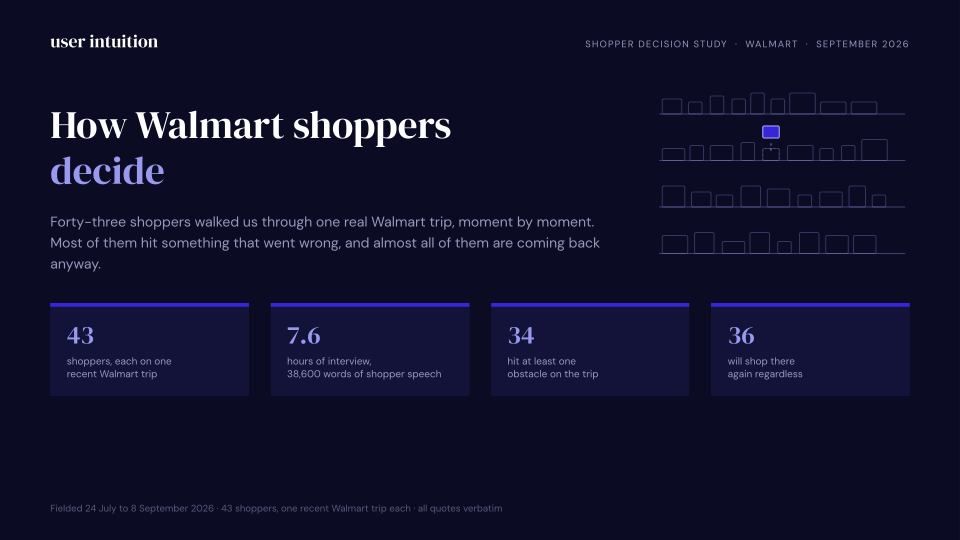
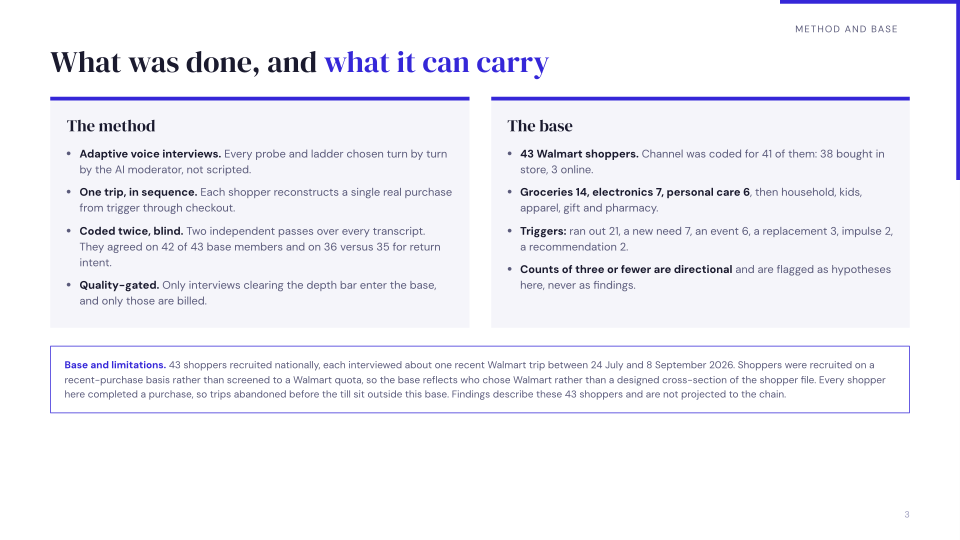
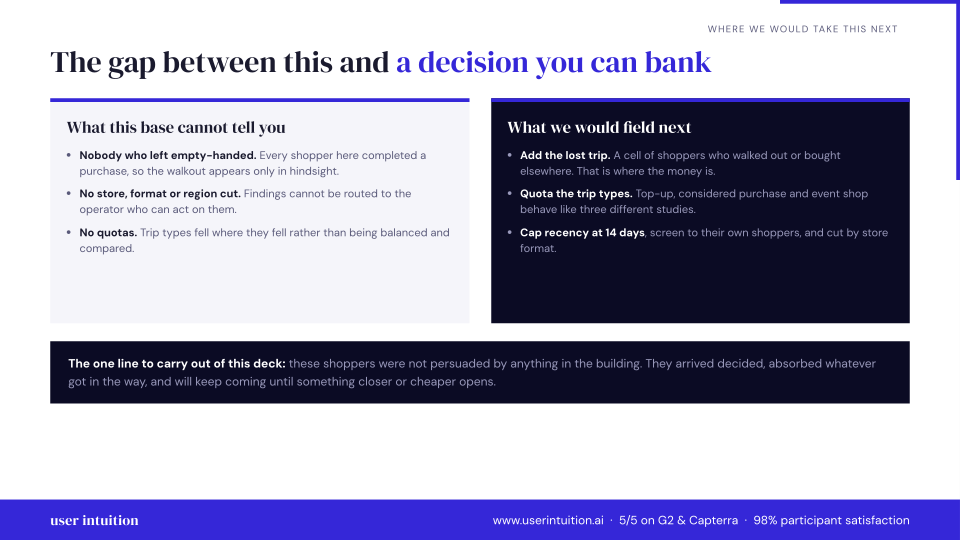
Explore calls and a sample presentation from our 43-participant Walmart shopper study.
Grocery top-up, supercenter
“Basically, because we use those things all a lot We try to always have you know, certain things in the house at all times because we use them very frequently. So we don't like to run out of them.”
What was making you want those specific things right then? Beyond just being out? Was it about being able to make certain meals or something else?
Basically, because we use those things all a lot We try to always have you know, certain things in the house at all times because we use them very frequently. So we don't like to run out of them.
Phone replacement, unplanned and urgent
“It made me feel so safe so relieved, and it brightened my day.”
Sounds like you knew exactly what you want. A Google Pixel 6 Pro. What was it about that phone that made it the right choice for you, especially in that moment?
Yeah. Thank you. So the the the phone had a lot of features. I I heard friends were talking about this phone. So in terms of the camera setting, it can take pictures and refine them into good quality. It has its own internal scanner, like I don't need to download other apps to scan to do scans. And of course, it has high quality for recording, which has been helping me in my meetings. In the office. So it's really amazing, and I love festival the quality of the phone in terms of the camera, because the previous phone I had was a Samsung. And the quality was really frustrating. And it had it has a very good processor speed as well. It's very fast. It's very efficient, and I like it. I like it. I'm enjoying the features.
Sample presentation
Preview three slides, or download the full 15-slide presentation.
Bring your own sample
$30 per quality voice interview
Use our 4M panel
$60 per quality voice interview
Common questions
200+ shopper interviews.
24 hours. Category-winning intelligence.
See how retail category teams and CPG shopper marketing teams run 200+ shopper interviews in 24 hours — decoding path to purchase, shelf decisions, and private label switching before the next category review.
Start with an editable research brief. Review your plan and discussion guide before inviting participants.
See how continuous shopper intelligence programs work for retailer category teams and CPG shopper marketing teams. We'll map a program to your planogram cadence, category calendar, and retail sell-in windows.
Your methodology · Your sample · No monthly fee on Starter
Go deeper on Shopper Insights Platform
Pillar Guides
Deep-dive guides covering this topic from strategy to execution.
Tools & Tactics
Practical frameworks and platform-specific guides for teams ready to act.
Reference Guides
Reference deep-dives on methodology, best practices, and applied research.
Alternatives & Comparisons
Side-by-side comparisons with competing platforms and approaches.
Industries
See how teams in specific verticals apply this research.
Platform Capabilities
The platform features that power this type of research.
Last updated