
AI User Research: Ship Features Users Actually Adopt
Stop shipping features and hoping users figure them out. Run user interviews inside your sprint cycle — 24 hours, not 6 weeks — instead of waiting on traditional research.

From individual interviews to a clearer picture.
Users complete core tasks 40% faster after targeted navigation improvements...
Trusted by teams at






An AI user research platform is software that runs scaled qualitative user interviews inside the product team's sprint cycle, replacing the recruit-moderate-synthesize bottleneck that pushed UX research to the edge of the timeline. User Intuition is a user research platform powered by AI-moderated interviews, probing 5-7 levels deep into friction, confusion, and workarounds across 200+ user interviews in 24 hours. Across 1,670 AI-moderated validation interviews with product teams, User Intuition found teams solved the right problem with the wrong interaction model — something no analytics dashboard can surface. Behavior-only data shows what users did; it cannot say what they expected, what confused them, or what they would have preferred. A User Intuition research study starts at $150, returns friction evidence in 24 hours, and is backed by 4.9/5 on G2 and 5/5 on Capterra. The output is practical: validated user journeys, friction maps, mental-model evidence, and JTBD signals for product, design, and UX research teams operating at sprint speed.
Your user research is scattered across
Notion, Figma, and abandoned decks
New team members can't access what you already learned. Every study starts from zero. Insight velocity doesn't match product velocity. Build a searchable research library so your team never re-learns the same usability lessons.
Knowledge Fragmentation
User pain points from checkout research don't inform onboarding research. Emotional insights from one segment aren't accessible to other teams.
New Team Members Start From Zero
A designer joins and redesigns a feature you researched 3 months ago. They don't know it. You waste budget re-discovering what you already learned.
Research Ships Monthly, Product Ships Weekly
Traditional user research takes 4–8 weeks. Product sprints run 2 weeks. Insights arrive too late to influence decisions.
Shallow Research Stays Shallow
'Users struggled with checkout' doesn't compound into organizational knowledge. You need the why: trust anxiety? friction? complexity?
Deep Research Is a Luxury
Traditional user research costs $500–$2,000+ per interview. Only large research departments with six-figure budgets can afford it.
How does User Intuition close the user-research gap?
User Intuition runs 200+ user interviews in 24 hours, ladders 5-7 levels into the friction and confusion behind behavior, and lands every conversation in a searchable Intelligence Hub. At $30 per interview, deep user research fits inside the sprint cycle instead of trailing it by six weeks.
One searchable library, never scattered
User Intuition lands every user interview in a searchable Intelligence Hub indexed by feature, segment, and friction, so checkout findings inform onboarding research instead of dying in Notion, Figma, and abandoned decks.
New hires inherit what you already learned
Because every study compounds in the Hub, a designer joining the team queries past research before redesigning a feature, so you stop burning budget re-discovering usability lessons you already paid for.
Research that ships at sprint speed
User Intuition returns 200+ user interviews in 24 hours, not 4-8 weeks, so insights land inside the two-week sprint they were meant to influence rather than arriving after the decision is made.
The why beneath the behavior, not just the what
Adaptive 5-7 level laddering pushes past 'users struggled with checkout' to the root cause, trust anxiety, friction, or complexity, turning shallow observations into mental-model evidence your team can act on.
Deep research at sprint-team cost
At $30 per interview with 24-hour turnaround, User Intuition makes depth a default, not a luxury, a fraction of the $500-$2,000 per interview that confines traditional user research to six-figure research departments.
From research question to product clarity
Design The Study
Frame your research questions — usability gaps, prototype reactions, or user behavior patterns — and set screener criteria. Our AI builds the interview guide, task flows, and recruitment plan for your specific product context.
AI Conducts the Conversations
Each participant completes a 30-minute AI-moderated voice interview exploring how they experience your product. The AI probes deeper on friction points, emotional responses, and the moments where users hesitate or abandon.
Get Evidence-Backed Results
Receive a structured research report with ranked pain points, user verbatims, behavioral patterns, and design recommendations — exportable to Figma, Jira, Slack, or PDF for your product and engineering teams.
Create Compounding Intelligence
Every study feeds your searchable intelligence hub. Onboarding research informs checkout redesign. Feature studies reference last sprint's findings. Re-mine past interviews when new design questions arise — so your product team never starts from zero.
Real-world applications
for AI User Research
AI user research applies across the full product lifecycle — from motivation mapping before spec to decision psychology during development to activation research post-launch — without the timeline constraints of traditional qual.
User Motivation & Needs Research
Move beyond feature lists to uncover the emotional and functional drivers behind user decisions. What job is the user hiring your product to do?
Experience Mapping & Journey Research
Understand the full user journey — where users encounter friction, when delight occurs, and what moments create abandonment risk.
Decision Psychology Research
Reveal subconscious drivers: visual trust, cognitive ease, social proof, loss aversion. Redesign to align with how users' brains actually work.
Emotional Response Research
How does your product make users feel? Does onboarding feel welcoming or overwhelming? Does error messaging feel punitive or supportive?
Comparative UX Evaluation
Side-by-side research comparing your product against 1–3 competitors. Where do users prefer your experience? Where do competitors outperform?
Onboarding & Activation Research
Isolate onboarding friction points: where new users get confused, what accelerates activation, what delight moments drive commitment.
Why user interviews beat unmoderated tasks and analytics dashboards
| Dimension | User Intuition | Unmoderated Tools (Maze / Lyssna) | Analytics (Hotjar / FullStory) |
|---|---|---|---|
| Depth of Insight | 5–7 levels of AI laddering into emotional and functional friction — the WHY behind behavior | Task completion and click paths; limited probing into motivation | Behavioral patterns only; no insight into why users do what they do |
| Emotional Capture | Voice-based interviews capture tone, hesitation, frustration, and enthusiasm in real time | Text-based responses; limited emotional signal | No emotional data; purely quantitative behavior patterns |
| Task Context | 30-minute conversations exploring the full decision context — not just the click | Task-based sessions focused on specific flows; limited broader context | Page-level data; no understanding of user intent or journey context |
| Scale | 200–1,000+ deep interviews per study at consistent quality | 5–50 participants typical; cost scales linearly with volume | Unlimited passive data but no qualitative depth at any scale |
| Speed | 24 hours from launch to full findings | 3–7 days for recruitment and completion; 1–2 weeks with analysis | Real-time data but requires manual analysis to extract actionable insights |
| Moderator Consistency | 100% AI-standardized methodology across every interview | Unmoderated; consistency depends on task design quality | N/A — no moderation; data quality depends on implementation |
| Cost | From $150 per study (5 interviews at $30 each, using your own audience) | $500–$5,000 per study depending on panel and complexity | $0–$500/mo for analytics; but tells you what, not why |
| Knowledge Retention | Searchable intelligence hub that compounds across every study and sprint | Study-by-study reports; no cross-study search or compounding | Dashboard data; no qualitative institutional knowledge |
How does User Intuition compare to other AI-moderated interview tools?
Easier setup
Brief in, study live in five minutes. No discovery workshop, no kickoff cadence. Competitors typically require a 30–60 minute onboarding call.
Faster fieldwork
User Intuition owns a 4M+ verified panel for consumer and broad-buyer audiences, and recruits specialty and B2B audiences to order. Competitors lean on third-party recruiters or make you bring your own.
Deeper insights
Adaptive 5–7 level laddering on every response — the same probing technique a senior qualitative researcher uses. Most AI moderators stop at one or two follow-ups before moving on.
Lower risk
Every interview is auto-scored against your brief on length, depth, and coverage. Conversations that miss the bar aren't charged. No refund request required, no manual review.
When Should You Use AI-Moderated Interviews for User Research — and When Shouldn't You?
AI-moderated interviews fit inside sprint cycles — delivering deep user motivation research in 24 hours with consistent methodology across every participant. But they're not the right tool for in-person contextual inquiry, accessibility research requiring accommodations, or co-design workshops.
AI-Moderated Interviews Are Best For
- User motivation and decision psychology research at scale
- Onboarding and activation experience research
- Feature prioritization and pain point discovery across segments
- Remote usability interviews with screen sharing
- Pre-build validation to prevent low-adoption feature investment
- Continuous research programs that fit inside sprint cycles
Consider Other Methods When
- In-person contextual inquiry and observation is required
- Complex physical prototypes need hands-on walkthroughs
- Accessibility research requires specific accommodations
- Highly sensitive UX topics (health, finance, safety) need empathy
- Co-design and participatory design workshops need facilitation
- Expert heuristic evaluation requires specialized UX credentials
N=1,670 AI-moderated user research interviews on User Intuition (2024-2026), using 5-7 level laddering (Gutman 1982). Best for sprint-cycle validation; reserve human moderation for discovery and contextual research.
"You get 30 minutes of honest, unprompted reasoning about why someone actually chose your product over a competitor's. Consumers go deeper because there's no social pressure from a group setting and no moderator rushing to stay on schedule."
 Eric O., Chief Commercial Officer, Turning Point Brands
 "We had already seen people pause on step three of the invite-teammate flow. The heatmap showed exactly where, but not why. Twelve interviews on that flow gave us the missing context around expectations and confidence."
Hear the interviews. See the presentation.
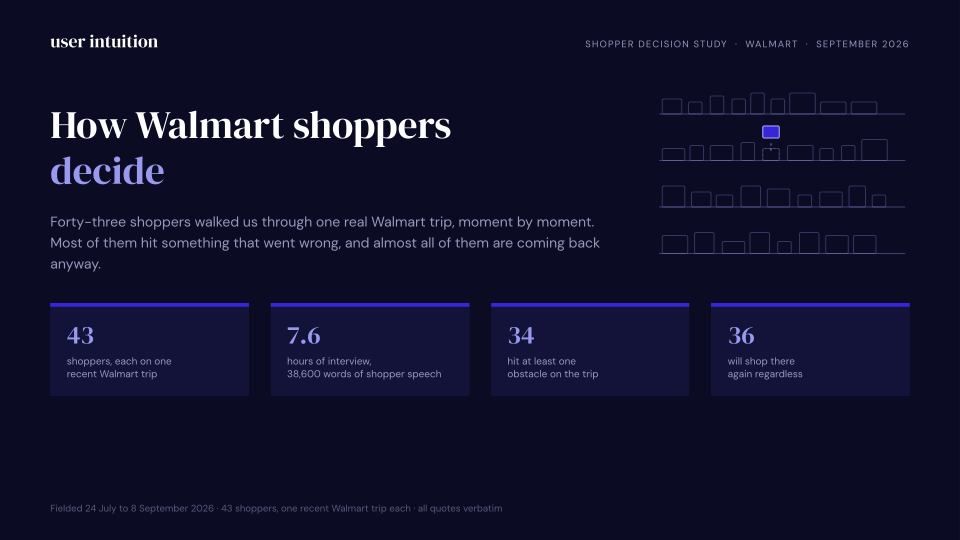
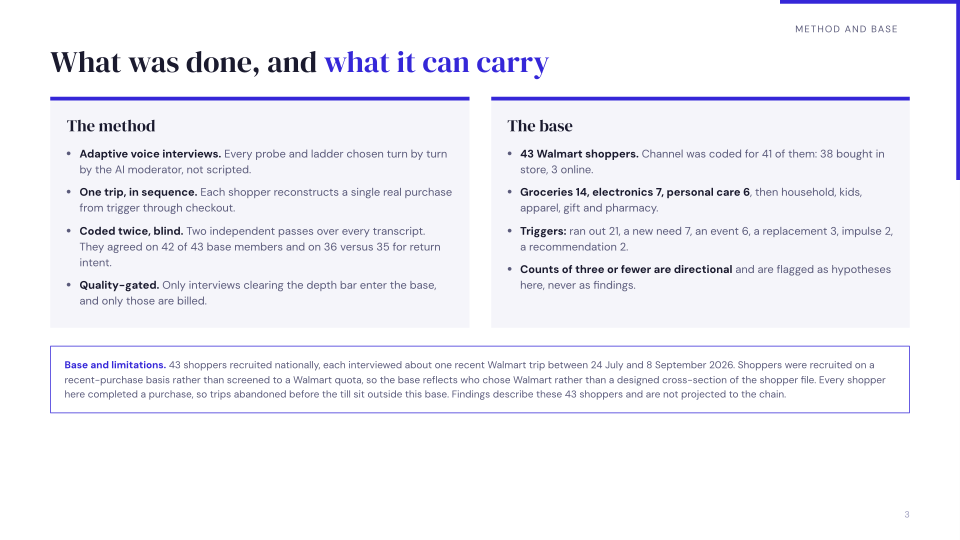
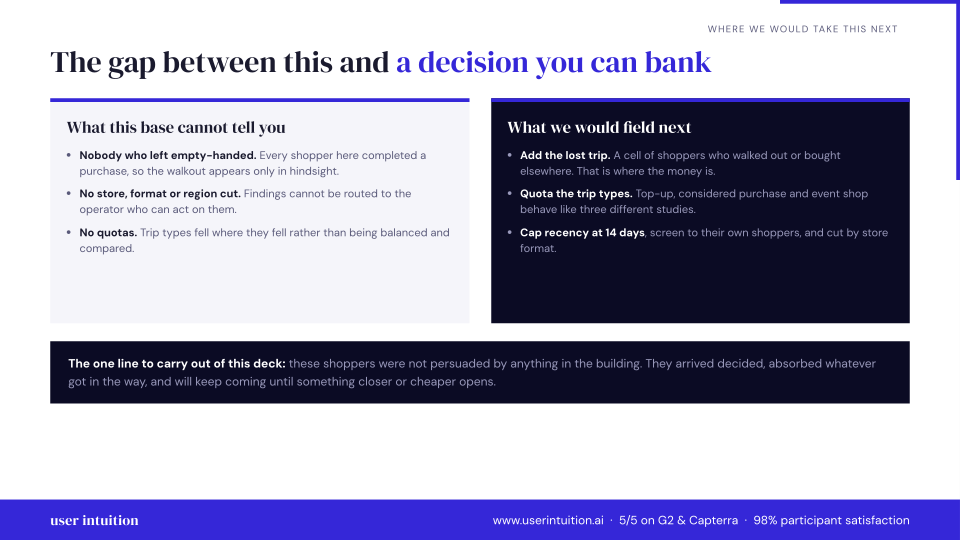
Explore calls and a sample presentation from our 43-participant Walmart shopper study.
Grocery top-up, supercenter
“Basically, because we use those things all a lot We try to always have you know, certain things in the house at all times because we use them very frequently. So we don't like to run out of them.”
What was making you want those specific things right then? Beyond just being out? Was it about being able to make certain meals or something else?
Basically, because we use those things all a lot We try to always have you know, certain things in the house at all times because we use them very frequently. So we don't like to run out of them.
Phone replacement, unplanned and urgent
“It made me feel so safe so relieved, and it brightened my day.”
Sounds like you knew exactly what you want. A Google Pixel 6 Pro. What was it about that phone that made it the right choice for you, especially in that moment?
Yeah. Thank you. So the the the phone had a lot of features. I I heard friends were talking about this phone. So in terms of the camera setting, it can take pictures and refine them into good quality. It has its own internal scanner, like I don't need to download other apps to scan to do scans. And of course, it has high quality for recording, which has been helping me in my meetings. In the office. So it's really amazing, and I love festival the quality of the phone in terms of the camera, because the previous phone I had was a Samsung. And the quality was really frustrating. And it had it has a very good processor speed as well. It's very fast. It's very efficient, and I like it. I like it. I'm enjoying the features.
Sample presentation
Preview three slides, or download the full 15-slide presentation.
Bring your own sample
$30 per quality voice interview
Use our 4M panel
$60 per quality voice interview
Common questions
- Speed. Full studies return in 24 hours, versus 5-10 days for moderator-scheduled platforms.
- Cost. Quality interview studies start at $150 — versus $750-$1,500+ per session billed regardless of session quality.
- Depth. The AI moderator runs 5-7 laddering levels per interview, versus 2-4 levels for unmoderated or lightly-moderated formats.
- Consistency. Every interview follows the same AI-standardized protocol, versus the moderator-to-moderator variability of human-led research.
User research intelligence that deepens
with every study
In 24 hours, understand the why behind user behavior. Build institutional knowledge that makes every product decision smarter.
Start with an editable research brief. Review your plan and discussion guide before inviting participants.
See how continuous user research integrates into sprint cycles. We'll help you build a compounding research practice.
Your methodology · Your sample · No monthly fee on Starter
Go deeper on AI User Research
Pillar Guides
Deep-dive guides covering this topic from strategy to execution.
Tools & Tactics
Practical frameworks and platform-specific guides for teams ready to act.
Reference Guides
Reference deep-dives on methodology, best practices, and applied research.
Alternatives & Comparisons
Side-by-side comparisons with competing platforms and approaches.
Industries
See how teams in specific verticals apply this research.
Platform Capabilities
The platform features that power this type of research.
Last updated