
Test concepts with real consumers
Test messaging, packaging, and positioning before committing budget. Understand what consumers choose, why it matters, and what to improve.

From individual interviews to a clearer picture.
Top theme: claim clarity. "I like the look, but I couldn't tell what makes it different from what I buy now."
Trusted by teams at






AI concept testing is a method that puts new concepts, packaging, and messaging in front of real consumers and probes their reactions in conversation — before budget gets committed. User Intuition is concept testing software powered by AI-moderated interviews, going beyond yes/no preference to the why underneath and testing concepts in 24 hours. Across 1,280 AI-moderated concept and message-testing interviews spanning CPG, software, healthcare, and financial-services teams, User Intuition found the team-favorite concept underperformed the one consumers preferred — for reasons nobody in the room considered. That gap closes only when consumers can talk about appeal, clarity, and purchase intent in their own words. A User Intuition concept test starts at $150, returns ranked results in 24 hours, and is backed by 4.9/5 on G2 and 5/5 on Capterra. The output is practical: ranked concept performance by segment, language consumers use, and credibility checks for product, brand, and innovation teams before they commit budget.
What is concept testing with User Intuition?
Concept testing with User Intuition puts your pack, message or prototype in front of real consumers in 20–30 minute AI-moderated interviews in voice, video or chat, that ladder 5–7 levels into appeal, clarity and purchase intent. 200+ reactions come back in 24 hours.
Who is concept testing with User Intuition for?
Agencies, insights and innovation teams deciding what to change before a concept goes to production.
How does AI-moderated concept testing work?
Upload pack and shelf images, video or a prototype. Compare concepts A, B and C in one interview, or run each stimulus order as its own cell with hard quotas. The moderator probes every reaction on the spot.
What do you get from a concept test?
Drivers and verbatims by concept and by cell, what to change next, an editable presentation, and every transcript, recording and screener answer, exportable to CSV.
Why does concept testing give you a score, but not what to change?
Most concept tests return a score without the reason, too late to change the concept. Here's what researchers tell us, and how User Intuition closes each gap.
- Sound familiar?
We got “68% like it.” Then someone asked what to change, and we had no answer.
The why beneath every reaction
The moderator ladders 5–7 levels into appeal, clarity and purchase intent, so you hear what to change in the consumer's own words.
- Sound familiar?
By the time the readout lands, the pack is already in production.
200+ concept reactions in 24 hours
Launch on Monday and read the reasons on Tuesday, while the concept can still change.
- Sound familiar?
We can afford one round. There's never budget to test the revised version.
Test, refine, test again
Run the first round, revise from the evidence, and test the new version the same week. You pay only for interviews that pass.
- Sound familiar?
Half the sample sees A first, half sees B first, and each cell is read on its own. If an AI tool can't run that design, we can't use it.
Your concept test design, run cell by cell
Run each stimulus order as its own parallel study cell, A then B in one and B then A in the other, with hard quotas and screeners per cell and the actual pack, shelf image, video or prototype in front of every respondent. Each cell is analyzed on its own.
- Sound familiar?
We learned what works on premium cues last year. Nobody can find the deck.
A concept library that compounds
Every test lands in your Intelligence Hub, searchable by concept, segment and driver, so the next brief starts from what already worked.
- The question
- Which consumer problem should a new product address?
- The evidence
- 500 US consumer conversations, followed by tests of two product concepts.
- The outcome
- The team chose a launch direction and made independent, trustworthy product rankings central to its positioning.
From concept to consumer verdict
Design The Study
Upload your concepts — packaging, messaging, ads, or product ideas — and define your target audience. Bring your own guide, or our AI builds the evaluation guide and screener to surface the specific consumer reactions that matter for your go/no-go decision.
AI Conducts the Conversations
Each consumer completes a 20–30 minute AI-moderated voice interview reacting to your concepts. The AI probes deeper on appeal, clarity, purchase intent, and the emotional drivers behind preference — not just top-2-box scores.
Get Evidence-Backed Results
Receive a structured concept evaluation with go/refine/kill signals, consumer verbatims, segment breakdowns, and clear iteration recommendations — so you know exactly what to change before the next round.
Create Compounding Intelligence
Every concept test feeds your searchable intelligence hub. Cross-concept patterns emerge across studies — which claims resonate by segment, which design elements drive premium perception — so your team builds on what already worked.
Real-world applications
for Concept Testing
Product Concept Testing
Test new product ideas, improvements, or feature combinations before committing to development and launch.
Packaging Design Testing
Test packaging designs, label refreshes, sustainability claims, and material changes before production.
Messaging & Positioning
Test different positioning angles, benefit statements, and campaign messages before rolling out.
Ad Concept & Creative Testing
Test video ads, print concepts, social media creatives, and tagline alternatives before spending on production.
Brand & Product Naming
Test whether product names are memorable, communicate the right message, and avoid negative associations.
Pricing & Value Perception
Test pricing strategies, bundle options, subscription vs. purchase models, and perceived value.
Why researchers choose User Intuition
User Intuition is an AI-moderated interview platform that gives research teams and agencies the depth of a senior researcher at the scale of a survey, with vetted respondents, your own methodology and evidence you can trace to the verbatim. Quality is built in: a person vets every panelist by hand, every session is screened for fraud, and you pay only for interviews that pass.
Senior-researcher depth
The moderator ladders 5–7 levels deep by default, using Reynolds and Gutman's laddering method, so you hear the reasons behind the reasons.
Your methodology, run as written
Bring your discussion guide and frameworks. Required questions stay pinned in order, word for word if you need it, study rules keep the moderator inside your compliance lines, screeners and hard quotas fill every cell to plan, and you decide how far it probes.
Every finding traces to its source
Click any theme through to the verbatim, the transcript and the recording. Nothing in the deliverable you can’t defend.
Respondents you can stand behind
A 4M+ vetted panel across 58 countries: a person listens to every panelist's interviews before they're accepted, then every session is screened for AI-generated or coached answers and panelists are tracked across studies. Or bring your own: customer lists, your panel provider, or respondents straight from your survey.
Deliverables ready to present
Themes, verbatims and an editable presentation for every study, plus every transcript, recording and screener answer to export into your own tools. Put your own brand on them when you need to.
Survey scale, quality-only billing
200+ panel interviews in 24 hours, with no cap on parallel conversations. Each one is scored on length, depth and coverage, and you pay only for those that pass.
- Isolated workspaces
- Confidential stimulus
- Never used to train AI models
- GDPR & CCPA compliant
- SOC 2 Type II examination underway
- Security →
Why concept interviews beat monadic surveys and focus groups
| Dimension | User Intuition | Quant Concept Screening (Zappi / Quantilope) | Focus Groups |
|---|---|---|---|
| Depth of Motivation | 5–7 levels of laddering into why consumers prefer a concept — emotional and functional drivers | Top-2-box scores and purchase intent; no probing into the why behind preference | Verbal reactions but contaminated by groupthink, moderator influence, and social desirability |
| Speed | Results in 24 hours | 1–2 weeks for fielding and automated analysis | 6–12 weeks including recruitment, facility booking, moderation, and synthesis |
| Cost | Starter: $150 for 5 voice interviews with your own sample | Per-concept or subscription platform fees; scores, not reasons | $15K–$75K per project including recruitment and facility |
| Scale | From 5 to 300+ individual 1-on-1 concept interviews per study | 500+ shallow responses; volume compensates for lack of depth | 6–8 participants per group; 3–4 groups typical; limited generalizability |
| Bias Control | One-on-one interviews keep groupthink out, and every participant gets the same neutral, non-leading probing, so every reaction is independent | Question framing bias; no ability to probe unexpected reactions | Dominant voice bias; participants conform to group consensus |
| Consumer Language | Full verbatim consumer language — usable directly in creative briefs and positioning documents | Checkbox selections and scaled ratings; no natural language capture | Transcripts available but contaminated by group dynamics and moderator framing |
| Iteration Speed | Test, refine, re-test in 1 week — multiple iteration cycles before production | Sequential testing; each round adds 1–2 weeks | Single round typical; iteration requires new recruitment and scheduling |
| Knowledge Retention | Searchable intelligence hub — compare concept performance across campaigns and markets over time | Platform dashboard; limited cross-study comparison | Static decks; starts from zero each project |
Hear the interviews. See the presentation.
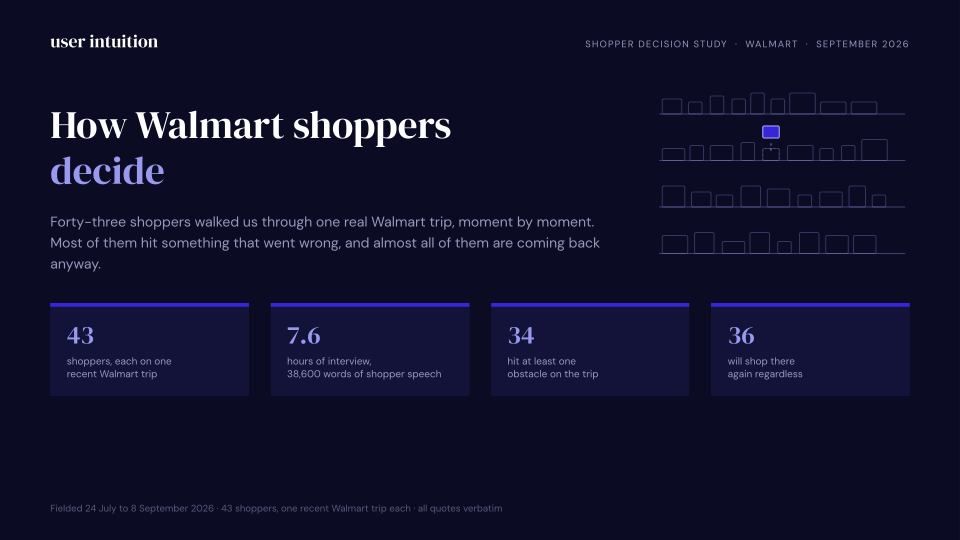
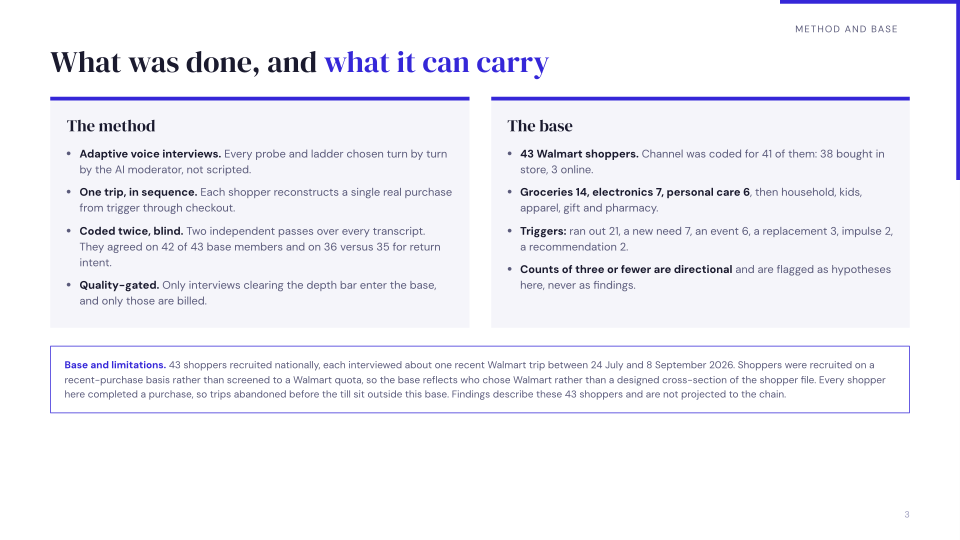
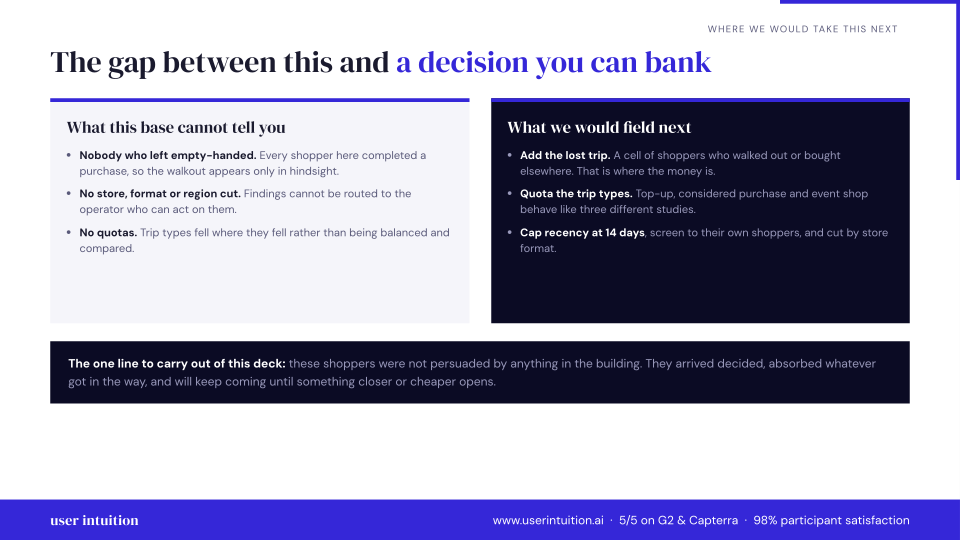
Explore calls and a sample presentation from our 43-participant Walmart shopper study.
Grocery top-up, supercenter
“Basically, because we use those things all a lot We try to always have you know, certain things in the house at all times because we use them very frequently. So we don't like to run out of them.”
What was making you want those specific things right then? Beyond just being out? Was it about being able to make certain meals or something else?
Basically, because we use those things all a lot We try to always have you know, certain things in the house at all times because we use them very frequently. So we don't like to run out of them.
Phone replacement, unplanned and urgent
“It made me feel so safe so relieved, and it brightened my day.”
Sounds like you knew exactly what you want. A Google Pixel 6 Pro. What was it about that phone that made it the right choice for you, especially in that moment?
Yeah. Thank you. So the the the phone had a lot of features. I I heard friends were talking about this phone. So in terms of the camera setting, it can take pictures and refine them into good quality. It has its own internal scanner, like I don't need to download other apps to scan to do scans. And of course, it has high quality for recording, which has been helping me in my meetings. In the office. So it's really amazing, and I love festival the quality of the phone in terms of the camera, because the previous phone I had was a Samsung. And the quality was really frustrating. And it had it has a very good processor speed as well. It's very fast. It's very efficient, and I like it. I like it. I'm enjoying the features.
Sample presentation
Preview three slides, or download the full 15-slide presentation.
Bring your own sample
$30 per quality voice interview
Use our 4M+ vetted panel
$60 per quality voice interview
What researchers say
"What surprised me was the moderator. In one pack study people kept saying a concept felt "more premium," and instead of logging that and moving on it kept asking what premium meant to them, until it came out that they meant the front wasn't cluttered, they could find the ingredients, and it looked like something they'd actually put in their cart. I'd normally only get that from a good human moderator."
"We ended up testing four screens and a concept image for a shared-lists idea that design was falling in love with. Fourteen video interviews later, we paused the build and saved a sprint on something people didn't connect with."
Common questions
Concept intelligence that
compounds with every test
Start with a concept and a research question. Review the interviews, understand the response, and use the evidence to refine the next version.
Start with an editable research brief. Review your plan and discussion guide before inviting participants.
See concept testing in action. We'll help you design a continuous testing program that builds institutional knowledge.
Your methodology · Your sample · No monthly fee on Starter
Go deeper on Concept Testing
Pillar Guides
Deep-dive guides covering this topic from strategy to execution.
Tools & Tactics
Practical frameworks and platform-specific guides for teams ready to act.
Reference Guides
Reference deep-dives on methodology, best practices, and applied research.
Alternatives & Comparisons
Side-by-side comparisons with competing platforms and approaches.
Platform Capabilities
The platform features that power this type of research.
Last updated