
Retail shopper insights that compound — 200+ interviews in 24 hours
POS data shows what sold. AI-moderated interviews reveal why shoppers chose it, switched, or walked away: 20–30 minute depth interviews at scale in 24 hours.

Walk me through the last time you made this choice. What tipped it?
The deciding reason surfaced four follow-ups deep, not in the first answer.
Trusted by teams at






Retail customer research is the practice of retailers, brands, and merchandising teams understanding how shoppers think, browse, and buy across channels — typically through POS data, loyalty programs, and exit surveys that miss the experiential context behind every choice. User Intuition is retail customer research software powered by AI-moderated interviews, running 20–30 minute conversations with real shoppers across in-store, omnichannel, and DTC contexts. Across 2,380 AI-moderated retail shopper interviews, User Intuition found that stated purchase drivers — price, convenience, loyalty points — masked the emotional and experiential motivations that predict store switching, basket abandonment, and channel preference. User Intuition surfaces those drivers by having shoppers narrate the trip across 5-7 levels of probing. A User Intuition retail study starts at $150, returns shopper-decision evidence in 24 hours, and is backed by 4.9/5 on G2 and 5/5 on Capterra. The output is practical: shelf and channel-decision drivers, basket-abandonment signals, loyalty-program effectiveness evidence, and format-preference maps for category, store-ops, and digital teams at retailers and DTC brands.
What is retail customer research with User Intuition?
Retail customer research with User Intuition means AI-moderated shopper interviews for path-to-purchase, loyalty drivers, omnichannel preference and competitive switching. Each 20–30 minute interview ladders 5–7 levels from the purchase back to the motivation, with 200+ panel interviews in 24 hours from a 4M+ vetted panel across 58 countries; your loyalty list runs in parallel as members respond.
Who is retail customer research with User Intuition for?
Research agencies serving retail and CPG clients, and in-house insights, merchandising, e-commerce and CX teams at retailers.
How does AI-moderated retail customer research work?
Add your guide and stimulus, such as promo creative, shelf images or the checkout flow. The AI moderator interviews screened shoppers in voice, video or chat, and every finding links back to the recording.
What do you get from a retail research study?
Themes with verbatims, reads by shopper segment and channel, an editable presentation, and every transcript and recording.
Why does retail customer research show what sold but not why?
POS, e-commerce analytics and loyalty data each show a piece of the shopper, and none of them shows the reason. Here's what retail researchers tell us, and how User Intuition closes each gap.
- Sound familiar?
POS tells us the private label slipped. It can't tell us whether that's price or perception.
The why behind what sold
Shoppers explain the choice in 20–30 minute 1-on-1 interviews with 5–7 level laddering (Reynolds and Gutman), so assortment, planogram and pricing calls rest on current motivations, not historical velocity.
- Sound familiar?
Foot traffic dropped on Tuesday. The focus groups won't report back for eight weeks.
200+ shopper interviews in 24 hours
Spot the problem Tuesday and have qualitative root-cause evidence by Thursday, fast enough to iterate promo messaging, assortment and seasonal pivots in days.
- Sound familiar?
Our app shopper and our in-store shopper want different things, and one survey flattens both.
Omnichannel reads in one study
Recruit in-store visitors, app users and web shoppers in parallel and compare why the convenience-driven shopper abandons mobile while the discovery-driven shopper thrives in-store.
- Sound familiar?
We keep funding loyalty promos and still can't say why members are drifting.
Loyalty drivers, diagnosed at the root
Interview lapsed loyalty members and category-loyal buyers to separate stockouts, private label perception and basket thresholds, and learn what shoppers value in tiers, rewards and experiences.
- Sound familiar?
We see exactly where carts get abandoned and have no idea why.
Cart abandonment and switching, explained
Hear whether shoppers left over shipping friction, trust, navigation or a better price elsewhere, why a core shopper switched to a competitor last week, and whether that switch is reversible.
- Sound familiar?
Every study is a snapshot. Next season we start the shopper map over.
A shopper map that compounds
Findings flow into your Intelligence Hub, building a living map of core cohorts across seasons, store formats and regions that stays when people leave.
From shopper question to retail intelligence
Design The Study
Every study starts with a research plan. Define your question — path-to-purchase, loyalty drivers, assortment gaps, or omnichannel friction — then bring your own guide, or our AI builds the discussion guide, screener, and timeline tailored to retail decision cycles.
AI Conducts the Conversations
Each participant completes a 20–30 minute AI-moderated interview. The AI moderator adapts questions in real time, probing deeper when shoppers reveal substitution triggers, loyalty barriers, or channel preferences that shape merchandising strategy.
Get Evidence-Backed Results
After interviews are complete, you receive a full research report with quantified findings, participant verbatims, and strategic recommendations — organized by shopper cohort, channel, and purchase motivation.
Create Compounding Intelligence
Every study feeds your searchable Intelligence Hub. Query past research across loyalty studies, assortment tests, and seasonal campaigns. Surface patterns across shopper segments and re-mine interviews for new insights — so your retail intelligence compounds over time.
How Retail Teams Use User Intuition
Assortment Planning with Shopper Motivation Data
Identify which segments see certain categories as essential, which avoid private label for emotional reasons, and which trade on convenience over discovery. 20–30 minute, 5–7 level laddering studies reveal motivation chains.
Omnichannel Strategy & Channel Preference
Build layered profiles: convenience-driven app shoppers, discovery-driven in-store shoppers, digital coupon hunters, and premium seekers. Test new features against known motivation profiles.
Pricing Strategy & Markdown Optimization
Understand why shoppers accept or reject price points, what anchors they use, and how promotions land psychologically. Find out whether a margin-optimizing price increase fails on perception or on economics.
Loyalty Program Redesign & Engagement
Map emotional and practical barriers to engagement across lapsed members, power users, and new joiners. 5–7 level laddering reveals whether points systems, tier opacity, or forced participation drive disengagement.
Private Label Expansion & Positioning
Map perception gaps: what would convince the only-buy-name-brands segment to trial? Is it packaging, guarantee, or visibility? Every design and messaging test informed by stored learnings.
Store Traffic Decline Root-Cause Analysis
Run rapid, targeted studies with lapsed store visitors to pinpoint the real driver. Is it assortment, store experience, pricing, local competition, or loyalty program perception?
Why researchers choose User Intuition
User Intuition is an AI-moderated interview platform that gives research teams and agencies the depth of a senior researcher at the scale of a survey, with vetted respondents, your own methodology and evidence you can trace to the verbatim. Quality is built in: a person vets every panelist by hand, every session is screened for fraud, and you pay only for interviews that pass.
Senior-researcher depth
The moderator ladders 5–7 levels deep by default, using Reynolds and Gutman's laddering method, so you hear the reasons behind the reasons.
Your methodology, run as written
Bring your discussion guide and frameworks. Required questions stay pinned in order, word for word if you need it, study rules keep the moderator inside your compliance lines, screeners and hard quotas fill every cell to plan, and you decide how far it probes.
Every finding traces to its source
Click any theme through to the verbatim, the transcript and the recording. Nothing in the deliverable you can’t defend.
Respondents you can stand behind
A 4M+ vetted panel across 58 countries: a person listens to every panelist's interviews before they're accepted, then every session is screened for AI-generated or coached answers and panelists are tracked across studies. Or bring your own: customer lists, your panel provider, or respondents straight from your survey.
Deliverables ready to present
Themes, verbatims and an editable presentation for every study, plus every transcript, recording and screener answer to export into your own tools. Put your own brand on them when you need to.
Survey scale, quality-only billing
200+ panel interviews in 24 hours, with no cap on parallel conversations. Each one is scored on length, depth and coverage, and you pay only for those that pass.
- Isolated workspaces
- Confidential stimulus
- Never used to train AI models
- GDPR & CCPA compliant
- SOC 2 Type II examination underway
- Security →
How Does User Intuition Compare to POS Analytics, Mystery Shopping, and In-Store Intercepts for Retail Research?
| Dimension | User Intuition | POS Analytics (dunnhumby / Numerator) | Mystery Shopping | In-Store Intercepts |
|---|---|---|---|---|
| Depth of Insight | 20–30 min conversations probing 5–7 levels into emotional and experiential shopper motivations | Transaction-level data; shows what sold, not why shoppers chose it | Evaluates store execution and compliance, not shopper motivation | 2–5 min intercepts; surface-level feedback limited by time and context pressure |
| Time to Insights | 24 hours from study launch to full report | Monthly or quarterly reporting cycles; weeks old by delivery | 2–4 weeks for shop completion and report synthesis | 1–3 weeks for fieldwork and manual analysis |
| Cost per Study | From $150 (5 interviews at $30 each, using your own audience) | $50K–$200K+ annual subscription; no per-study flexibility | $500–$2K per shop visit; $10K–$50K for multi-location programs | $5K–$15K per wave depending on sample size and geography |
| Path-to-Purchase Mapping | Full shopper journey from trigger to purchase with emotional motivation chains | Shows final transaction only; no journey context or decision drivers | Observes in-store execution, not the shopper's decision process | Captures post-purchase recall; misses pre-visit research and channel switching |
| Omnichannel Coverage | Interview shoppers across all channels — in-store, online, app, and hybrid journeys | Tracks transactions per channel but can't explain cross-channel switching | In-store only; no visibility into digital shopping behavior | In-store only; excludes e-commerce, app, and curbside shoppers |
| Consumer Language | Full verbatim transcripts — usable directly in merchandising briefs and loyalty strategy | SKU-level data and category codes; no shopper voice | Standardized checklists; scripted evaluations with no open-ended depth | Brief open-text responses; limited emotional context |
| Knowledge Retention | Searchable intelligence hub that compounds across every study, season, and segment | Dashboard access during subscription; no cross-study synthesis | Reports filed per visit; no longitudinal pattern tracking | Wave-by-wave reports; no institutional memory system |
| Private Label & Pricing Research | Direct shopper conversations revealing why shoppers accept or reject private label and pricing changes | Market share and price elasticity data; no perception drivers | Can evaluate shelf placement but not shopper perception or purchase intent | Can ask about price but limited to surface-level stated reactions |
Hear the interviews. See the presentation.
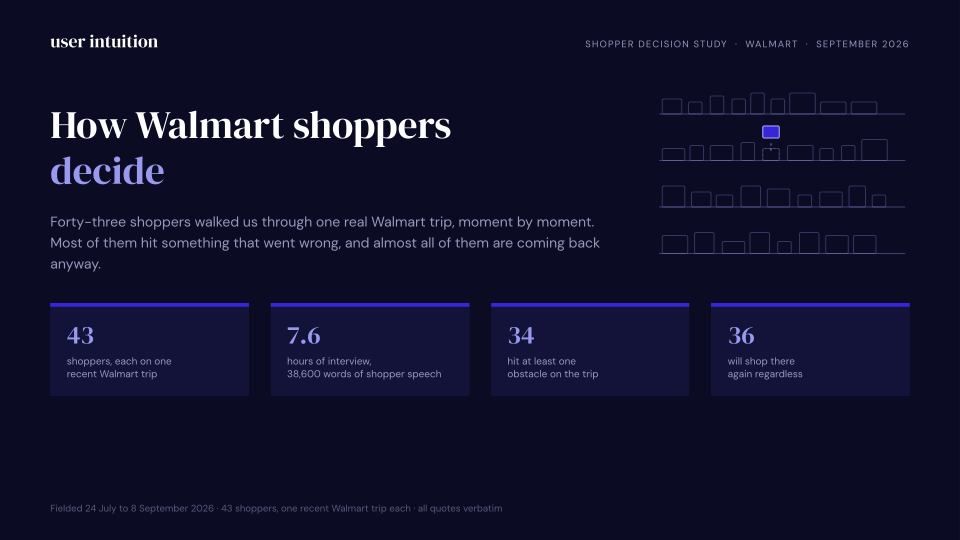
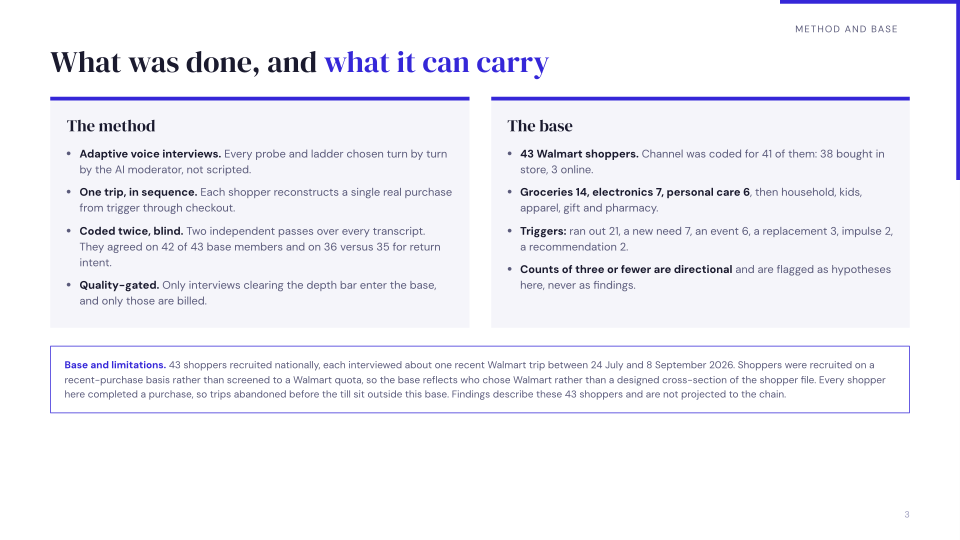
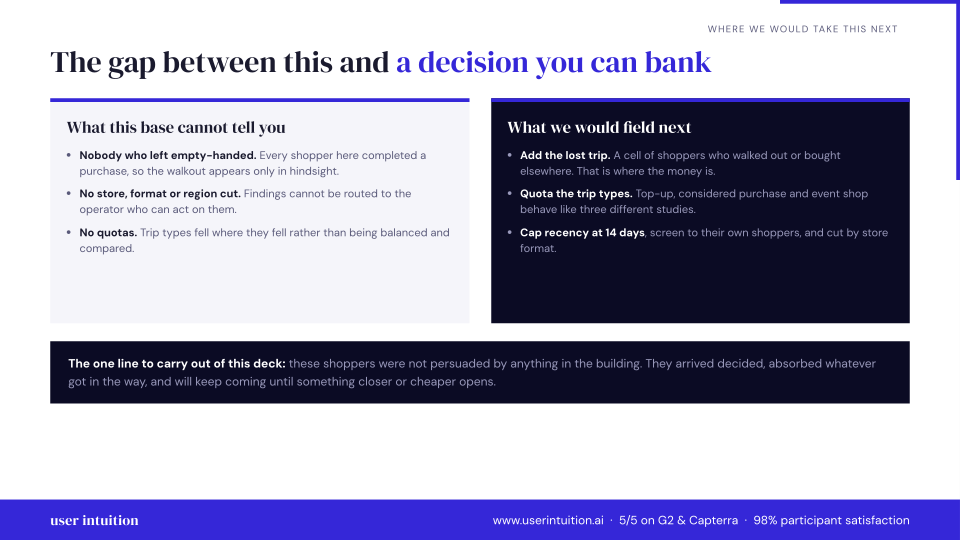
Explore calls and a sample presentation from our 43-participant Walmart shopper study.
Grocery top-up, supercenter
“Basically, because we use those things all a lot We try to always have you know, certain things in the house at all times because we use them very frequently. So we don't like to run out of them.”
What was making you want those specific things right then? Beyond just being out? Was it about being able to make certain meals or something else?
Basically, because we use those things all a lot We try to always have you know, certain things in the house at all times because we use them very frequently. So we don't like to run out of them.
Phone replacement, unplanned and urgent
“It made me feel so safe so relieved, and it brightened my day.”
Sounds like you knew exactly what you want. A Google Pixel 6 Pro. What was it about that phone that made it the right choice for you, especially in that moment?
Yeah. Thank you. So the the the phone had a lot of features. I I heard friends were talking about this phone. So in terms of the camera setting, it can take pictures and refine them into good quality. It has its own internal scanner, like I don't need to download other apps to scan to do scans. And of course, it has high quality for recording, which has been helping me in my meetings. In the office. So it's really amazing, and I love festival the quality of the phone in terms of the camera, because the previous phone I had was a Samsung. And the quality was really frustrating. And it had it has a very good processor speed as well. It's very fast. It's very efficient, and I like it. I like it. I'm enjoying the features.
Sample presentation
Preview three slides, or download the full 15-slide presentation.
Bring your own sample
$30 per quality voice interview
Use our 4M+ vetted panel
$60 per quality voice interview
What researchers say
"The depth of insight rivals expensive user research, but the scale is completely different. We went from 12 win/loss interviews per quarter to 200+. Now we can segment by industry, deal size, and competitor."
"A brand manager Slack'd me at four about our new resealable pouch and I answered before standup the next morning with quotes from a study we'd run six weeks earlier. Searched the hub and that was it. Used to mean a panel export, a Qualtrics export, and digging through Dovetail."
Common questions
Run your first retail shopper interview this week
Whether it's foot traffic, private label adoption, or omnichannel experience—get qualitative, motivation-mapped answers in 24 hours.
Start your first retail shopper interview today. No credit card required. Design a 15–20 person study on your highest-priority question.
See how User Intuition fits your research workflow. Walk through a real retail study and the Intelligence Hub in action.
Walk through a real study — from interview to report. See exactly what the platform delivers before you commit.
No contract · Transparent per-interview pricing · Results in 24 hours
Related research and resources
Pillar Guides
Deep-dive guides covering this topic from strategy to execution.
Tools & Tactics
Practical frameworks and platform-specific guides for teams ready to act.
Reference Guides
Reference deep-dives on methodology, best practices, and applied research.
Alternatives & Comparisons
Side-by-side comparisons with competing platforms and approaches.
Related Solutions
Complementary research use cases that pair with this topic.
Platform Capabilities
The platform features that power this type of research.
Last updated