
AI Market Intelligence: See Your Market Shift Before Analysts Do
Analyst reports tell you what already happened. Consumer interviews reveal what's happening now. Talk to 200+ buyers in 24 hours and track category dynamics quarter over quarter.

From individual interviews to a clearer picture.
Top switching theme: onboarding. "The new brand walked me through setup in five minutes. With ours I gave up on day two."
Trusted by teams at






An AI market intelligence platform is software that interviews real consumers and buyers across a category, surfacing the competitive moves, white-space gaps, and emerging behaviors that public data and analyst reports miss. User Intuition is market intelligence software powered by AI-moderated interviews, building category-level evidence from 200+ direct consumer conversations in 24 hours. User Intuition surfaces how consumer language about a category shifts before behavior follows — emerging needs, dissatisfaction with status-quo brands, and switching triggers that show up in unprompted conversation months before syndicated trackers catch them. Those signals exist only in the buyer's head, and they move faster than any panel report can refresh. A User Intuition market study starts at $150, returns category evidence in 24 hours, and is backed by 4.9/5 on G2 and 5/5 on Capterra. The output is practical: category shift signals, white-space opportunities, competitive perception maps, and unmet-need evidence for strategy, corporate development, and category leadership.
What is market intelligence with User Intuition?
Market intelligence with User Intuition is first-party and consumer-backed: 20–30 minute AI-moderated interviews that ladder 5–7 levels into the needs, perceptions and switching triggers shaping your category. Run 200+ panel interviews in 24 hours from a 4M+ vetted panel across 58 countries, or bring your own sample, and re-run the same flow quarter over quarter in a searchable Intelligence Hub.
Who is market intelligence with User Intuition for?
Research agencies and in-house insights, strategy and competitive intelligence teams who need to see category shifts before analyst reports do.
How does AI-moderated market intelligence work?
Set the guide for your category and competitors. The AI moderator interviews screened buyers in voice, video or chat across markets, and every finding links back to the recording.
What do you get from a market intelligence study?
Competitive perception and white-space themes with verbatims, quarter-over-quarter trend reads, an editable presentation, and every transcript and recording.
Why does market intelligence keep starting from scratch?
Every study is a one-off, filed and forgotten until the same question gets funded again. Here's what insights and strategy teams tell us, and how User Intuition closes each gap.
- Sound familiar?
Last year's white-space study never met this year's switching data. We're funding the same questions again.
Market intelligence that compounds
Every interview lands in your Intelligence Hub, indexed by category, segment, competitor and motivation, so each study builds on the last.
- Sound familiar?
We have a Q1 snapshot and a Q4 snapshot. We can't tell how the market moved between them.
Quarter-over-quarter category trend lines
Re-run identical research flows every quarter to track how consumer perception shifts, so you spot a category move while you can still respond.
- Sound familiar?
Our competitors read the same analyst reports we do. Nothing in our market view is ours alone.
First-party market intelligence only you hold
Interview the buyers in your category directly, screened to your segments and to competitors' customers, so your market view rests on conversations you commissioned, not the report every competitor already owns. Every finding links to its recording.
- Sound familiar?
By the time the research lands, the market has moved and we're reacting.
Signal ahead of syndicated trackers
Consumer language shifts before behavior follows, and 200+ interviews in 24 hours of scaled qualitative research surface emerging needs and dissatisfaction before syndicated trackers catch them.
- Sound familiar?
We can afford one annual primary study. Continuous monitoring is out of reach.
Continuous competitive monitoring
You pay only for interviews that pass, so always-on category tracking replaces the single consulting-firm snapshot a year.
- Sound familiar?
We're entering three new markets and every analyst report describes last year.
Market entry research across 58 countries
Interview buyers in each market at once in 80+ languages from a 4M+ vetted panel, and size up white space and competitor strength before entry.
From market question to competitive edge
Design The Study
Define your market questions — competitive threats, category dynamics, or positioning gaps — and select your target audience. Bring your own guide, or our AI builds the competitive interview guide, screener, and sample plan around your strategic priorities.
AI Conducts the Conversations
Each participant completes a 20–30 minute AI-moderated voice interview exploring competitive perceptions, switching triggers, and category expectations. The AI probes deeper on why consumers choose competitors — not just that they do.
Get Evidence-Backed Results
Receive a structured competitive intelligence report with perception rankings, trend signals, positioning vulnerabilities, and consumer verbatims — ready for strategy briefs, board decks, and go-to-market planning.
Create Compounding Intelligence
Every market study feeds your searchable intelligence hub. Re-run identical research flows to compare perception shifts quarter over quarter, surface emerging competitive threats, and re-mine past studies when new market entrants appear.
Real-world applications
for Market Intelligence
Competitive Perception Tracking
Understand how consumers perceive your brand versus competitors — and why. Quarterly tracking reveals shifting competitive dynamics.
Market Trend Identification
Spot emerging consumer preference shifts before they scale. Identify when trends transition from niche to mainstream.
Longitudinal Competitive Tracking
Run identical research flows over time. Track how competitor perception changes quarter to quarter. Build trend lines.
Consumer Sentiment Monitoring
Monitor brand and competitor sentiment shifts over time. Get early warning signs of declining loyalty or competitive disruption.
Category Intelligence
Understand how consumers think about your entire category. Identify emerging entrants, disruption signals, and growth pockets.
White Space Identification
Find unmet consumer needs and positioning gaps that no competitor owns. Surface functional, emotional, and market gaps.
Why researchers choose User Intuition
User Intuition is an AI-moderated interview platform that gives research teams and agencies the depth of a senior researcher at the scale of a survey, with vetted respondents, your own methodology and evidence you can trace to the verbatim. Quality is built in: a person vets every panelist by hand, every session is screened for fraud, and you pay only for interviews that pass.
Senior-researcher depth
The moderator ladders 5–7 levels deep by default, using Reynolds and Gutman's laddering method, so you hear the reasons behind the reasons.
Your methodology, run as written
Bring your discussion guide and frameworks. Required questions stay pinned in order, word for word if you need it, study rules keep the moderator inside your compliance lines, screeners and hard quotas fill every cell to plan, and you decide how far it probes.
Every finding traces to its source
Click any theme through to the verbatim, the transcript and the recording. Nothing in the deliverable you can’t defend.
Respondents you can stand behind
A 4M+ vetted panel across 58 countries: a person listens to every panelist's interviews before they're accepted, then every session is screened for AI-generated or coached answers and panelists are tracked across studies. Or bring your own: customer lists, your panel provider, or respondents straight from your survey.
Deliverables ready to present
Themes, verbatims and an editable presentation for every study, plus every transcript, recording and screener answer to export into your own tools. Put your own brand on them when you need to.
Survey scale, quality-only billing
200+ panel interviews in 24 hours, with no cap on parallel conversations. Each one is scored on length, depth and coverage, and you pay only for those that pass.
- Isolated workspaces
- Confidential stimulus
- Never used to train AI models
- GDPR & CCPA compliant
- SOC 2 Type II examination underway
- Security →
Why consumer interviews beat analyst reports and market surveys
| Dimension | User Intuition | Secondary Research (Gartner / McKinsey) | Market Surveys |
|---|---|---|---|
| Depth of Insight | 20–30 min conversations probing 5–7 levels into consumer motivation and decision drivers | Synthesized analyst opinions; no primary consumer voice | 2–5 min closed-ended responses; surface-level preference data |
| Freshness | 24 hours from question to market intelligence | Quarterly or annual publications; months old by release | 1–2 weeks for fielding; 3–4 weeks with analysis |
| Customization | Custom research designed for your specific market questions and segments | Standardized category reports; limited customization | Custom design possible but adds weeks and cost to timeline |
| Speed | Launch a study today, get findings tomorrow | Publication schedule fixed; no on-demand capability | 2–4 week minimum including design, fielding, and analysis |
| Cost | From $150 per study (5 interviews with your own sample) | Annual analyst subscription | Per-study fees that scale with sample size |
| Consumer Voice | Full verbatim consumer language — the exact words people use to describe needs and frustrations | Analyst language; not how consumers talk | Checkbox selections and scaled ratings; no natural language |
| Competitive Context | Direct consumer comparisons of your brand vs. competitors — in their own words | Category-level competitive landscape; limited head-to-head | Can include competitive questions but lacks depth on why |
| Knowledge Retention | Searchable intelligence hub that compounds across every study | PDF reports stored in shared drives; no cross-study search | Data exports; no institutional knowledge system |
Hear the interviews. See the presentation.
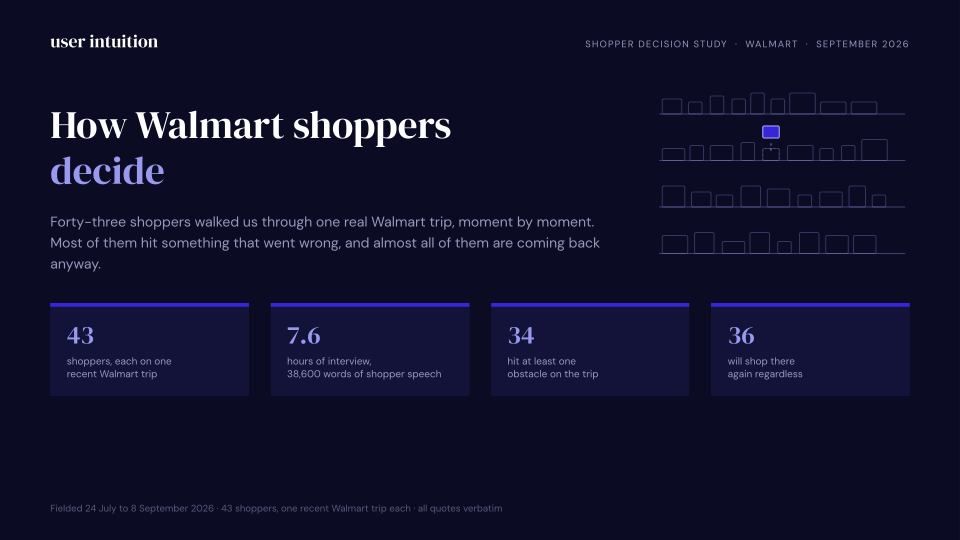
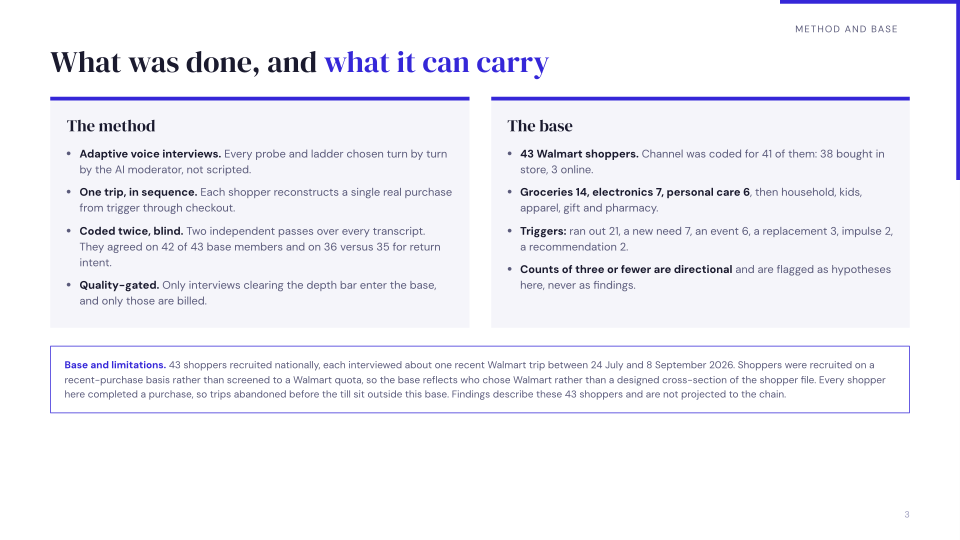
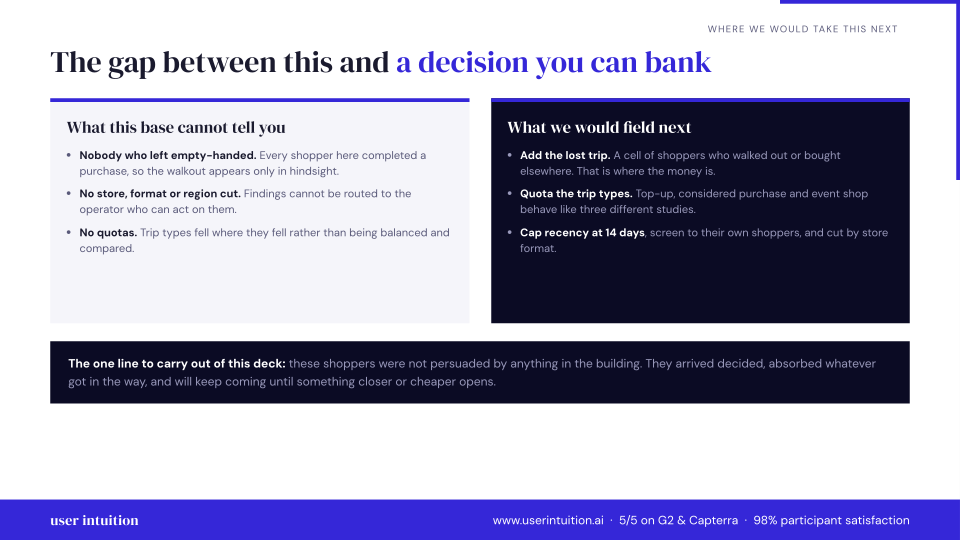
Explore calls and a sample presentation from our 43-participant Walmart shopper study.
Grocery top-up, supercenter
“Basically, because we use those things all a lot We try to always have you know, certain things in the house at all times because we use them very frequently. So we don't like to run out of them.”
What was making you want those specific things right then? Beyond just being out? Was it about being able to make certain meals or something else?
Basically, because we use those things all a lot We try to always have you know, certain things in the house at all times because we use them very frequently. So we don't like to run out of them.
Phone replacement, unplanned and urgent
“It made me feel so safe so relieved, and it brightened my day.”
Sounds like you knew exactly what you want. A Google Pixel 6 Pro. What was it about that phone that made it the right choice for you, especially in that moment?
Yeah. Thank you. So the the the phone had a lot of features. I I heard friends were talking about this phone. So in terms of the camera setting, it can take pictures and refine them into good quality. It has its own internal scanner, like I don't need to download other apps to scan to do scans. And of course, it has high quality for recording, which has been helping me in my meetings. In the office. So it's really amazing, and I love festival the quality of the phone in terms of the camera, because the previous phone I had was a Samsung. And the quality was really frustrating. And it had it has a very good processor speed as well. It's very fast. It's very efficient, and I like it. I like it. I'm enjoying the features.
Sample presentation
Preview three slides, or download the full 15-slide presentation.
Bring your own sample
$30 per quality voice interview
Use our 4M+ vetted panel
$60 per quality voice interview
What researchers say
"ALP was beating the market but we couldn’t explain it in a way that told our teams what to do differently. User Intuition gave us always-on consumer signal — market by market, week by week. What we found was that merchandising was the primary lever: shelf presence and placement, not just brand. We refocused the sales team there. The next quarter we beat our plan by over 40% and gained share in a category that was getting more competitive every month. That’s what happens when you stop guessing and start listening at scale."
 Eric O., Chief Commercial Officer, Turning Point Brands
 "Collapsed our stack without giving up interview depth, which was the fear. Recruiting, conversations, and the archive live in one place now. Brand questions get answered from what we already know instead of another fielding cycle."
Common questions
Market intelligence that
compounds over time
In 24 hours, understand competitive threats today. Six months from now, with the same methodology and Intelligence Hub, you'll spot trends competitors still don't see.
See how Intelligence Hub enables quarterly competitive tracking. We'll help you design a continuous monitoring program.
Start with an editable research brief. Review your plan and discussion guide before inviting participants.
Your methodology · Your sample · No monthly fee on Starter
Go deeper on Market Intelligence
Pillar Guides
Deep-dive guides covering this topic from strategy to execution.
Tools & Tactics
Practical frameworks and platform-specific guides for teams ready to act.
Reference Guides
Reference deep-dives on methodology, best practices, and applied research.
Alternatives & Comparisons
Side-by-side comparisons with competing platforms and approaches.
Industries
See how teams in specific verticals apply this research.
Platform Capabilities
The platform features that power this type of research.
Last updated