
SaaS customer research: find the adoption barrier before the sprint
SaaS user research at sprint speed: 20–30 minute AI-moderated interviews that go 5–7 levels deep into user motivation. Panel results in 24 hours. Bring your users or recruit from our 4M+ vetted panel.

Walk me through the last time you made this choice. What tipped it?
The deciding reason surfaced four follow-ups deep, not in the first answer.
Trusted by teams at






SaaS customer research is the practice of software companies understanding how users, buyers, and churned customers think about onboarding, feature adoption, switching, and value — historically requiring 4-8 week traditional UX cycles that no sprint team has time for. User Intuition is SaaS customer research software powered by AI-moderated interviews, running 20–30 minute conversations that probe 5-7 levels deep into workflow friction, onboarding gaps, and JTBD signals. Across 4,160 AI-moderated interviews with software and SaaS users, User Intuition found stated churn reasons like price, missing features, and competitor switch masked the deeper workflow friction, onboarding confusion, and unmet job-to-be-done gaps that predict retention. Those drivers only surface when users describe their workflow in their own words. A User Intuition SaaS study starts at $150, returns retention evidence as participants respond, and is backed by 4.9/5 on G2 and 5/5 on Capterra. The output is practical: friction maps, onboarding-failure signals, feature-priority evidence, and churn-driver analysis for product, growth, customer success, and design teams at B2B SaaS companies.
What is SaaS customer research with User Intuition?
SaaS customer research with User Intuition means AI-moderated interviews with your users, buyers and churned accounts for churn diagnosis, feature validation, win-loss and onboarding research. Each 20–30 minute interview ladders 5–7 levels deep, with your own customer list interviewed in parallel as invitees respond, or 200+ panel interviews in 24 hours from a 4M+ vetted panel across 58 countries; senior B2B roles are recruited to order, with timing set by incidence.
Who is SaaS customer research with User Intuition for?
Research agencies serving software clients, and in-house product, UX research and growth teams at SaaS and B2C tech companies who need evidence inside the sprint.
How does AI-moderated SaaS customer research work?
Add your guide, Figma prototype or live URL. The AI moderator interviews users in voice, video or chat, including screen-share walkthroughs, and every finding links back to the recording.
What do you get from a SaaS research study?
Themes with verbatims, reads by persona and segment, an editable presentation, and every transcript and recording.
Why does SaaS customer research fall behind the sprint?
Feature expectations shift monthly, and research findings land a quarter late. Here's what product and research teams tell us, and how User Intuition closes each gap.
- Sound familiar?
Our best participants are our own customers, and getting them scheduled through account teams takes weeks.
Your paying customers, interviewed as they respond
Upload paying customers, power users or churned accounts from your CRM, or recruit B2B and B2C personas from our 4M+ vetted panel, screened to your defined segment.
- Sound familiar?
Users say they like the dashboard. Nobody can tell us why it beats the competitor.
The motivation behind usage
Moderation with 5–7 level laddering goes past the first answer into workflows, workarounds, mental models and unmet needs, with no hypothesis in the interviewer's voice.
- Sound familiar?
Our Q3 findings landed in Q4, after engineering had already started building.
SaaS customer research inside the sprint
Interviews run in parallel as customers respond, putting evidence in the sprint where the question came up, before engineering capacity is locked.
- Sound familiar?
We shipped the onboarding fix and still can't say why people drop off.
Prototype and onboarding friction, in users' own words
Test Figma prototypes, staging sites and live URLs as screen-share walkthroughs and hear exactly where onboarding loses people, so the next cohort gets the fix.
- Sound familiar?
Churn shows up in the dashboard after it's too late to save the account.
Churn and win-loss interviews that surface risk early
Pulse interviews with churned, at-risk and lost-deal accounts surface whether the cause is onboarding, feature gaps, pricing, support or competitive displacement, weeks before it shows in NPS or usage dashboards.
- Sound familiar?
A new PM joins and rebuilds everything we already learned about notification friction.
A research hub that traces every decision
Every interview is searchable in your Intelligence Hub, so a feature traces back to the evidence behind it and the next PM starts from what the team already learned.
- The question
- Why were prospects choosing competing customer data platforms?
- The evidence
- Win-loss interviews with more than 40 prospects who chose a competitor.
- The outcome
- The findings exposed budget ownership and positioning gaps, helping the team refocus its go-to-market strategy.
From product question to user truth
Design The Study
Every study starts with a research plan. Define your product question — churn diagnosis, feature validation, onboarding friction, or win-loss — then bring your own guide, or our AI builds the discussion guide, screener, and timeline tailored to SaaS decision cycles.
AI Conducts the Conversations
Each participant completes a 20–30 minute AI-moderated interview. The AI moderator adapts questions in real time, probing deeper when users reveal workarounds, churn triggers, or feature gaps that matter to your roadmap.
Get Evidence-Backed Results
After interviews are complete, you receive a full research report with quantified findings, participant verbatims, and strategic recommendations — organized by theme, user segment, and product initiative.
Create Compounding Intelligence
Every study feeds your searchable Intelligence Hub. Query past research across churn studies, feature tests, and win-loss analyses. Surface patterns across sprints and re-mine interviews for new insights — so your product knowledge compounds over time.
How Software & SaaS Teams Use User Intuition
Validate Product-Market Fit Before Launch
Run 8–12 rapid interviews with target customers before committing to a quarter-long build. Use laddering to uncover whether the core job-to-be-done maps to your solution.
Reduce Churn Through Root-Cause Research
Pulse interviews with churned and at-risk customers, run in parallel as they respond, surface whether the problem is onboarding, feature gaps, pricing friction, or competitive displacement.
Test Feature Prioritization Every Sprint
Test roadmap assumptions with 5–6 targeted interviews before locking engineering capacity. Go deep on actual usage, current workarounds, and what would make it worth upgrading.
Win Competitive Displacement (Win-Loss)
Surface what drove the purchase decision for recent buyers and lost customers. Reveal whether your feature advantages matter and where product friction costs you deals.
Segment Users by Motivation, Not Demographics
Interview across power users, casual adopters, integrators, and end-users. Understand distinct jobs-to-be-done and churn patterns. Store motivation maps in Intelligence Hub.
Usability & Prototype Testing
Test Figma prototypes and staging environments with real users before engineering commits. Discover workarounds and mental models behind interface interactions.
Why researchers choose User Intuition
User Intuition is an AI-moderated interview platform that gives research teams and agencies the depth of a senior researcher at the scale of a survey, with vetted respondents, your own methodology and evidence you can trace to the verbatim. Quality is built in: a person vets every panelist by hand, every session is screened for fraud, and you pay only for interviews that pass.
Senior-researcher depth
The moderator ladders 5–7 levels deep by default, using Reynolds and Gutman's laddering method, so you hear the reasons behind the reasons.
Your methodology, run as written
Bring your discussion guide and frameworks. Required questions stay pinned in order, word for word if you need it, study rules keep the moderator inside your compliance lines, screeners and hard quotas fill every cell to plan, and you decide how far it probes.
Every finding traces to its source
Click any theme through to the verbatim, the transcript and the recording. Every claim in the deliverable traces to what a participant said.
Respondents you can stand behind
A 4M+ vetted panel across 58 countries: a person listens to every panelist's interviews before they're accepted, then every session is screened for AI-generated or coached answers and panelists are tracked across studies. Or bring your own: customer lists, your panel provider, or respondents straight from your survey.
Deliverables ready to present
Themes, verbatims and an editable presentation for every study, plus every transcript, recording and screener answer to export into your own tools. Put your own brand on them when you need to.
Survey scale, quality-only billing
200+ panel interviews in 24 hours, with no cap on parallel conversations. Each one is scored on length, depth and coverage, and you pay only for those that pass.
- Isolated workspaces
- Confidential stimulus
- Never used to train AI models
- GDPR & CCPA compliant
- SOC 2 Type II examination underway
- Security →
How Does User Intuition Compare to Product Analytics, NPS Tools, and Win-Loss Consultants for Software Research?
| Dimension | User Intuition | Product Analytics (Amplitude / Mixpanel) | NPS Tools (Medallia / Qualtrics) | Win-Loss Consultants (Clozd) |
|---|---|---|---|---|
| Depth of Insight | 20–30 min conversations probing 5–7 levels into emotional and workflow-driven user motivations | Behavioral data; shows what users clicked, not why they churned or stayed | 1–2 question scores; captures satisfaction without root-cause depth | Structured interviews but limited to deal-level analysis, not product-wide patterns |
| Time to Insights | Your users interviewed in parallel as they respond; panel studies report in 24 hours | Real-time dashboards but requires weeks to identify meaningful patterns | Quarterly reporting cycles; lagging indicator by design | 4–8 weeks per engagement including recruitment and synthesis |
| Cost per Study | From $150 (5 interviews at $30 each, using your own audience) | $50K–$150K annual platform cost; no per-study flexibility | $25K–$100K annual subscription; additional cost for analysis | $30K–$75K per engagement; consulting-model pricing |
| Churn Root-Cause Analysis | Direct user conversations revealing why users churn — onboarding friction, feature gaps, or competitive displacement | Shows usage decline patterns but can’t explain the motivation behind them | Captures detractor scores but misses the layered reasons behind dissatisfaction | Focused on deal outcomes, not ongoing product churn patterns |
| Feature Validation | Test roadmap assumptions before engineering commits with real user motivation data | Shows feature adoption rates post-launch; no pre-build validation | Can measure feature satisfaction after release; no concept testing capability | Not designed for product roadmap or feature-level research |
| Consumer Language | Full verbatim transcripts — usable directly in product briefs and roadmap justification | Event streams and funnels; no user voice | Open-text fields with brief responses; limited context | Interview summaries available but locked in consultant deliverables |
| Knowledge Retention | Searchable intelligence hub that compounds across every study, sprint, and product line | Dashboard access during subscription; no cross-study synthesis | Survey data stored per wave; no longitudinal intelligence system | Reports delivered per engagement; no institutional memory across deals |
| Sprint Integration | Parallel interviews that fit within two-week sprints — research informs this sprint, not next quarter | Always-on data but pattern identification requires analyst time measured in weeks | Quarterly cadence misaligned with sprint cycles | 4–8 week engagements incompatible with agile product development |
Hear the interviews. See the presentation.
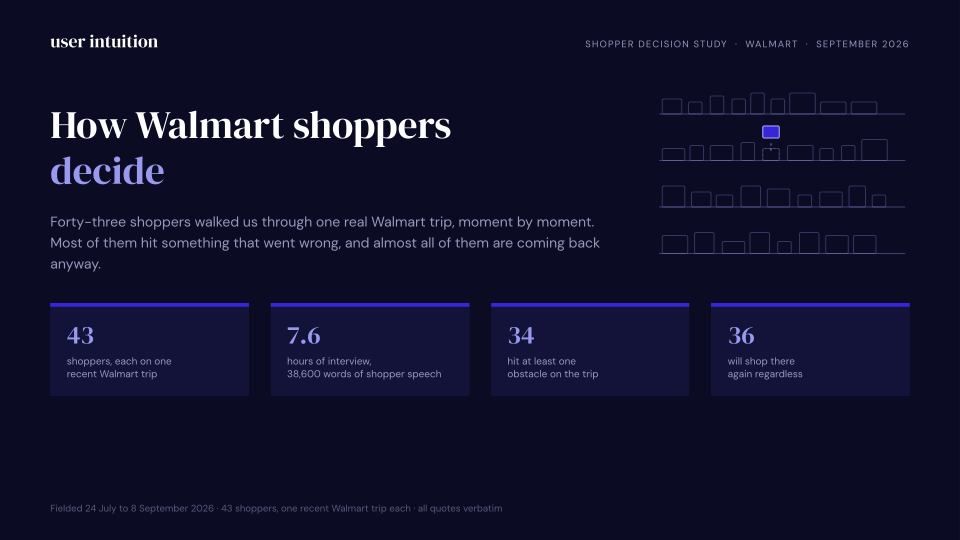
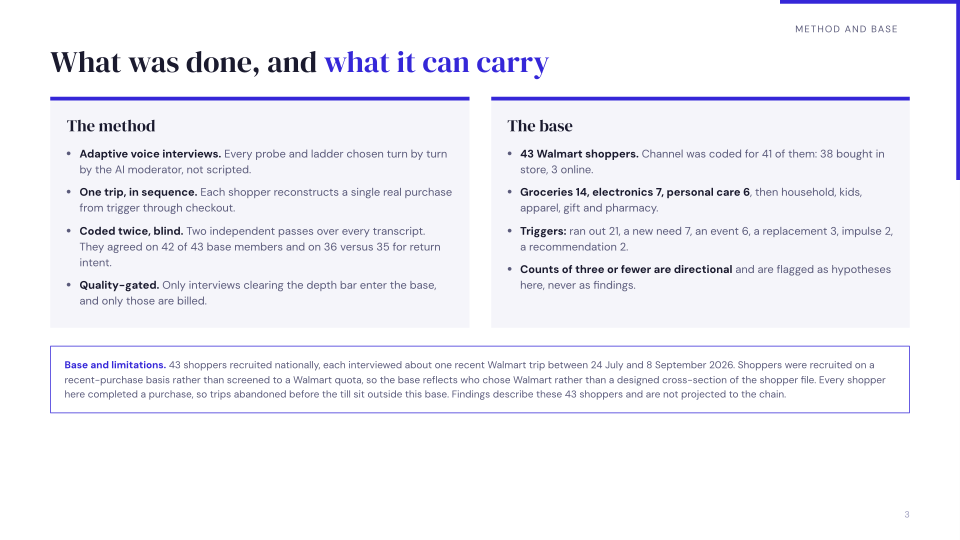
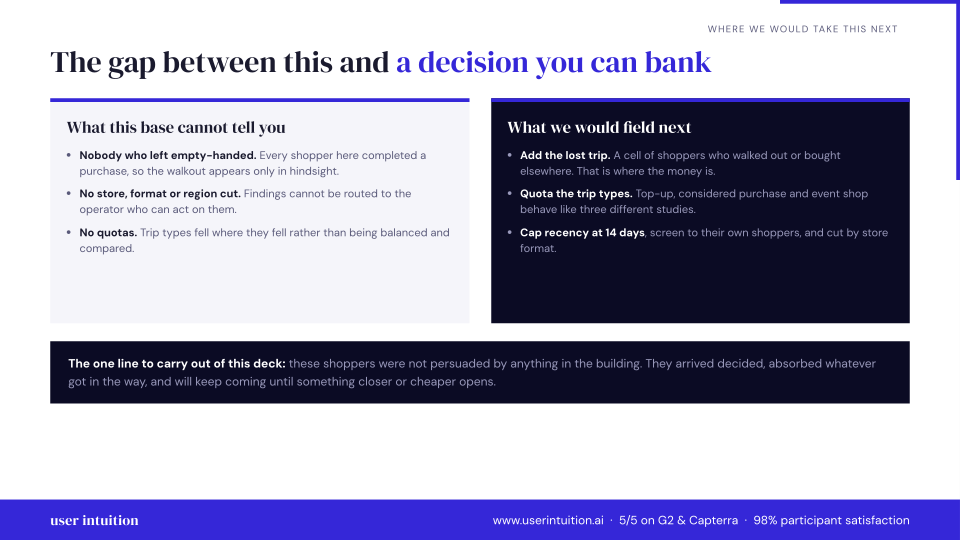
Explore calls and a sample presentation from our 43-participant Walmart shopper study.
Grocery top-up, supercenter
“Basically, because we use those things all a lot We try to always have you know, certain things in the house at all times because we use them very frequently. So we don't like to run out of them.”
What was making you want those specific things right then? Beyond just being out? Was it about being able to make certain meals or something else?
Basically, because we use those things all a lot We try to always have you know, certain things in the house at all times because we use them very frequently. So we don't like to run out of them.
Phone replacement, unplanned and urgent
“It made me feel so safe so relieved, and it brightened my day.”
Sounds like you knew exactly what you want. A Google Pixel 6 Pro. What was it about that phone that made it the right choice for you, especially in that moment?
Yeah. Thank you. So the the the phone had a lot of features. I I heard friends were talking about this phone. So in terms of the camera setting, it can take pictures and refine them into good quality. It has its own internal scanner, like I don't need to download other apps to scan to do scans. And of course, it has high quality for recording, which has been helping me in my meetings. In the office. So it's really amazing, and I love festival the quality of the phone in terms of the camera, because the previous phone I had was a Samsung. And the quality was really frustrating. And it had it has a very good processor speed as well. It's very fast. It's very efficient, and I like it. I like it. I'm enjoying the features.
Sample presentation
Preview three slides, or download the full 15-slide presentation.
Bring your own sample
$30 per quality voice interview
Use our 4M+ vetted panel
$60 per quality voice interview
What researchers say
"We were flying blind on why we lost deals. Sales reps said it was pricing, but User Intuition interviews revealed it was actually implementation timelines and integration concerns. We adjusted our sales process and saw win rates improve 23% in the next quarter."
 Eric O., COO, RudderStack
 "We thought most of our churn happened because of price and in fact we'd heard it 90% of the time. The follow-up questions from User Intuition uncovered that most of those customers never connected a datasource so didn't see much value from our product. We're now actively solving cancels and downgrades by focusing on the integration steps instead of discounting."
Common questions
Run your first SaaS user interview study this week
Whether you're validating product-market fit, diagnosing churn, or testing feature assumptions—get research-quality answers from interviews that run in parallel as your users respond.
Launch your first study in minutes. Define your question, target your segment, and see panel results in 24 hours, or interviews with your own users as they respond.
No sales deck. We'll map User Intuition to your next product decision, churn investigation, or competitive question.
Walk through a real study — from interview to report. See exactly what the platform delivers before you commit.
No contract · Per-interview pricing · Panel results in 24 hours
Related research and resources
Pillar Guides
Deep-dive guides covering this topic from strategy to execution.
Tools & Tactics
Practical frameworks and platform-specific guides for teams ready to act.
Reference Guides
Reference deep-dives on methodology, best practices, and applied research.
Alternatives & Comparisons
Side-by-side comparisons with competing platforms and approaches.
Related Solutions
Complementary research use cases that pair with this topic.
Platform Capabilities
The platform features that power this type of research.
Last updated