
Concept Tests That Go Deeper Than the First Reaction
User Intuition runs concept tests as AI-moderated interviews — show video, image, or product stimulus, then probe 5–7 layers deep into the reasoning, identity, and motivations behind each reaction. From 5 to 300+ interviews per study, with 200+ panel interviews in 24 hours.

Walk me through the last time you made this choice. What tipped it?
The deciding reason surfaced four follow-ups deep, not in the first answer.
Trusted by teams at






Concept testing usually captures one of two things: a survey score (people rate it 8/10) or a first reaction (the eyebrow-raise on initial view). Neither tells you why. User Intuition runs concept tests as AI-moderated in-depth interviews — show the stimulus, then probe 5–7 layers deep into the reasoning, identity claims, and social context behind each reaction. Layer 1 is the surface ("I'd buy it"). Layers 2–3 reveal decision criteria ("it reminds me of X"). Layers 5–7 surface the identity and emotional drivers ("my sister would think I'm crazy for getting this"). User Intuition concept tests run from 5 to 300+ interviews per study, return panel results in 24 hours, and recruit from a 4M+ vetted panel across 58 countries, interviewing in 80+ languages. The output isn't a rating — it's the verbatim chain of reasoning that determines whether a concept ships, iterates, or dies.
What is a concept testing platform?
A concept testing platform captures reactions to unreleased packaging, ad creative, product concepts, positioning and pricing before launch. User Intuition shows the actual image, video, product or in-context stimulus inside 20–30 minute AI-moderated interviews and ladders 5–7 levels into the reasoning behind each reaction, with 200+ panel interviews in 24 hours from a 4M+ vetted panel across 58 countries, or your own sample, run in parallel as participants respond.
Who uses the User Intuition concept testing platform?
Research agencies testing concepts for brand clients, and in-house insights, innovation and creative teams that need the reasoning behind a score before a concept ships.
How does AI-moderated concept testing work?
Upload your guide and image, video, product or in-context stimulus. Participants see the actual concept inside the interview in voice, video or chat, you compare up to 5–7 concepts per study, and every finding links back to the recording.
What do you get from a concept test?
Themed verbatims, friction maps showing where each concept loses momentum, identity drivers, competitive mentions, a ship-or-iterate recommendation, an editable presentation, and every transcript and recording.
Why do concepts that win on survey-based concept testing platforms still fail in market?
Rating scales capture preference, not the friction that kills a launch on shelf, in feed or on a sales call. Here's what researchers tell us, and how User Intuition closes each gap.
- Sound familiar?
The concept scored 8 out of 10. Six months later it was sitting on shelf, unsold.
The reasoning behind every concept score
Each reaction is laddered 5–7 levels into identity, social context and hesitation, the friction a Likert scale never records, so you see why a concept gets repeat-bought or scrolled past.
- Sound familiar?
The synthetic personas loved every concept. Our actual shoppers didn't.
Real consumers, not synthetic personas
Every interview is a verified person from a 4M+ panel across 58 countries, reacting in real time in 80+ languages, not an LLM simulation of your buyer.
- Sound familiar?
Whichever concept people saw first scored best, and we couldn't untangle preference from order.
Separate cells with rotated order
Show each concept on its own or several in sequence, and run parallel cells that rotate the order, one seeing A then B and another B then A. Each cell has its own screeners and hard quotas, and you read every cell separately before comparing them.
- Sound familiar?
We describe the concept in a paragraph of copy, and people react to the paragraph.
Native image, video, product and in-context stimulus
Show the actual mock with its price tag, shelf context and competing brands beside it, directly in the interview flow, so consumers react to the concept, not a description of it.
From Concept to Decision in 4 Steps
Upload stimulus, let the AI probe, and get ship-or-iterate evidence from the panel in 24 hours.
Upload Concept Stimulus
Upload image, video, product mockup, or in-context layout. Define your target audience from a 4M+ vetted global panel. Choose interview mode — voice, video, or chat. Bring your own guide, or the AI builds the discussion guide and screener automatically.
AI Shows + Probes Reaction
Each participant joins on their own time. The AI presents the stimulus, captures the immediate reaction, and ladders 5-7 levels deep into the reasoning — identity claims, social context, friction, and competitive comparisons.
Verbatim Reasoning Synthesized
As interviews complete, findings are processed through a structured ontology — extracting reactions, identity drivers, friction patterns, and competitive mentions. Quantified themes emerge with verbatim evidence behind every claim.
Decision-Ready Output in the Intelligence Hub
Each study returns a ship-or-iterate recommendation with evidence trails. Findings feed your Customer Intelligence Hub — searchable across studies, with cross-concept patterns surfacing as the catalog grows.
Test Any Concept Format in the Interview Flow
Show participants the actual concept — not a description of it — and capture reactions that survey-based testing can't access.
Image Concept Testing
Show packaging mocks, ad creative, logo concepts, or any static visual stimulus. Participants react to the actual artifact — color, framing, claims, and price tag together.
Video Concept Testing
Show TV ads, product demos, brand films, or social-media-style creative. Capture reactions to specific moments and the reasoning behind drop-off, replay, or share intent.
Product + In-Context Testing
Show physical product mockups, app screens, comparative shelf layouts, or in-context shopping scenarios. Capture how the concept lands when it's surrounded by competitors or category cues.
Multi-Concept Comparison
Show A vs B vs C in the same interview. Capture stated preference, revealed reasoning, and the specific feature, frame, or visual cue that drove the choice — not just the winning concept.
Visual Stimulus + Adaptive Laddering
Survey-based concept testing returns scores. User Intuition combines visual stimulus presentation with 5-7 levels of structured laddering — surfacing the identity-driven reasoning, social context, and category-specific friction that determine whether a concept ships or iterates.
How User Intuition Tests Concepts
- Visual stimulus shown natively in the interview — image, video, product, in-context
- 5-7 levels of structured laddering on every reaction (not just the first few interviews)
- Multi-concept comparison in a single session — captures the why behind preference, not just the winner
- Identity-driver extraction: who would buy this, who wouldn't, and what each signals about the buyer
- Friction-pattern mapping across participants — where the concept loses momentum, and why
- Competitive mentions captured automatically — what the concept reminds participants of, for better or worse
Built-In Quality Controls
- Panelists vetted and tracked longitudinally; every session screened for AI-generated or coached answers
- Attention and engagement monitoring throughout every interview
- Professional respondent filtering across all panel sources
- Evidence trails for every finding — cite the exact verbatim
- Methodology transparency: see why the AI asked each question
- GDPR & CCPA compliant; customer data is never used to train AI models
Methodology validated across 30,000+ AI-moderated interviews. Visual stimulus + adaptive laddering — not a survey with a logo on it.
What can teams run with concept tests?
Apply visual concept testing across innovation, marketing, and product decisions.
Concept Testing
Validate product, package, and ad concepts before launch.
→Idea Validation
Test early-stage ideas with real consumers, fast.
→Product Innovation
Refine product concepts with category-buyer reactions.
→Consumer Insights
Deep-dive purchase motivations and brand perception.
→Shopper Insights
Test concepts in-context with shelf and feed scenarios.
→CPG
Add diagnostic concept tests, with panel results in 24 hours, before late-stage volumetric gates.
→Why researchers choose User Intuition
User Intuition is an AI-moderated interview platform that gives research teams and agencies the depth of a senior researcher at the scale of a survey, with vetted respondents, your own methodology and evidence you can trace to the verbatim. Quality is built in: a person vets every panelist by hand, every session is screened for fraud, and you pay only for interviews that pass.
Senior-researcher depth
The moderator ladders 5–7 levels deep by default, using Reynolds and Gutman's laddering method, so you hear the reasons behind the reasons.
Your methodology, run as written
Bring your discussion guide and frameworks. Required questions stay pinned in order, word for word if you need it, study rules keep the moderator inside your compliance lines, screeners and hard quotas fill every cell to plan, and you decide how far it probes.
Every finding traces to its source
Click any theme through to the verbatim, the transcript and the recording. Every claim in the deliverable traces to what a participant said.
Respondents you can stand behind
A 4M+ vetted panel across 58 countries: a person listens to every panelist's interviews before they're accepted, then every session is screened for AI-generated or coached answers and panelists are tracked across studies. Or bring your own: customer lists, your panel provider, or respondents straight from your survey.
Deliverables ready to present
Themes, verbatims and an editable presentation for every study, plus every transcript, recording and screener answer to export into your own tools. Put your own brand on them when you need to.
Survey scale, quality-only billing
200+ panel interviews in 24 hours, with no cap on parallel conversations. Each one is scored on length, depth and coverage, and you pay only for those that pass.
- Isolated workspaces
- Confidential stimulus
- Never used to train AI models
- GDPR & CCPA compliant
- SOC 2 Type II examination underway
- Security →
How does User Intuition compare to Zappi, Quantilope, and Nielsen BASES?
User Intuition is built for early-stage diagnostic depth; Zappi and Quantilope for fast quant concept screening; Nielsen BASES for late-stage volumetrics.
| Dimension | User Intuition | Nielsen BASES | Zappi / Quantilope |
|---|---|---|---|
| Methodology | AI-moderated in-depth interviews with visual stimulus | Volumetric forecasting + survey panel | Automated survey panel |
| Turnaround | 24 hours for panel audiences | 6-12 weeks | Fast automated fielding |
| Output type | Verbatim reasoning, friction maps, identity drivers | Volume forecast (units, share) | Concept scores + segment cuts |
| Visual stimulus | Image, video, product, in-context | Limited (static print) | Image-led survey |
| Design control | Monadic or sequential monadic cells with hard quotas | Standardized volumetric design | Standardized survey templates |
| Best for | Diagnostic refinement, early-stage exploration | Late-stage volumetric gate | Fast quant concept screening |
Hear the interviews. See the presentation.
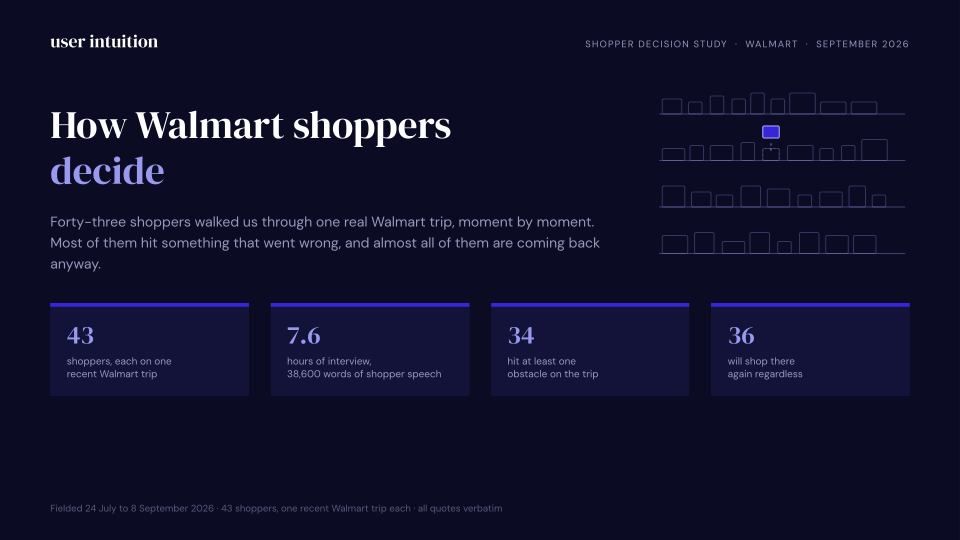
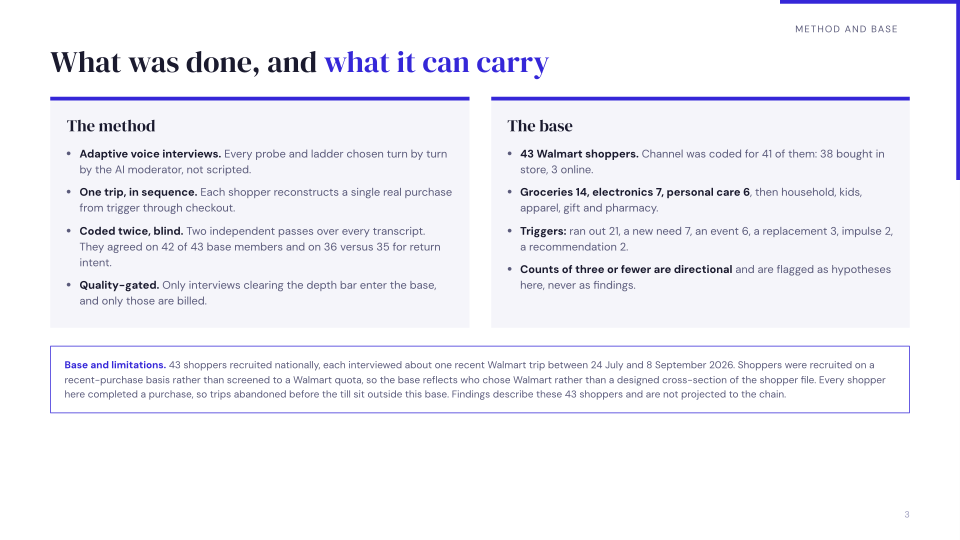
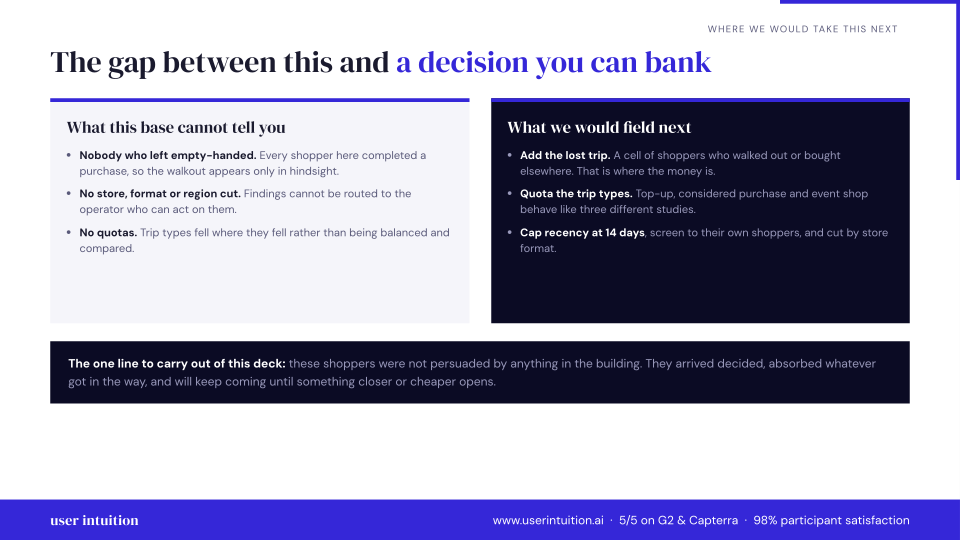
Explore calls and a sample presentation from our 43-participant Walmart shopper study.
Grocery top-up, supercenter
“Basically, because we use those things all a lot We try to always have you know, certain things in the house at all times because we use them very frequently. So we don't like to run out of them.”
What was making you want those specific things right then? Beyond just being out? Was it about being able to make certain meals or something else?
Basically, because we use those things all a lot We try to always have you know, certain things in the house at all times because we use them very frequently. So we don't like to run out of them.
Phone replacement, unplanned and urgent
“It made me feel so safe so relieved, and it brightened my day.”
Sounds like you knew exactly what you want. A Google Pixel 6 Pro. What was it about that phone that made it the right choice for you, especially in that moment?
Yeah. Thank you. So the the the phone had a lot of features. I I heard friends were talking about this phone. So in terms of the camera setting, it can take pictures and refine them into good quality. It has its own internal scanner, like I don't need to download other apps to scan to do scans. And of course, it has high quality for recording, which has been helping me in my meetings. In the office. So it's really amazing, and I love festival the quality of the phone in terms of the camera, because the previous phone I had was a Samsung. And the quality was really frustrating. And it had it has a very good processor speed as well. It's very fast. It's very efficient, and I like it. I like it. I'm enjoying the features.
Sample presentation
Preview three slides, or download the full 15-slide presentation.
Bring your own sample
$30 per quality voice interview
Use our 4M+ vetted panel
$60 per quality voice interview
What researchers say
"What surprised me was the moderator. In one pack study people kept saying a concept felt "more premium," and instead of logging that and moving on it kept asking what premium meant to them, until it came out that they meant the front wasn't cluttered, they could find the ingredients, and it looked like something they'd actually put in their cart. I'd normally only get that from a good human moderator."
"We ended up testing four screens and a concept image for a shared-lists idea that design was falling in love with. Fourteen video interviews later, we paused the build and saved a sprint on something people didn't connect with."
Frequently Asked Questions
Test Your Next Concept With Real Consumers
Book a demo to see a concept test in action, or start free with 3 interviews. Panel recruiting is billed separately.
No synthetic personas. Real consumers, real reactions, panel results in 24 hours.
Related resources
Pillar Guides
Deep-dive guides covering this topic from strategy to execution.
Tools & Tactics
Practical frameworks and platform-specific guides for teams ready to act.
Reference Guides
Reference deep-dives on methodology, best practices, and applied research.
Alternatives & Comparisons
Side-by-side comparisons with competing platforms and approaches.
Related Solutions
Complementary research use cases that pair with this topic.
Last updated