Win the deals you should be winning — why buyers decided
Go beyond CRM loss reasons. Interview the actual buying committee in parallel, uncover the real objections, and sharpen every pipeline review.

From individual interviews to a clearer picture.
Price is cited as the loss reason in 62.3% of deals. AI-moderated interviews find it's the real decision driver only 18.1% of the time. The gap is where deals are really lost...
Trusted by teams at





An AI win-loss analysis platform is software that interviews won, lost, and churned buyers after a decision, then turns those conversations into evidence on why deals close, stall, or renew. User Intuition is win-loss analysis software powered by AI-moderated interviews, running buyer conversations in the days after the decision so teams capture what sales calls and CRM notes usually miss. Across 10,247 post-decision buyer interviews, User Intuition found price is cited in 62.3% of lost deals but is the primary driver in only 18.1%. The deeper blockers were implementation risk, integration concerns, and competitive positioning, which surfaced only when buyers could talk candidly for 20–30 minutes without a sales rep in the room. A User Intuition win-loss study starts at $150, returns close-rate evidence as participants respond, and is backed by 4.9/5 on G2 and 5/5 on Capterra. The output is practical: close-rate drivers by segment, objection patterns, competitive loss evidence, and post-deal renewal signals for sales enablement, product, and pricing teams.
What is win-loss analysis with User Intuition?
Win-loss analysis with User Intuition interviews won, lost and churned buyers within days of the decision in 20–30 minute AI-moderated conversations that ladder 5–7 levels past the CRM loss reason. Buyers on client-authorized lists of closed deals are interviewed in parallel as soon as they accept, with no moderator scheduling, alongside comparable market buyers from a 4M+ vetted panel.
Who is win-loss analysis with User Intuition for?
Agencies and research leads running win-loss programs for B2B and tech companies, and in-house product marketing, sales enablement and revenue teams.
How does AI-moderated win-loss analysis work?
Bring your discussion guide and the buyers from closed deals. The AI moderator interviews each one in voice, video or chat, with no sales rep in the room, and every finding links back to the recording.
What do you get from a win-loss analysis study?
Close-rate drivers by segment, objection patterns and competitive loss evidence with verbatims, an editable presentation, and every transcript and recording.
Why does win-loss analysis keep producing reports, not revenue?
B2B teams keep losing the same deals for the same reasons because their win-loss data is shallow, slow and siloed. Here's what win-loss researchers tell us, and how User Intuition closes each gap.
- Sound familiar?
Half our losses say “price” in the CRM. That's just the fastest box for a rep to click.
Real win-loss reasons, not CRM fiction
Interview buyers directly after the decision, so close-rate evidence reflects why deals were won or lost, not the reason a rep picked to close the ticket.
- Sound familiar?
The post-deal survey told us what buyers would type in two minutes. Nothing about the champion who lost the room.
The why behind the why
The moderator ladders 5–7 levels past the two-minute survey answer to the risk perception, lost champion and integration gap that decided the deal.
- Sound familiar?
Our rep wasn't in the security review or the steering committee. Their post-mortem is a guess.
The whole buying committee, interviewed
Invite the economic buyer, IT lead and procurement reviewer from each deal to talk on their own time, in any timezone, and reconstruct the rooms your rep never sat in.
- Sound familiar?
Every buyer interview needs a senior moderator's hour, so we stop at a dozen a quarter. That's too few to cut by segment or competitor.
Win-loss interviews at a volume you can segment
Interview every buyer who accepts, in parallel and without adding moderator hours, then read drivers by segment, deal size and competitor. Run a first wave, act on it, and run the next as your product and competitors change, paying only for interviews that pass. How to run a win-loss program that changes sales behavior.
- Sound familiar?
Sales skimmed the PDF. Product never saw it. Six months later we paid for the same recommendations.
Win-loss intelligence that compounds
Every interview lands in your Intelligence Hub, indexed by competitor, segment and objection, so sales, product and marketing act on the same evidence, built on our qualitative research at scale platform.
- The question
- Why were prospects choosing competing customer data platforms?
- The evidence
- Win-loss interviews with more than 40 prospects who chose a competitor.
- The outcome
- The findings exposed budget ownership and positioning gaps, helping the team refocus its go-to-market strategy.
From closed deal to competitive advantage
Design The Study
Select your deal cohort — won, lost, or competitive displacement — and the competitors you want to analyze. Bring your own guide, or our AI builds the buyer interview guide, screener criteria, and recruitment plan around your specific deal dynamics.
AI Conducts the Conversations
Each buyer completes a 20–30 minute AI-moderated voice interview reconstructing their evaluation process. The AI probes deeper on competitive comparisons, risk perception, and the moments that tipped the decision.
Get Evidence-Backed Results
Receive a structured competitive intelligence report with quantified win/loss drivers, positioning gaps, buyer verbatims, and actionable recommendations for sales battlecards, product roadmap, and marketing messaging.
Create Compounding Intelligence
Every win-loss study feeds your searchable intelligence hub. Query competitive patterns across deals, surface shifting buyer priorities quarter over quarter, and re-mine past interviews when new competitors emerge.
Real-world applications
for Top-Rated Win-Loss Analysis Software
Quarterly Competitive Loss Reviews
Losing more deals to a rising competitor? Interview 15–20 lost buyers about their recent decision. Identify the exact messaging, capability gaps, or sales motion breakdowns driving the shift — and adapt before next quarter.
Mid-Market Deal Post-Mortems
Lost a $500K deal to a smaller competitor? Interview the operations lead, IT lead and economic buyer separately for the committee's view, not your rep's reconstruction.
Positioning and Messaging Validation
Your ICP is mid-market B2B SaaS ops teams. Do buyers perceive you that way? Interview 30 recent evaluators to learn how you're being positioned — by your buyers, not your marketing team.
Continuous Monthly Win-Loss Programs
Run 10–15 buyer interviews monthly. After six months, you have a living map of competitive dynamics, pricing sensitivity trends, and feature priorities — updated in real time, not once a year.
Pre-Launch Product Validation
Before your next feature release, interview buyers who evaluated your roadmap against competitors. Find out what they expected, what fell short, and what would have changed their decision.
Revenue Team Alignment
Sales gets battlecard updates. Product gets prioritized feature gaps. Marketing gets repositioning briefs. RevOps gets pipeline pattern analysis. One study. Every team moves together.
PE Portfolio Post-Close Win-Loss Programs
Show operating partners why the portco wins and loses deals. Run 30/60/90-day post-close buyer programs, then monthly, with every study compounding in the portco's intelligence hub.
Why researchers choose User Intuition
User Intuition is an AI-moderated interview platform that gives research teams and agencies the depth of a senior researcher at the scale of a survey, with vetted respondents, your own methodology and evidence you can trace to the verbatim. Quality is built in: a person vets every panelist by hand, every session is screened for fraud, and you pay only for interviews that pass.
Senior-researcher depth
The moderator ladders 5–7 levels deep by default, using Reynolds and Gutman's laddering method, so you hear the reasons behind the reasons.
Your methodology, run as written
Bring your discussion guide and frameworks. Required questions stay pinned in order, word for word if you need it, study rules keep the moderator inside your compliance lines, screeners and hard quotas fill every cell to plan, and you decide how far it probes.
Every finding traces to its source
Click any theme through to the verbatim, the transcript and the recording. Every claim in the deliverable traces to what a participant said.
Respondents you can stand behind
A 4M+ vetted panel across 58 countries: a person listens to every panelist's interviews before they're accepted, then every session is screened for AI-generated or coached answers and panelists are tracked across studies. Or bring your own: customer lists, your panel provider, or respondents straight from your survey.
Deliverables ready to present
Themes, verbatims and an editable presentation for every study, plus every transcript, recording and screener answer to export into your own tools. Put your own brand on them when you need to.
Survey scale, quality-only billing
200+ panel interviews in 24 hours, with no cap on parallel conversations. Each one is scored on length, depth and coverage, and you pay only for those that pass.
- Isolated workspaces
- Confidential stimulus
- Never used to train AI models
- GDPR & CCPA compliant
- SOC 2 Type II examination underway
- Security →
Why buyer interviews beat surveys, consultants, and rep self-reporting
| Dimension | User Intuition | Clozd / Consultants / Self-Reporting |
|---|---|---|
| Research Method | 20–30 min AI conversation · emotional laddering | Expert-led or AI-assisted interviews (Clozd), consultant calls, or rep self-reporting |
| Interview Depth | 5–7 laddering levels · uncovers why behind the why | Surface reasons — what buyers type in 2 minutes |
| Turnaround | In parallel, with every buyer interviewed as they accept | 4–8+ weeks (consultants); days (surveys, shallow) |
| Study Cost | From $150 — no monthly fees, see /pricing/ | $15K–$75K per project (consultants); annual SaaS contract (Clozd) |
| Buyer Honesty | High · no vendor-employee dynamic | Low (reps); moderate (surveys); variable (consultants) |
| Mid-Market Scalability | Run continuous programs at $20M–$100M ARR without budget strain | Cost-prohibitive for frequent studies at mid-market scale |
| Buyer Pool | Your actual won and lost buyers, plus a 4M+ vetted panel for market-level buyer research | Your own list (Clozd) or consultant network |
| Intelligence Compounding | Searchable Intelligence Hub — knowledge builds every study | PDF report per study — no institutional memory |
| Data Quality | Consistent AI methodology · 98% participant satisfaction | Variable by consultant; surveys miss nuance entirely |
| ROI Timeline | Buyer evidence to guide sales and positioning changes | Unclear — no systematic measurement or compounding |
Hear the interviews. See the presentation.
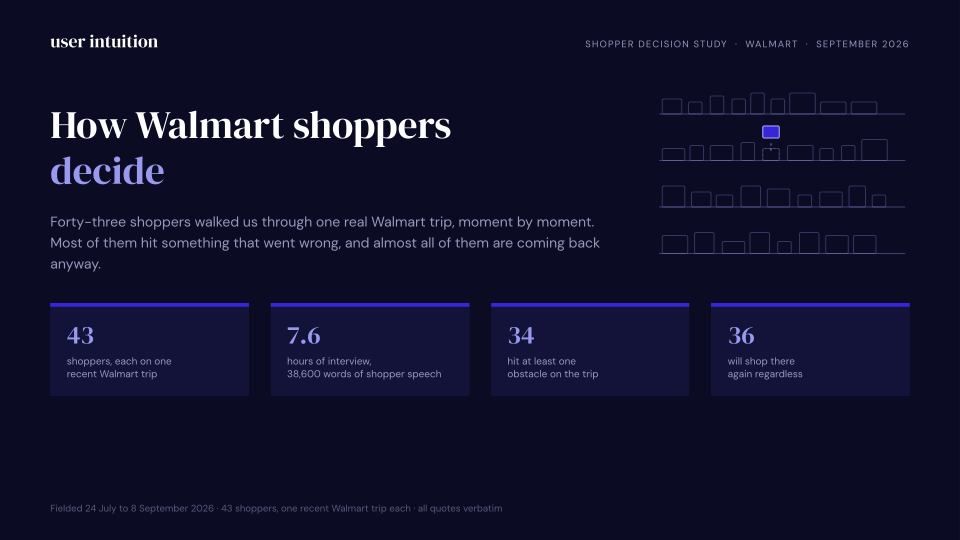
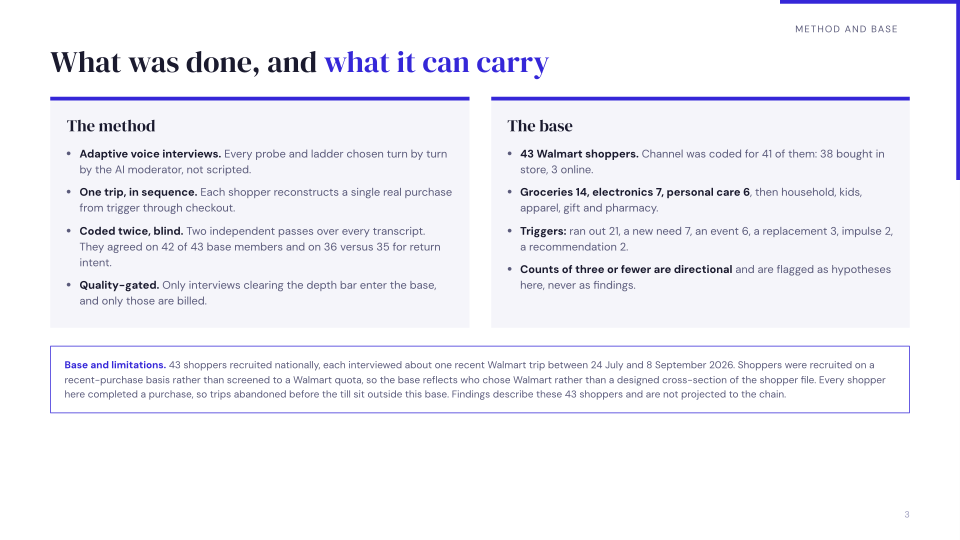
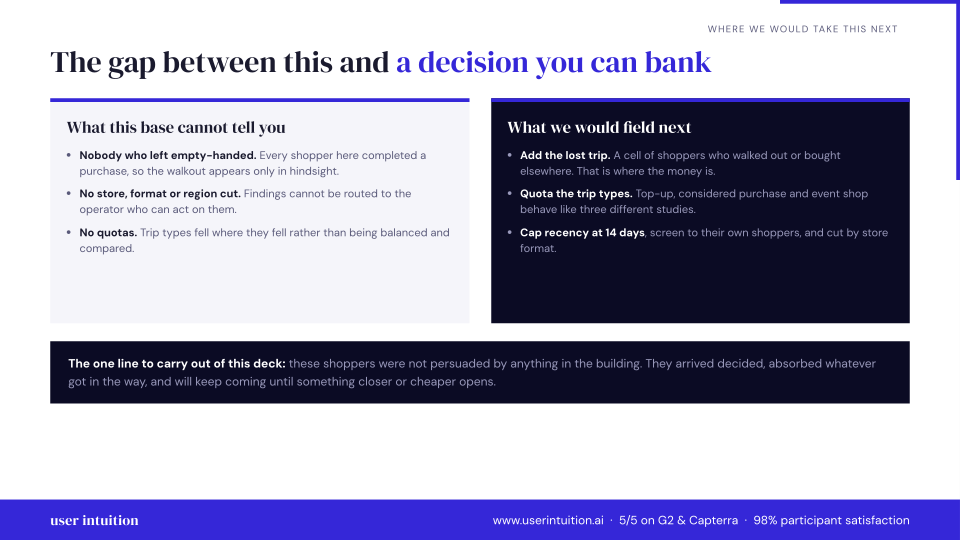
Explore calls and a sample presentation from our 43-participant Walmart shopper study.
Grocery top-up, supercenter
“Basically, because we use those things all a lot We try to always have you know, certain things in the house at all times because we use them very frequently. So we don't like to run out of them.”
What was making you want those specific things right then? Beyond just being out? Was it about being able to make certain meals or something else?
Basically, because we use those things all a lot We try to always have you know, certain things in the house at all times because we use them very frequently. So we don't like to run out of them.
Phone replacement, unplanned and urgent
“It made me feel so safe so relieved, and it brightened my day.”
Sounds like you knew exactly what you want. A Google Pixel 6 Pro. What was it about that phone that made it the right choice for you, especially in that moment?
Yeah. Thank you. So the the the phone had a lot of features. I I heard friends were talking about this phone. So in terms of the camera setting, it can take pictures and refine them into good quality. It has its own internal scanner, like I don't need to download other apps to scan to do scans. And of course, it has high quality for recording, which has been helping me in my meetings. In the office. So it's really amazing, and I love festival the quality of the phone in terms of the camera, because the previous phone I had was a Samsung. And the quality was really frustrating. And it had it has a very good processor speed as well. It's very fast. It's very efficient, and I like it. I like it. I'm enjoying the features.
Sample presentation
Preview three slides, or download the full 15-slide presentation.
Bring your own sample
$30 per quality voice interview
Use our 4M+ vetted panel
$60 per quality voice interview
What researchers say
"For two years our post-mortems said the same thing — pricing, features. User Intuition ran 40 interviews with prospects who'd chosen a competitor. The real story: Mixpanel owned the marketing budget we were never going to get. Freshpaint had claimed the healthcare persona while we were still messaging to the generic market. Two competitors, same move — they'd stopped selling CDPs and started owning specific personas. That insight restructured our GTM entirely. We stopped chasing fights we couldn't win, and that clarity played a real role in how we positioned the $56M Series C."
 Eric O., COO, RudderStack
 "The depth of insight rivals expensive user research, but the scale is completely different. We went from 12 win/loss interviews per quarter to 200+. Now we can segment by industry, deal size, and competitor."
Common questions
Understand the decision.
Improve the next deal.
See how mid-market B2B SaaS teams and PE operating partners run continuous win-loss programs that compound — and stop losing the same deals every quarter.
Start with an editable research brief. Review your plan and discussion guide before inviting participants.
Walk through the interview evidence and plan a win-loss program around your sales cycle, deal volume, and buyer availability.
Your methodology · Your sample · No monthly fee on Starter
Go deeper on Top-Rated Win-Loss Analysis Software
Pillar Guides
Deep-dive guides covering this topic from strategy to execution.
Tools & Tactics
Practical frameworks and platform-specific guides for teams ready to act.
Reference Guides
Reference deep-dives on methodology, best practices, and applied research.
Alternatives & Comparisons
Side-by-side comparisons with competing platforms and approaches.
Industries
See how teams in specific verticals apply this research.
Platform Capabilities
The platform features that power this type of research.
Last updated