
User Research Platform: Democratize Research Without Losing Quality
Too many research requests, too few researchers. Scale rigorous studies across your org without losing quality — methodology built into the platform, 24-hour turnaround.

From individual interviews to a clearer picture.
Research team serving 4x more product teams without additional headcount...
Trusted by teams at






A user research platform is software that helps researchers conduct and synthesize studies — most support recruitment, transcripts, and synthesis but leave interview depth dependent on whichever researcher happens to run it. User Intuition is a user research platform powered by AI-moderated interviews, with the methodology built into the platform itself — 5-7 levels of laddering depth applied consistently across every conversation, scaled across the org. Across 1,670 AI-moderated interviews conducted by user research teams, User Intuition enabled non-researchers to launch rigorous studies because the platform enforces methodology that previously required senior practitioners to apply consistently. That democratization scales research capacity without diluting rigor. A User Intuition study starts at $150, returns methodology-rigorous evidence in 24 hours, and is backed by 4.9/5 on G2 and 5/5 on Capterra. The output is practical: rigorous laddering depth at scale, validated study designs, themed transcripts and verbatim libraries, and a Customer Intelligence Hub for user researchers, ResearchOps leaders, and product orgs democratizing research access.
How Do User Research Teams Scale Depth Without Scaling Headcount?
Most user research teams face more requests than they can handle. PMs decide without evidence or wait weeks. Democratization sounds great until quality collapses. Researchers must scale without trading rigor for throughput.
Too Many Requests, Too Few Researchers
Product teams queue research requests for weeks. Half the decisions that needed evidence were made before your study even launched. Your backlog is a graveyard of missed opportunities.
Democratization Without Quality Control
You empower PMs to run their own research. They write leading questions, interview 3 users, and call it validated. Democratization without methodology is just confirmation bias at scale.
Recruiting Friction Slows Everything
Finding the right participants takes days or weeks. Internal panels are exhausted. External recruiting adds cost and delay. By the time you field the study, the sprint already shipped.
Longitudinal Tracking Is Impossible at Scale
You want to track how user perception changes over time. But tracking studies require consistent methodology across waves — which requires your personal involvement every time.
Insight Repositories Go Unused
You've built a research repository. Nobody uses it. Findings from last quarter's study sit unqueried while a PM re-runs the same research because they didn't know it existed.
No Time for Strategic Research
You spend 80% of your time on tactical requests — feature validation, usability fixes — and never get to the foundational research that would shape product direction for the next year.
How Does User Intuition Scale Research Without Scaling Headcount?
User research teams use User Intuition to scale rigorous research without scaling headcount at the same rate. Methodology is built into the platform, so non-researchers can launch bounded studies while researchers focus on strategy, synthesis, and standards instead of becoming the operational bottleneck for every request.
How do research teams clear the backlog without hiring more researchers?
PMs and designers launch rigorous studies independently because 5-7 level laddering methodology is built into the platform. Your team sets guardrails while the AI handles 50-300 interviews per study in 24 hours at $30 each.
How do research teams democratize without losing quality control?
The AI enforces consistent probing methodology, non-leading language, and adaptive depth on every interview. Non-researchers get the same methodological rigor as your senior team members without the training or experience gap.
How do research teams stop research debt from accumulating?
Every study feeds a searchable intelligence hub that replaces static repositories nobody queries. Product teams find relevant past research before launching new studies, and cross-study patterns surface automatically across the organization.
Hear the interviews. See the presentation.
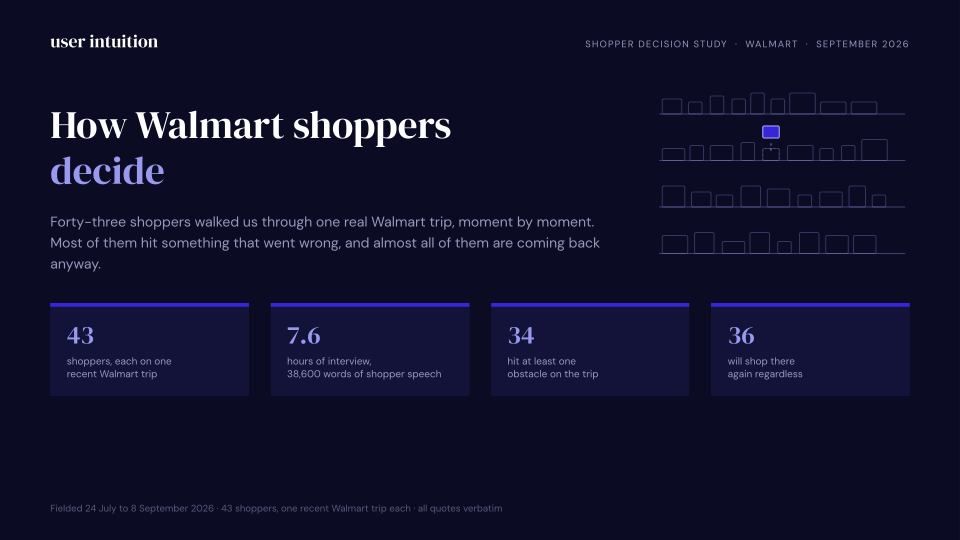
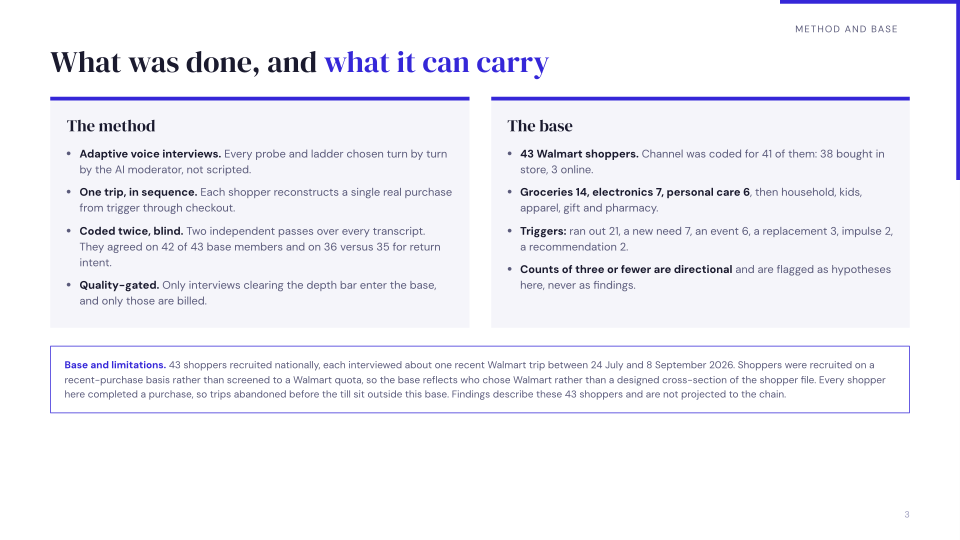
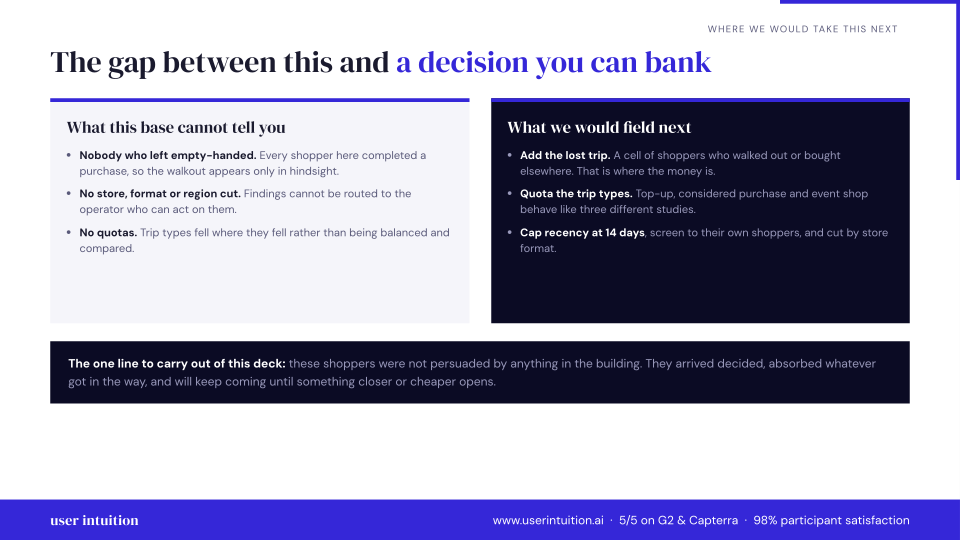
Explore calls and a sample presentation from our 43-participant Walmart shopper study.
Grocery top-up, supercenter
“Basically, because we use those things all a lot We try to always have you know, certain things in the house at all times because we use them very frequently. So we don't like to run out of them.”
What was making you want those specific things right then? Beyond just being out? Was it about being able to make certain meals or something else?
Basically, because we use those things all a lot We try to always have you know, certain things in the house at all times because we use them very frequently. So we don't like to run out of them.
Phone replacement, unplanned and urgent
“It made me feel so safe so relieved, and it brightened my day.”
Sounds like you knew exactly what you want. A Google Pixel 6 Pro. What was it about that phone that made it the right choice for you, especially in that moment?
Yeah. Thank you. So the the the phone had a lot of features. I I heard friends were talking about this phone. So in terms of the camera setting, it can take pictures and refine them into good quality. It has its own internal scanner, like I don't need to download other apps to scan to do scans. And of course, it has high quality for recording, which has been helping me in my meetings. In the office. So it's really amazing, and I love festival the quality of the phone in terms of the camera, because the previous phone I had was a Samsung. And the quality was really frustrating. And it had it has a very good processor speed as well. It's very fast. It's very efficient, and I like it. I like it. I'm enjoying the features.
Sample presentation
Preview three slides, or download the full 15-slide presentation.
Bring your own sample
$30 per quality voice interview
Use our 4M panel
$60 per quality voice interview
How User Researchers use
User Intuition
UX Research
Run usability studies, feature evaluations, and experience assessments with 50-300 users. Go beyond 5-person tests to statistically meaningful UX insights.
Product Innovation
Validate new product ideas, feature concepts, and roadmap priorities with real users before committing engineering resources.
Concept Testing
Test design concepts, feature configurations, and UX patterns with real users. Multi-concept studies with consistent methodology.
NPS & CSAT Deep-Dives
Go beyond satisfaction scores. Interview users to understand why they rate your product the way they do and what would improve their experience.
Win-Loss Analysis
Understand why users chose your product or a competitor. Surface the decision drivers that analytics and CRM data never capture.
Consumer Insights
Map user needs, pain points, and mental models across segments. Build the foundational understanding that shapes product strategy.
How Does User Intuition Compare to Unmoderated Platforms, In-House Moderation, and Research Agencies for User Research Teams?
| Dimension | User Intuition | Unmoderated Platforms (Maze / Lyssna) | In-House Moderation | Research Agencies |
|---|---|---|---|---|
| Depth of Insight | 30+ min · 5-7 laddering levels per user | 5-15 min task-based clips, surface reactions | Deep but limited by researcher capacity | Deep but limited to 15-30 interviews per project |
| Time to Insights | 24 hours from design to structured findings | 24 hours for task completion data | 2-6 weeks (recruit + conduct + synthesize) | 6-12 weeks from briefing to final report |
| Cost per Study | From $150 ($30/interview) | $100-$500+ per study depending on panel | Internal team cost (salary + opportunity cost) | $15K-$75K per project |
| Scale | 50-300 in-depth interviews per study | 50-500 task completions, shallow depth | 5-12 interviews per study (capacity limited) | 15-30 interviews per project |
| Democratization Quality | Methodology built into the platform — PMs launch rigorous studies | Low barrier but low depth — task-based only | Quality depends entirely on researcher skill | Quality depends on agency team assigned |
| Recruiting | 4M+ panel + CRM import, no sourcing delay | Built-in panel, limited to platform users | Internal panels exhaust, external recruit takes weeks | Agency handles recruit, adds weeks and cost |
| Methodological Consistency | Identical probing methodology every interview | Consistent tasks, no adaptive probing | Varies by researcher energy and approach | Varies by moderator assigned to project |
| Knowledge Retention | Searchable Intelligence Hub across all studies | Individual test results, no cross-study search | Confluence pages and notebooks nobody finds | Decks in shared drives, knowledge walks out the door |
How does User Intuition compare to other AI-moderated interview tools?
Easier setup
Brief in, study live in five minutes. No discovery workshop, no kickoff cadence. Competitors typically require a 30–60 minute onboarding call.
Faster fieldwork
User Intuition owns a 4M+ verified panel for consumer and broad-buyer audiences, and recruits specialty and B2B audiences to order. Competitors lean on third-party recruiters or make you bring your own.
Deeper insights
Adaptive 5–7 level laddering on every response — the same probing technique a senior qualitative researcher uses. Most AI moderators stop at one or two follow-ups before moving on.
Lower risk
Every interview is auto-scored against your brief on length, depth, and coverage. Conversations that miss the bar aren't charged. No refund request required, no manual review.
From research request to org-wide insight
Design the Study
Define the research question and target users. Our AI builds the interview guide with 5-7 level laddering — embedding your methodology into every conversation. Non-researchers can launch studies because the rigor is in the platform, not the person.
AI Conducts the Interviews
Each user completes a 10-20 minute AI-moderated voice interview. The AI probes deeper on pain points, workflows, and motivations — surfacing the why behind user behavior at a scale that would take your team months.
Get Actionable Research Findings
Receive structured analysis with user segments, theme clusters, and evidence-traced findings. Every insight links to the exact user verbatims — so product teams can see the evidence, not just the recommendation.
Build Institutional Research Knowledge
Every study feeds a searchable intelligence hub. Product teams query past research before launching new studies. Patterns emerge across projects. Your research compounds instead of sitting in forgotten repositories.
"Honestly hard to find a complaint. If I had to nitpick — the platform is so fast that it can actually outpace internal decision-making processes, so we had to adjust our own workflows to keep up with the speed of insights coming in."
 Eric O., Chief Commercial Officer, Turning Point Brands
 "I still use quick unmoderated tests for task metrics. User Intuition is better for understanding the reasons behind those metrics. Using both made the redesign much easier to defend."
When Should You Use AI-Moderated Interviews for User Research — and When Shouldn't You?
AI-moderated interviews handle the volume and consistency your team needs for most research requests. Human facilitation remains essential for observational and participatory methods.
AI-Moderated Interviews Are Best For
- Large-scale attitudinal research across user segments
- Feature validation and concept testing at statistical scale
- Continuous feedback programs that run alongside sprints
- Democratized research where PMs need methodology guardrails
- Multi-market research in 80+ languages
- Tracking studies with consistent methodology across waves
Consider Other Methods When
- Generative research with no hypothesis (pure exploration)
- Accessibility research with users requiring accommodations
- Co-design sessions and participatory design workshops
- Research involving minors or vulnerable populations
- Complex enterprise workflows requiring live system interaction
N=1,670 AI-moderated user research interviews on User Intuition (2024-2026), using 5-7 level laddering (Gutman 1982). Best for 80% of attitudinal research; reserve human moderation for participatory design and other high-touch methods requiring in-person facilitation.
Go from research bottleneck
to research force multiplier
Enable your entire org to run rigorous research. Every study builds a searchable knowledge base that compounds over time.
Start with an editable research brief. Review your plan and discussion guide before inviting participants.
See how user research teams are scaling impact across their orgs. We'll design a pilot around your highest-priority research question.
Your methodology · Your sample · No monthly fee on Starter
Common questions
Go deeper on User Researchers
Pillar Guides
Deep-dive guides covering this topic from strategy to execution.
Tools & Tactics
Practical frameworks and platform-specific guides for teams ready to act.
Reference Guides
Reference deep-dives on methodology, best practices, and applied research.
Alternatives & Comparisons
Side-by-side comparisons with competing platforms and approaches.
Industries
See how teams in specific verticals apply this research.
Platform Capabilities
The platform features that power this type of research.
Last updated