
The Customer Intelligence Platform Where Every Conversation Compounds
Your team’s next decision should benefit from the research you’ve already done. Ask new questions across interviews and research documents, inspect the supporting evidence, and turn what you learn into the next readout.

Calls, transcripts, and findings.
Trusted by teams at







A customer intelligence platform makes customer research searchable and reusable across business decisions. User Intuition’s Customer Intelligence Hub brings interviews and uploaded research documents into a knowledge base that researchers can query in plain language. Instead of reopening every transcript when a stakeholder asks a new question, teams can explore relevant evidence, inspect the sources, and generate reports or presentations for review. The value extends beyond the original study brief: an interview about a purchase may also reveal what built confidence, which alternatives mattered, or what remained unresolved. Each new study adds material that can inform later questions. For insights teams, this creates continuity between projects and a clearer starting point for follow-up research. Researchers retain responsibility for interpretation, including differences in audience, timing, and study design. Start with the research relevant to one decision, then build a body of evidence the team can return to as its questions evolve.
What is a customer intelligence platform?
A customer intelligence platform makes customer research searchable and reusable across decisions. User Intuition's Customer Intelligence Hub holds every 20–30 minute AI-moderated interview, laddered 5–7 levels deep, alongside the research documents you upload, so you can ask a new question, inspect the cited sources and generate the next readout. Every new study adds to it, whether 200+ panel interviews in 24 hours from a 4M+ vetted panel across 58 countries or your own sample, run in parallel as participants respond.
Who is the customer intelligence platform for?
Research agencies answering each client's follow-up questions from that client's own isolated workspace, and in-house insights teams who field the same stakeholder questions again and again.
How does the Customer Intelligence Hub work?
Interviews run in voice, video or chat and every quality conversation feeds the Hub automatically; upload past research documents alongside them. Ask a question and the answer cites the passages it came from.
What do you get from a customer intelligence platform?
Answers to new questions with source references, cross-study comparisons, reports and editable presentations, and every transcript, with recordings for voice and video interviews.
Why does past research go unused without a customer intelligence platform?
The research is there, but the next answer still takes work. Here's what insights teams tell us, and how User Intuition closes each gap.
- Sound familiar?
The brand team asked a new question about last quarter's study. The answer is buried somewhere in forty transcripts.
Ask new questions of research you've already run
Query interviews and uploaded documents in the Hub, including details that never made the original deck, and put the same conversations to work on the next decision.
- Sound familiar?
I've become the team's search engine. Every week someone asks which study covered pricing.
Source references behind every answer
Every answer cites the passages it came from, so colleagues can check the evidence in context and you get back to the research only you can do.
- Sound familiar?
Our concept test and our churn study point at the same customer need, and nobody has connected them.
Connect related studies in one conversation
Explore concept, purchase and churn research together, with differences in audience and study design kept in view, instead of running a manual synthesis project.
- Sound familiar?
Before I can commission more interviews, I have to prove we don't already know the answer.
A sharper brief for the next study
Start from what the Hub already shows, isolate the gap, and field only what's missing; the new interviews feed straight back into the Hub.
From Conversations to Compounding Intelligence
Begin with one decision and the research that can help answer it.
Bring Together Relevant Research
Work with interviews and uploaded documents in the Hub. Include the context you will need to interpret them.
Ask a Decision-Led Question
Ask what made buyers confident, why an option was rejected, or what customers still needed to know.
Follow the Evidence
Inspect source references and assess how well the answer fits the research. Explore another question when you need more detail.
Prepare the Readout
Generate a report or presentation, review it, and bring the supporting evidence into your stakeholder discussion.
Watch a sample footwear-brand NPS Recovery Study move from completed customer interviews to themes, cited reports, and a leadership-ready presentation.
- 0:00 What User Intuition does
- 0:05 Sample NPS Recovery Study
- 0:13 Customer interviews flowing into themes
- 0:21 Chatting with customer research data
- 0:25 Finding what is driving an NPS decline
- 0:32 Creating a stakeholder-ready report
- 0:48 Inspecting verbatim customer evidence
- 0:56 Turning findings into an executive presentation
- 1:17 Bringing Voice of Customer into every decision
Video transcript
User Intuition is the fastest way to turn customer conversations into intelligence that compounds over time. Here, we're looking at a Nike NPS Recovery Study. As interviews finish, responses come in from recent nike.com purchasers. Each call is mapped into themes, evidence, reports, and presentation-ready outputs. Over time, that intelligence compounds across every study you run. Now you can chat with the data. For example, you might ask, "What's driving the NPS decline on nike.com?" The product synthesizes every interview, separating product satisfaction from service moments that weaken recommendation. In this case, customers still like the shoes, but confidence drops after checkout. Every claim is backed by quant signals and clickable interview references. From there, you can create a stakeholder-ready report with cited findings, supporting tables, and customer evidence. You can scroll into the details, click a reference, and inspect the source verbatim behind the insight. Then you can ask User Intuition to turn the report into an executive presentation. The same evidence base becomes a leadership-ready story. The deck stays aligned with the findings from the underlying interviews and automatically updates as more interviews come in. No more research silos, just always-on customer intelligence. Get your first insights in less than 24 hours for only twenty-five dollars per completed interview. Bring the Voice of the Customer into every decision with User Intuition.
The next study should start where the last one left off.
Investigate purchase confidence with a connected research program. Run each wave around a decision, and bring the evidence together in the Hub.
Find What Buyers Need to Know
Interview recent buyers about how they chose. Explore which questions they needed answered before they could commit.
Research a Specific Change
After the team introduces clearer product information, interview people who used it. Investigate what helped and what remains unresolved.
Use Both Studies to Shape the Next
Review the evidence together, accounting for audience and guide changes. Focus the next brief on the remaining questions rather than repeating the original discovery.
What the Intelligence Hub Includes
Ask the Question Behind the Request
A stakeholder asks for “everything on trust.” Turn that into a focused question: what made these buyers confident enough to choose? Explore an answer drawn from the research in your Hub.
Bring Existing Research With You
Upload research documents so previous work can contribute to new questions. Start with the studies relevant to a decision rather than waiting to organize an entire archive.
Explore Across Studies
Ask about a customer need across related studies. Investigate where accounts align or differ, taking each study’s audience, timing, and objectives into account.
Inspect the Evidence
Follow source references to the underlying material. Check the wording and context before taking a finding into a stakeholder discussion.
Prepare the Next Readout
Generate a report or presentation from the research. Review the narrative and supporting evidence, then shape it around the decision your audience needs to make.
Work Through MCP
Access supported research tools from an MCP-compatible assistant, including querying the knowledge base and retrieving research outputs.
A finding is more useful when you can show its basis.
Research credibility comes from the connection between the question, the evidence, and the interpretation. Keep that connection visible as you reuse your work.
Use the Hub to
- Find material relevant to a new question
- Explore related interviews and documents together
- Return to the sources behind an answer
- Generate reports and presentations for review
Apply your research judgment to
- Check what participants said
- Consider differences in audience and study design
- Distinguish a recurring theme from a measured trend
- Decide what to recommend and what needs new evidence
Your team brings the judgment. The Hub helps bring the evidence into reach.
Intelligence That Powers Every Research Challenge
Every solution feeds and draws from the same intelligence hub.
Win-Loss Analysis
Query win-loss patterns across quarters and segments.
→Churn & Retention
Track churn drivers over time — see what's changed and what hasn't.
→Consumer Insights
Build cumulative understanding of purchase motivations.
→UX Research
Surface UX friction patterns across studies and product versions.
→Brand Health Tracking
Track perception shifts with longitudinal evidence.
→Market Intelligence
Competitive intelligence that compounds with every study.
→Why researchers choose User Intuition
User Intuition is an AI-moderated interview platform that gives research teams and agencies the depth of a senior researcher at the scale of a survey, with vetted respondents, your own methodology and evidence you can trace to the verbatim. Quality is built in: a person vets every panelist by hand, every session is screened for fraud, and you pay only for interviews that pass.
Senior-researcher depth
The moderator ladders 5–7 levels deep by default, using Reynolds and Gutman's laddering method, so you hear the reasons behind the reasons.
Your methodology, run as written
Bring your discussion guide and frameworks. Required questions stay pinned in order, word for word if you need it, study rules keep the moderator inside your compliance lines, screeners and hard quotas fill every cell to plan, and you decide how far it probes.
Every finding traces to its source
Click any theme through to the verbatim, the transcript and the recording. Nothing in the deliverable you can’t defend.
Respondents you can stand behind
A 4M+ vetted panel across 58 countries: a person listens to every panelist's interviews before they're accepted, then every session is screened for AI-generated or coached answers and panelists are tracked across studies. Or bring your own: customer lists, your panel provider, or respondents straight from your survey.
Deliverables ready to present
Themes, verbatims and an editable presentation for every study, plus every transcript, recording and screener answer to export into your own tools. Put your own brand on them when you need to.
Survey scale, quality-only billing
200+ panel interviews in 24 hours, with no cap on parallel conversations. Each one is scored on length, depth and coverage, and you pay only for those that pass.
- Isolated workspaces
- Confidential stimulus
- Never used to train AI models
- GDPR & CCPA compliant
- SOC 2 Type II examination underway
- Security →
Choose the right starting point for the question.
| Dimension | Customer Intelligence Hub | An Existing Study Report | A New Research Study |
|---|---|---|---|
| Best suited to | Exploring questions across available source material | Communicating findings against the original brief | Collecting evidence the existing research does not cover |
| What you work with | Interviews and documents available in your knowledge base | The selected findings and evidence in the report | New participants, questions, and observations |
| When the question changes | Ask again and inspect the relevant sources | Check whether the report addresses it | Design the study around the unanswered question |
| What you take forward | An interpretation with source references and research outputs | An established readout to share or revisit | Fresh evidence to inform the decision and future research |
Hear the interviews. See the presentation.
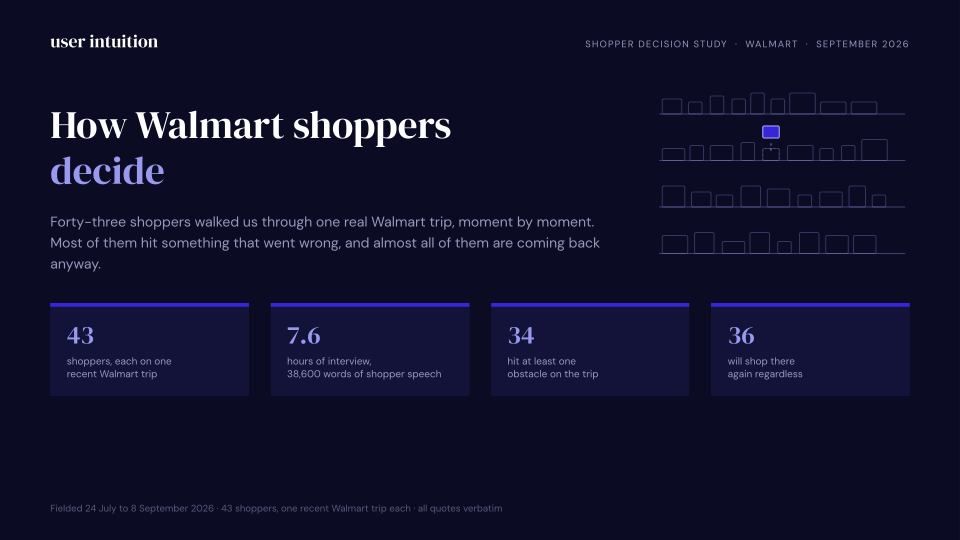
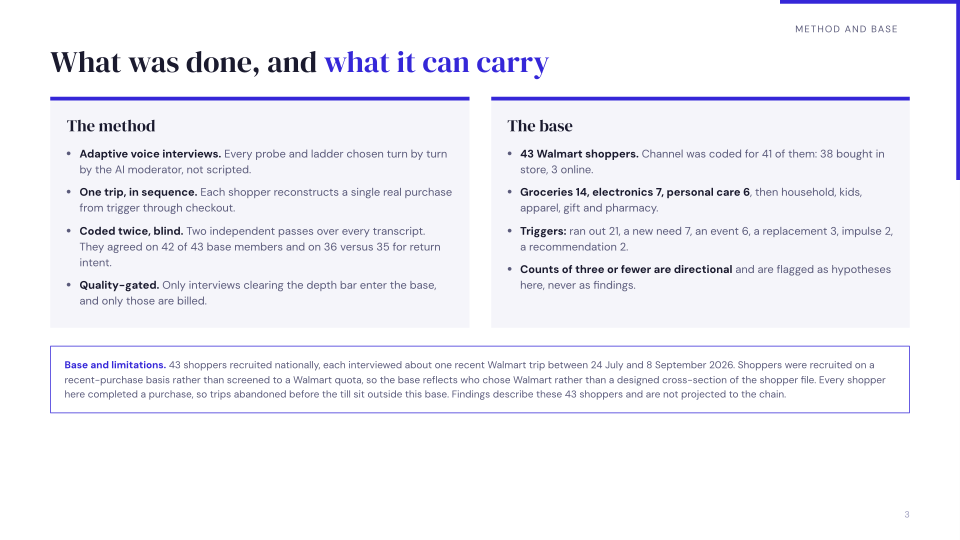
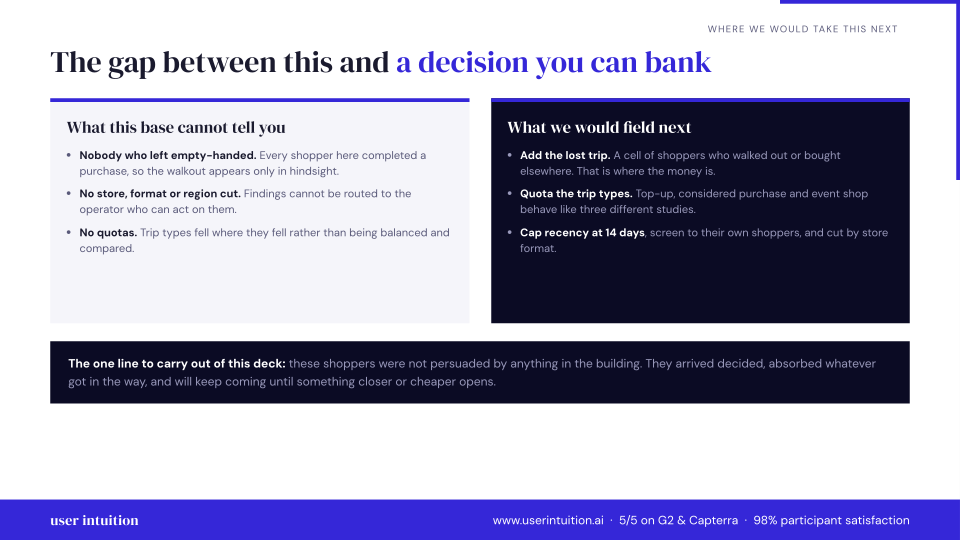
Explore calls and a sample presentation from our 43-participant Walmart shopper study.
Grocery top-up, supercenter
“Basically, because we use those things all a lot We try to always have you know, certain things in the house at all times because we use them very frequently. So we don't like to run out of them.”
What was making you want those specific things right then? Beyond just being out? Was it about being able to make certain meals or something else?
Basically, because we use those things all a lot We try to always have you know, certain things in the house at all times because we use them very frequently. So we don't like to run out of them.
Phone replacement, unplanned and urgent
“It made me feel so safe so relieved, and it brightened my day.”
Sounds like you knew exactly what you want. A Google Pixel 6 Pro. What was it about that phone that made it the right choice for you, especially in that moment?
Yeah. Thank you. So the the the phone had a lot of features. I I heard friends were talking about this phone. So in terms of the camera setting, it can take pictures and refine them into good quality. It has its own internal scanner, like I don't need to download other apps to scan to do scans. And of course, it has high quality for recording, which has been helping me in my meetings. In the office. So it's really amazing, and I love festival the quality of the phone in terms of the camera, because the previous phone I had was a Samsung. And the quality was really frustrating. And it had it has a very good processor speed as well. It's very fast. It's very efficient, and I like it. I like it. I'm enjoying the features.
Sample presentation
Preview three slides, or download the full 15-slide presentation.
Bring your own sample
$30 per quality voice interview
Use our 4M+ vetted panel
$60 per quality voice interview
What researchers say
"The depth of insight rivals expensive user research, but the scale is completely different. We went from 12 win/loss interviews per quarter to 200+. Now we can segment by industry, deal size, and competitor."
"A brand manager Slack'd me at four about our new resealable pouch and I answered before standup the next morning with quotes from a study we'd run six weeks earlier. Searched the hub and that was it. Used to mean a panel export, a Qualtrics export, and digging through Dovetail."
Frequently Asked Questions
Make Your Next Decision Better Informed
Start with one customer question. See the research process, then build a body of evidence your team can keep using.
Every conversation makes your intelligence more valuable.
Related resources
Pillar Guides
Deep-dive guides covering this topic from strategy to execution.
Tools & Tactics
Practical frameworks and platform-specific guides for teams ready to act.
Reference Guides
Reference deep-dives on methodology, best practices, and applied research.
Alternatives & Comparisons
Side-by-side comparisons with competing platforms and approaches.
Related Solutions
Complementary research use cases that pair with this topic.
Industries
See how teams in specific verticals apply this research.
Last updated