
MVP Testing for Solo Founders: Validate Before You Build
No research team, no months to wait, no shortcuts on depth. AI-moderated depth interviews with real potential customers from our 4M+ vetted panel in 24 hours — build what people need.

From individual interviews to a clearer picture.
Solo founder validated expense tracking SaaS: 4 of 5 target segments confirmed pain, but only freelancers earning $50K+ showed willingness to pay...
Trusted by teams at





MVP testing is the practice of validating a minimum viable product with target customers before fully building it — most tooling relies on prototype analytics or surveys, which miss the why behind purchase intent. User Intuition is MVP testing software powered by AI-moderated interviews, running depth conversations with real potential customers through a 4M+ vetted panel in 80+ languages, in 24 hours. Across solo-founder studies on the platform, User Intuition found the cheapest way to be wrong is skipping customer evidence at four decision points that rely on intuition alone: pre-PMF problem validation, pricing and packaging tests, competitive positioning before fundraising, and MVP concept validation. Each study returns a structured validation report: demand scores, willingness-to-pay ranges, segment breakdowns, and pitch-deck-ready customer quotes. A User Intuition MVP study starts at $150, returns panel results in 24 hours with 98% participant satisfaction, and is backed by 4.9/5 on G2 and 5/5 on Capterra. The Starter plan has no monthly fee and includes 3 free interviews with your own participants.
What is MVP testing with User Intuition?
MVP testing with User Intuition means AI-moderated depth interviews with real potential customers before you build: 20–30 minute conversations that ladder 5–7 levels into the problem, willingness to pay and what would stop someone buying. Recruit from a 4M+ vetted panel across 58 countries and get results in 24 hours, or invite your own waitlist and interview them in parallel as they respond, in 80+ languages with no research team.
Who is MVP testing with User Intuition for?
Solo and early-stage founders validating a problem, a price or an MVP concept before they spend runway building it.
How does AI-moderated MVP testing work?
Describe your hypothesis and the AI drafts the interview guide. The AI moderator interviews your target customers in voice, video or chat, and every finding links back to its recording.
What do you get from an MVP testing study?
A validation report with demand signals and willingness-to-pay ranges by segment, pitch-ready verbatims, an editable presentation, and every transcript and recording.
Why does MVP testing get skipped when you're building alone?
You need customer evidence to build the right thing and to raise, but traditional research is priced for companies with research budgets. Here's what founders tell us, and how User Intuition closes each gap.
- Sound familiar?
A real research study costs more than my runway, so I skip it and build on gut feel.
MVP testing priced per interview
No monthly fee, and you pay only for interviews that pass quality scoring, so you can validate with five customers or fifty.
- Sound familiar?
No co-founder to push back. Every product call is me guessing what the market wants.
Real potential customers, 5–7 levels deep
20–30 minute interviews with your target segment ladder past polite interest to the problem, the workaround and what they'd pay to fix it.
- Sound familiar?
Runway is burning. I need an answer this week, not in two months.
MVP validation from the panel in 24 hours
Launch today and read 200+ interviews tomorrow, recruited from a 4M+ vetted panel across 58 countries.
- Sound familiar?
68% said yes on my Google Form. I still don't know why they'd pay, how much, or what would stop them.
Willingness to pay, with the reasons
The AI moderator probes price, packaging and deal-breakers, so you get willingness-to-pay ranges with the reasoning behind them.
- Sound familiar?
Investors ask if I've talked to customers. All I have is anecdotes.
Investor-ready customer evidence
Structured findings, demand signals by segment and verbatim quotes that drop straight into the pitch deck, each linked to its recording.
- Sound familiar?
I write the questions, pick the people and read the answers. Of course it says what I want to hear.
Unbiased interviews, not founder-led ones
Non-leading questions, independently recruited participants and consistent probing take confirmation bias out of the evidence.
- The question
- Which consumer problem should a new product address?
- The evidence
- 500 US consumer conversations, followed by tests of two product concepts.
- The outcome
- The team chose a launch direction and made independent, trustworthy product rankings central to its positioning.
From hypothesis to customer verdict
Describe Your Hypothesis
Tell us the problem you believe exists, the solution you're considering, and who you think needs it. Our AI builds the interview guide and screener — no research design expertise needed.
AI Interviews Real Customers
Each potential customer completes a 20–30 minute AI-moderated voice interview exploring whether the problem exists, how they solve it today, what they'd pay, and how urgently they need a solution.
Get Your Go/No-Go Signal
Receive a structured validation report with demand scores, segment breakdowns, willingness-to-pay ranges, and verbatim customer quotes — evidence you can act on and share with investors.
Build Compounding Intelligence
Every study feeds your searchable intelligence hub. When you pivot or explore adjacent ideas, compare demand signals across concepts and segments — each round of validation makes the next sharper.
How Solo Founders use
User Intuition
Pre-Build Idea Validation
Interview potential customers before writing code to confirm the problem exists, is painful enough to pay for, and isn't already solved.
Pricing Research
Test willingness to pay, price sensitivity, and optimal pricing models with real potential customers — not your assumptions about what they'd pay.
Investor Pitch Evidence
Build a customer evidence deck with real interview quotes, demand metrics, and segment analysis that gives VCs confidence in your market understanding.
Pivot Decision Research
When traction stalls, interview target customers to diagnose whether the problem, solution, audience, or pricing needs to change — before burning more runway.
Competitive Gap Analysis
Interview users of competitor products to identify unmet needs, frustrations, and switching triggers you can build your positioning around.
Feature Prioritization
When you can build 3 features but only have resources for 1, interview target users to find which capability they'd pay for first.
Why researchers choose User Intuition
User Intuition is an AI-moderated interview platform that gives research teams and agencies the depth of a senior researcher at the scale of a survey, with vetted respondents, your own methodology and evidence you can trace to the verbatim. Quality is built in: a person vets every panelist by hand, every session is screened for fraud, and you pay only for interviews that pass.
Senior-researcher depth
The moderator ladders 5–7 levels deep by default, using Reynolds and Gutman's laddering method, so you hear the reasons behind the reasons.
Your methodology, run as written
Bring your discussion guide and frameworks. Required questions stay pinned in order, word for word if you need it, study rules keep the moderator inside your compliance lines, screeners and hard quotas fill every cell to plan, and you decide how far it probes.
Every finding traces to its source
Click any theme through to the verbatim, the transcript and the recording. Every claim in the deliverable traces to what a participant said.
Respondents you can stand behind
A 4M+ vetted panel across 58 countries: a person listens to every panelist's interviews before they're accepted, then every session is screened for AI-generated or coached answers and panelists are tracked across studies. Or bring your own: customer lists, your panel provider, or respondents straight from your survey.
Deliverables ready to present
Themes, verbatims and an editable presentation for every study, plus every transcript, recording and screener answer to export into your own tools. Put your own brand on them when you need to.
Survey scale, quality-only billing
200+ panel interviews in 24 hours, with no cap on parallel conversations. Each one is scored on length, depth and coverage, and you pay only for those that pass.
- Isolated workspaces
- Confidential stimulus
- Never used to train AI models
- GDPR & CCPA compliant
- SOC 2 Type II examination underway
- Security →
How Does User Intuition Compare to DIY Validation and Traditional Research for Solo Founders?
| Dimension | User Intuition | DIY Methods (Surveys / Landing Pages) | Traditional Qualitative Research |
|---|---|---|---|
| Depth of Insight | 20–30 min AI-moderated depth interviews probing motivations, pain, and willingness to pay | Surface-level signals: click rates, form submissions, survey percentages — no context on why | Deep qualitative insight but limited to 8-15 interviews per $15K–$75K project |
| Speed to Answers | 24 hours from hypothesis to structured validation report on panel studies | Landing pages need 2-4 weeks of traffic to reach statistical significance; surveys return in days but lack depth | 6-12 weeks from briefing to final deliverable — longer than most founders' decision windows |
| Cost | From $150 (5 interviews at $30 each, using your own audience) | Free to low-cost tools, but ad spend for landing page tests adds up quickly ($500-$2K for meaningful traffic) | $15K–$75K per study — more than many solo founders' total runway |
| Real Human Conversations | Yes — real potential customers from a 4M+ global panel | No conversations — surveys capture stated preferences, landing pages capture clicks, neither captures reasoning | Yes — but recruiting takes 2-4 weeks and scheduling is a logistics nightmare for solo founders |
| Bias Control | AI interviewer follows structured, non-leading methodology, so your hypothesis doesn't steer the answers | You design the survey, pick the audience, and interpret results — confirmation bias at every step | Professional moderators reduce bias but small sample sizes limit generalizability |
| Segment Analysis | Automatic breakdown by demographics, behaviors, and willingness to pay | Basic demographic cuts on survey data; landing pages show aggregate conversion only | Manual cross-tabulation in final report — accurate but slow and expensive to extend |
| Investor-Ready Output | Structured reports with verbatim quotes, demand scores, and segment data for pitch decks | Raw metrics (conversion rates, survey charts) that VCs dismiss as vanity data or leading questions | Polished decks but turnaround doesn't match fundraising timelines |
| Knowledge Retention | Searchable intelligence hub — every study compounds | Scattered across Google Sheets, Typeform dashboards, and ad platforms — nothing connects | Final PDF report lives in a shared drive; findings don't compound across studies |
| Ease of Use | Launch a study in 5 minutes — no research design experience needed | Easy to launch but hard to design unbiased questions or interpret results without training | You brief a research team and wait — easy but slow and expensive |
Hear the interviews. See the presentation.
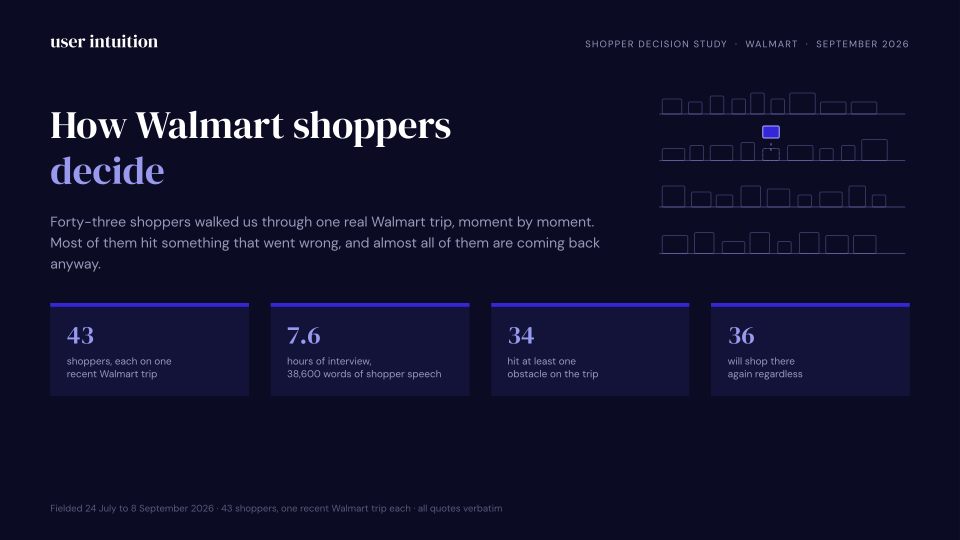
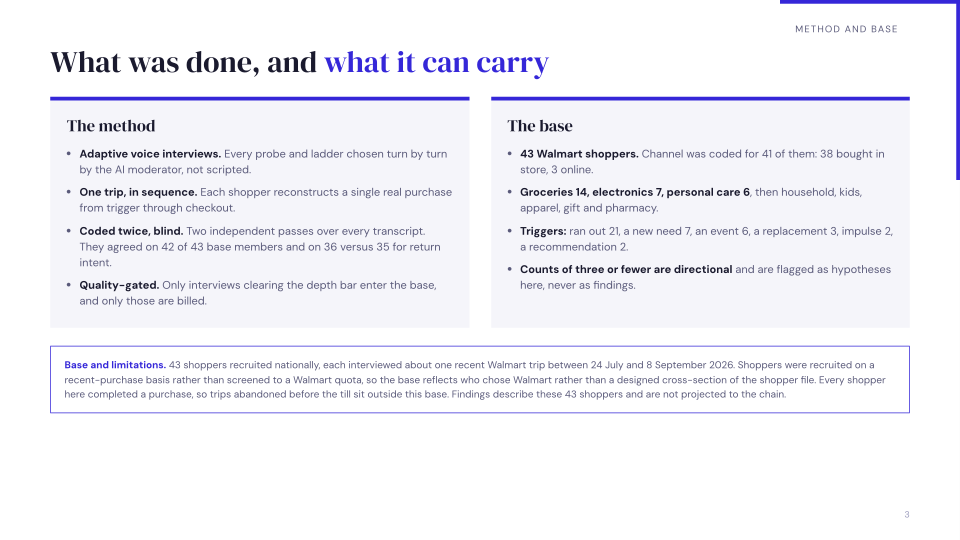
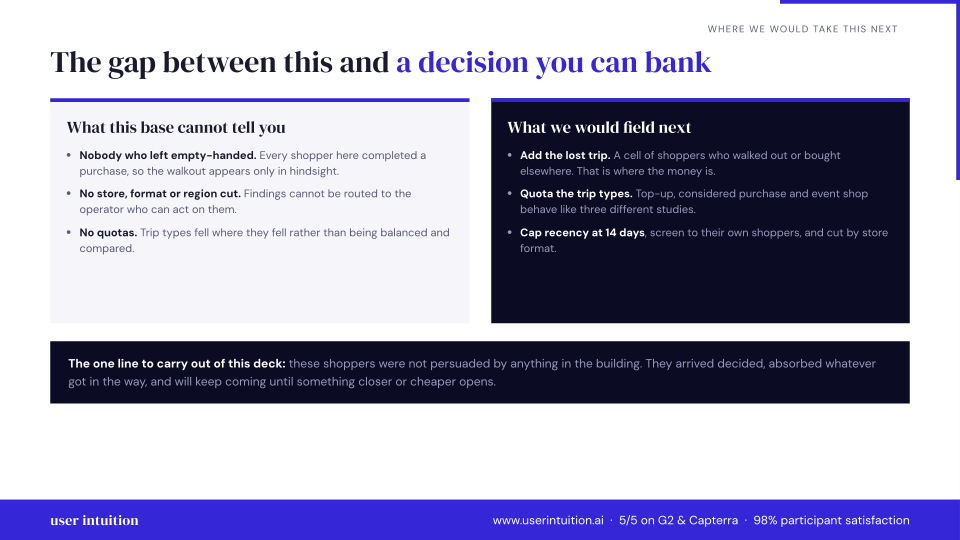
Explore calls and a sample presentation from our 43-participant Walmart shopper study.
Grocery top-up, supercenter
“Basically, because we use those things all a lot We try to always have you know, certain things in the house at all times because we use them very frequently. So we don't like to run out of them.”
What was making you want those specific things right then? Beyond just being out? Was it about being able to make certain meals or something else?
Basically, because we use those things all a lot We try to always have you know, certain things in the house at all times because we use them very frequently. So we don't like to run out of them.
Phone replacement, unplanned and urgent
“It made me feel so safe so relieved, and it brightened my day.”
Sounds like you knew exactly what you want. A Google Pixel 6 Pro. What was it about that phone that made it the right choice for you, especially in that moment?
Yeah. Thank you. So the the the phone had a lot of features. I I heard friends were talking about this phone. So in terms of the camera setting, it can take pictures and refine them into good quality. It has its own internal scanner, like I don't need to download other apps to scan to do scans. And of course, it has high quality for recording, which has been helping me in my meetings. In the office. So it's really amazing, and I love festival the quality of the phone in terms of the camera, because the previous phone I had was a Samsung. And the quality was really frustrating. And it had it has a very good processor speed as well. It's very fast. It's very efficient, and I like it. I like it. I'm enjoying the features.
Sample presentation
Preview three slides, or download the full 15-slide presentation.
Bring your own sample
$30 per quality voice interview
Use our 4M+ vetted panel
$60 per quality voice interview
What researchers say
"As a consumer brand we were spending $40K per focus group study. User Intuition lets us run continuous conversations and get insights instantly. It's driven 5 figures in revenue, easily!"
"I switched from SurveyMonkey to User Intuition because it allows me to collect real-time voice data from interviews, which is key for me. The initial setup was not hard at all; Charles, the AI, helped me set it up by using my parameters, and it generated everything I needed — just a bit of editing was required. It fits perfectly into our consulting workflow, as we don't do many interviews and it's cost-effective for our small team."
Common questions
Stop guessing.
Start building with evidence.
With panel results in 24 hours, know whether your idea has real demand — with the customer evidence to prove it to investors, co-founders, and yourself.
Start with an editable research brief. Review your plan and discussion guide before inviting participants.
See how solo founders use AI-moderated interviews to validate ideas, test pricing, and build investor-ready evidence. We'll walk through your specific use case.
Your methodology · Your sample · No monthly fee on Starter
Go deeper on Solo Founders
Pillar Guides
Deep-dive guides covering this topic from strategy to execution.
Tools & Tactics
Practical frameworks and platform-specific guides for teams ready to act.
Reference Guides
Reference deep-dives on methodology, best practices, and applied research.
Alternatives & Comparisons
Side-by-side comparisons with competing platforms and approaches.
Related Solutions
Complementary research use cases that pair with this topic.
Platform Capabilities
The platform features that power this type of research.
Last updated