
Build customer research into your product
Build on AI-moderated interviews that probe 5–7 layers deep, quality-scored conversations, and evidence-linked analysis. Connect through API and MCP while your team owns the customer experience.

Calls, transcripts, and findings.
Trusted by teams at





Qualitative research infrastructure lets developers add customer interviews to a product without building recruitment and moderation systems themselves. User Intuition provides study planning, participant recruitment, AI-moderated interviews, and research results through an API, MCP server, and CLI. Your application supplies the research brief, lets the user review the plan and cost, and retrieves the completed evidence. Study results expose findings, participant responses, participant profiles, and recommended next steps with source references and coverage context. Cross-study search finds relevant findings and response summaries so your application can reuse prior research. Your product controls the customer experience and decides how to interpret the evidence. User Intuition supports your own participants or panel recruitment, with recruiting charged separately from platform usage. Organization-scoped authentication limits access to authorized research. Public TypeScript examples show study execution, results retrieval, and evidence search, including a fictional fixture mode that requires no account or spending.
What is a qualitative research API?
A qualitative research API lets your product commission real customer interviews and retrieve the evidence. User Intuition provides planning, approved recruitment, 20–30 minute AI-moderated interviews that ladder 5–7 levels deep, study results and cross-study search through API and MCP, while your application owns the customer experience. Through the API and MCP, recruit from a 4M+ vetted panel across 58 countries or bring your own participants; Prolific, Cint / Lucid and CloudResearch connect through the workspace.
Who builds on the qualitative research API?
Research agencies productizing their methods for clients, and platforms adding customer research to their own product. Agencies that only need delivery capacity can run studies in the self-serve workspace with no integration.
How does the qualitative research API work?
Your application submits a study plan and audience, reviews the plan and cost, and approves recruitment. The AI moderator interviews participants in voice, video or chat, and results come back as JSON with source references to each interview.
What does the API return from a study?
Study findings, participant responses, participant profiles and recommended next steps as JSON, plus interview messages and recording links, in an isolated, org-scoped workspace per client.
Why build on a qualitative research API instead of building research infrastructure yourself?
Adding real customer research to your product means solving recruitment, moderation and analysis at once. Here's what builders and agencies tell us, and how User Intuition closes each gap.
- Sound familiar?
We scoped customer research as a form and a webhook. Then we hit recruitment, follow-up questions and evidence trails.
Adaptive interviews, not a survey API
AI-moderated interviews ask adaptive follow-up questions 5–7 levels deep instead of only collecting answers to a fixed questionnaire, with an evidence trail behind every finding.
- Sound familiar?
Recruitment ops and moderation tooling would eat a roadmap our customers are already waiting on.
Recruitment, moderation and analysis in one integration
Call the documented REST API and MCP server for recruitment, interviews and analysis instead of stitching fieldwork vendors together. Read the API and MCP documentation.
- Sound familiar?
A PDF report can't live inside our product. The evidence has to land where our customers work.
Structured, source-linked research results
Retrieve findings, individual response summaries, sample profiles and recommended next steps as JSON, and follow source references to the interviews behind each one. Recurring studies and next-study recommendations from Adaptive Research are platform capabilities too.
- Sound familiar?
Our clients' data can never touch, and we need to price the research our way.
Isolated client workspaces, your pricing
Each client gets its own isolated workspace with org-scoped keys. Own and export your data, blend in your own panel, and set your markup on top of transparent per-interview pricing.
- Sound familiar?
Half the team doesn't write code, and we want to see a real study work before engineering commits.
Self-serve workspace alongside the API
Researchers run a representative study in the workspace first; developers start from the public TypeScript examples, which run on fixtures before you connect a live key.
From API access to evidence-backed research
One integration. Works over REST or the MCP server — no dashboard required after setup.
Get an API Key
Sign in, open Manage Account, and create an organization-scoped key in the API Keys tab. Keep the key private and use it only for the account it authorizes.
Connect Your Product
Call the REST API directly, or add the User Intuition MCP server to your stack. Copy the exact config from the docs.
Create a Study
Your product creates a study — objectives, audience, mode — and recruits from the 4M+ panel or your customer's own list. Preview cost and timeline before it commits.
Real Interviews Run
Participants join AI-moderated voice, chat, or video conversations that probe 5–7 layers deep. You or your customer can watch progress or stay hands-off.
Pull Structured Results
Retrieve interview records, transcripts, and reports through the documented API. Account-wide completed-interview webhooks can notify your product when an interview completes. Verify ownership and signatures before using incoming data.
What You're Building On
The capabilities that matter when real customer research is a feature of your product.
Real participant evidence
Run interviews with real participants and inspect the evidence. Synthetic research stays separate and labeled, for exploration only.
API and MCP workflows
Connect research operations through API and MCP. The documentation lists every endpoint and tool.
Organization-scoped access
API keys are organization-scoped, and every request enforces account ownership, so client data never crosses workspaces.
Flexible sample sources
The platform supports your own audience, User Intuition recruitment, and selected third-party panels through the workspace.
Validate before you integrate
Run a representative study in the workspace first. Check audience fit, evidence quality, and operational requirements before building the customer-facing integration.
API for you, dashboard for them
Researchers can work in the dashboard while engineers connect supported operations through API and MCP.
Should You Build On the API or Build It Yourself?
The infrastructure question is the same one you already answered for payments, auth, and voice: build the undifferentiated heavy lifting, or call it.
Build On the API When
- Real customer research is a feature of your product, not your core IP
- You need real vetted people, not synthetic or scraped data
- You want to launch in days and iterate, not staff a research-ops team
- Your client integration has a defined account and authorization model
- Depth matters — you need the why, not just rows
- You want predictable, usage-based cost with margin to resell
Build It Yourself When
- Owning a panel and moderation stack is your core differentiation
- You have years and millions to build recruitment, moderation, and analysis
- Your compliance model forbids any third-party processor
- You need full control of every layer and can maintain it forever
Most teams building on top of research — like most teams building on top of payments or voice — call the infrastructure and put their energy into the product their customers pay for.
What Teams Build On the Research API
Products that turn real customer research into a feature.
Research platforms & OS
Products offering end-to-end research add qualitative depth at scale by calling the API mid-workflow, then pulling results back into their own reporting.
→Vertical insights products
Industry-specific tools embed customer interviews so their users get real consumer signal without leaving the product.
→Agencies productizing research
Agencies that want a programmatic backend — not a manual service — wire the API into their own delivery, under their own brand.
→SaaS adding 'talk to your customers'
Product and CX tools add a native 'interview your users' feature powered by the API instead of building moderation in-house.
→Agentic & AI-native workflows
When an AI agent needs real participant evidence, it calls the same infrastructure over MCP. See the agent-native page for that path.
→Concept & message testing at scale
Embed fast preference and message tests so your users validate creative before launch, with interviews running in parallel as they respond.
→Why researchers choose User Intuition
User Intuition is an AI-moderated interview platform that gives research teams and agencies the depth of a senior researcher at the scale of a survey, with vetted respondents, your own methodology and evidence you can trace to the verbatim. Quality is built in: a person vets every panelist by hand, every session is screened for fraud, and you pay only for interviews that pass.
Senior-researcher depth
The moderator ladders 5–7 levels deep by default, using Reynolds and Gutman's laddering method, so you hear the reasons behind the reasons.
Your methodology, run as written
Bring your discussion guide and frameworks. Required questions stay pinned in order, word for word if you need it, study rules keep the moderator inside your compliance lines, screeners and hard quotas fill every cell to plan, and you decide how far it probes.
Every finding traces to its source
Click any theme through to the verbatim, the transcript and the recording. Every claim in the deliverable traces to what a participant said.
Respondents you can stand behind
A 4M+ vetted panel across 58 countries: a person listens to every panelist's interviews before they're accepted, then every session is screened for AI-generated or coached answers and panelists are tracked across studies. Or bring your own: customer lists, your panel provider, or respondents straight from your survey.
Deliverables ready to present
Themes, verbatims and an editable presentation for every study, plus every transcript, recording and screener answer to export into your own tools. Put your own brand on them when you need to.
Survey scale, quality-only billing
200+ panel interviews in 24 hours, with no cap on parallel conversations. Each one is scored on length, depth and coverage, and you pay only for those that pass.
- Isolated workspaces
- Confidential stimulus
- Never used to train AI models
- GDPR & CCPA compliant
- SOC 2 Type II examination underway
- Security →
Choose your starting point
| Dimension | User Intuition API | Build in-house | Workspace first |
|---|---|---|---|
| Starting point | Connect supported API or MCP operations | Define and build the research workflow | Run a representative study without integration |
| Product experience | Your team builds the interface | Your team builds the interface | Use the User Intuition workspace |
| Moderation | AI-moderated interviews | Build or integrate moderation | AI-moderated interviews |
| Analysis | Retrieve supported research outputs | Build or integrate analysis | Review findings in the workspace |
| Sample | Own sample, our panel, or supported third-party panels | Arrange your recruitment workflow | Own sample, supported panels, or our recruitment |
| Customer boundaries | Isolated workspace per client, org-scoped keys | Design and maintain access controls | Configure appropriate workspace access |
| Best next step | Run a study, then wire up the documented API | Scope build and ongoing operations | Validate evidence quality and workflow fit |
Hear the interviews. See the presentation.
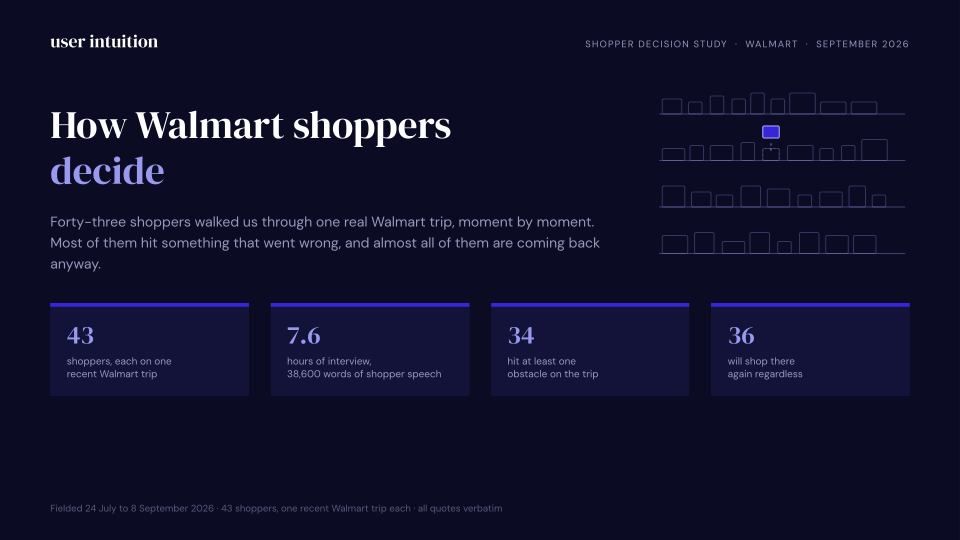
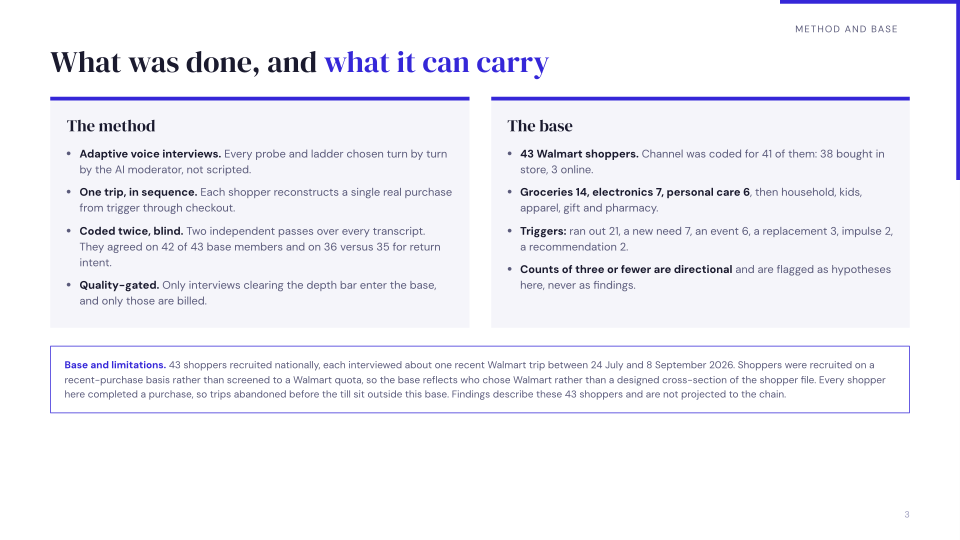
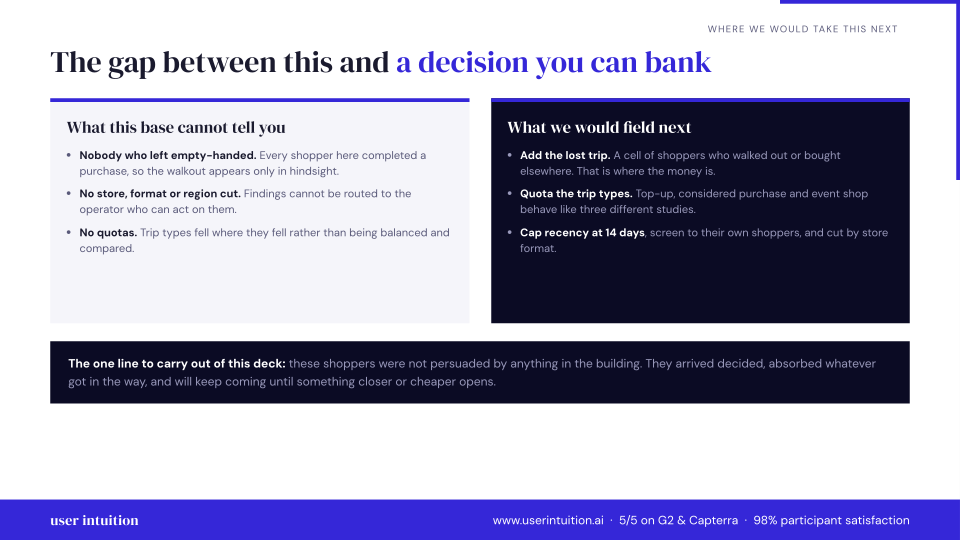
Explore calls and a sample presentation from our 43-participant Walmart shopper study.
Grocery top-up, supercenter
“Basically, because we use those things all a lot We try to always have you know, certain things in the house at all times because we use them very frequently. So we don't like to run out of them.”
What was making you want those specific things right then? Beyond just being out? Was it about being able to make certain meals or something else?
Basically, because we use those things all a lot We try to always have you know, certain things in the house at all times because we use them very frequently. So we don't like to run out of them.
Phone replacement, unplanned and urgent
“It made me feel so safe so relieved, and it brightened my day.”
Sounds like you knew exactly what you want. A Google Pixel 6 Pro. What was it about that phone that made it the right choice for you, especially in that moment?
Yeah. Thank you. So the the the phone had a lot of features. I I heard friends were talking about this phone. So in terms of the camera setting, it can take pictures and refine them into good quality. It has its own internal scanner, like I don't need to download other apps to scan to do scans. And of course, it has high quality for recording, which has been helping me in my meetings. In the office. So it's really amazing, and I love festival the quality of the phone in terms of the camera, because the previous phone I had was a Samsung. And the quality was really frustrating. And it had it has a very good processor speed as well. It's very fast. It's very efficient, and I like it. I like it. I'm enjoying the features.
Sample presentation
Preview three slides, or download the full 15-slide presentation.
Bring your own sample
$30 per quality voice interview
Use our 4M+ vetted panel
$60 per quality voice interview
What researchers say
"The depth of insight rivals expensive user research, but the scale is completely different. We went from 12 win/loss interviews per quarter to 200+. Now we can segment by industry, deal size, and competitor."
"After a few studies you've built up this base of consumer conversations you can go back and query anytime. You don't have to re-ask questions you've already explored. New studies build on what you already know, so each one gets more targeted and more valuable. We went from running brand studies once every six months to having a living, breathing picture of how we're doing that anyone on the team can check at any point."
 Eric O., Chief Commercial Officer, Turning Point Brands
Verified review on Capterra
Eric O., Chief Commercial Officer, Turning Point Brands
Verified review on Capterra Frequently Asked Questions
Build real customer research into your product
Validate the workflow in the workspace, explore the documentation, and scope the integration your product needs.
Full API and MCP docs at docs.userintuition.ai. Works over REST or any MCP-compatible client.
Related resources
Pillar Guides
Deep-dive guides covering this topic from strategy to execution.
Tools & Tactics
Practical frameworks and platform-specific guides for teams ready to act.
Reference Guides
Reference deep-dives on methodology, best practices, and applied research.
Alternatives & Comparisons
Side-by-side comparisons with competing platforms and approaches.
Related Solutions
Complementary research use cases that pair with this topic.
Industries
See how teams in specific verticals apply this research.
Last updated