
Research that builds on what you learn
Go deeper at mid-study checkpoints. Find the best next study. Track change with recurring research—while your team owns the decision.

Walk me through the last time you made this choice. What tipped it?
The deciding reason surfaced four follow-ups deep, not in the first answer.
Trusted by teams at







Adaptive research is research that builds on what you learn. It uses emerging evidence to deepen ongoing interviews, identify unanswered questions, and inform the next study. User Intuition combines interviews that probe 5–7 levels deep with quality-scored conversations and findings linked to participant verbatims. User Intuition supports mid-study checkpoints that review findings and suggest improvements, recommends the best next study, and lets teams set up recurring studies. Scheduled tracking revisits a stable question over time; discovery follow-ups investigate a finding, contradiction, or missing perspective. Researchers should preserve core questions and sampling for comparisons, review proposed changes, and assess supporting, contradicting, mixed, or inconclusive evidence. The goal is enough evidence to support a decision within defined limits, not automatic proof of a hypothesis. Agencies can apply this approach to ongoing client programs, while self-serve teams can start with one study and build from the questions it leaves open.
What is the User Intuition adaptive research platform?
An adaptive research platform builds each study on what the last one taught you. User Intuition runs 20–30 minute AI-moderated interviews that ladder 5–7 levels deep, and adds mid-study checkpoints, best-next-study recommendations and recurring studies while your researchers own interpretation and the next decision. Field 200+ panel interviews in 24 hours from a 4M+ vetted panel across 58 countries, or bring your own sample and run interviews in parallel as participants respond.
Who is the adaptive research platform for?
Research agencies running ongoing client programs, and in-house insights teams whose questions keep evolving after the first readout.
How does adaptive research work in User Intuition?
Launch a study from your guide and stimulus. The AI moderator interviews in voice, video or chat, a mid-study checkpoint reviews findings so far and suggests improvements for your team to approve, and every finding links back to the recording.
What do you get from an adaptive research study?
Themes with verbatims, segment reads, an editable presentation, every transcript and recording, and a recommended next study you can scope, approve or decline.
Why does each study start over without an adaptive research platform?
The report lands, and the next question is already forming. Here's what researchers tell us, and how User Intuition closes each gap.
- Sound familiar?
The objection that mattered showed up in interview twelve. By the readout, fieldwork was over.
Mid-study checkpoints that go deeper
User Intuition reviews findings while the study is still running and suggests improvements to probe emerging questions. Your team decides what changes and what stays fixed.
- Sound familiar?
Every readout ends with “further research recommended,” and writing that next brief is a project of its own.
Next-study recommendations from the evidence
Each study suggests the best next study to close the gaps it found. You set the audience, scope and budget before anything launches.
- Sound familiar?
We changed two questions in wave three, and now nobody trusts the trend.
Recurring studies with a stable core
Set up weekly, monthly or quarterly waves that keep core questions and sampling consistent, and explore new questions in focused follow-ups, so change across waves stays readable.
- Sound familiar?
One vivid interview took over the debrief, and the missing segment never came up.
Researcher-led decisions, evidence in view
Every finding links to its verbatims and recordings, so your team weighs contradictions and missing segments before deciding whether more fieldwork is worth it.
From one objective to the next informed decision
Start self-serve with a study. Use the evidence to decide how far the program should go.
Name the decision and its limits
Before launch, write down the hypothesis, the decision it informs, supporting and contradicting evidence, required segments, and an interview or budget limit. These are research planning commitments, not promises of statistical certainty.
Review the mid-study checkpoint
Inspect findings and suggested improvements. Keep a stable core for comparison and use adaptable probes to investigate emerging questions. For example, explore who approves a purchase after participants repeatedly mention manager approval.
Decide what the evidence supports
Consider continuing, investigating a contradiction, recruiting a missing segment, or concluding. Mixed and inconclusive evidence are valid outcomes. Reaching the agreed limit is a reason to report uncertainty, not to keep searching for confirmation.
Choose the next research action
Review the best-next-study suggestion or schedule a recurring wave. Keep tracking distinct from discovery follow-ups. If the decision is sufficiently informed, take action rather than launching another study simply because you can.
One objective. Two ways to keep learning.
Understand and reduce onboarding friction. Use tracking to see what changes, and discovery to explain what remains unclear.
Scheduled tracking
Repeat a stable study monthly, quarterly, or around a milestone. Keep core questions and audience definitions sufficiently consistent to compare results; document changes that could affect interpretation.
Discovery follow-up
Design a separate study around a finding, contradiction, or missing perspective. An onboarding study might uncover setup confusion among new users but an integration-support gap among experienced users.
Return to the business decision
Review what changed, which questions remain open, and whether another method is needed. Agreement in interviews can explain a mechanism; it does not by itself establish how prevalent that mechanism is in the population.
Build a learning cycle around the decision
Mid-study checkpoints
Review emerging findings and suggested improvements while fieldwork is underway. Look for opportunities to move beyond repeated surface answers and investigate the reasoning behind them.
Best-next-study suggestions
Use recommendations to shape the next brief around what remains unanswered. Your team chooses whether the proposed study is relevant to the decision and worth pursuing.
Recurring study setup
Set up research to run weekly, monthly, or quarterly. Keep the tracking objective explicit and review whether questions and sample definitions support comparisons across each wave.
Evidence-linked findings
Inspect participant verbatims behind the analysis before acting on a recommendation. Separate an emerging theme that deserves investigation from a finding strong enough to inform a decision.
Adapt the learning, not the evidence standard
User Intuition suggests ways to go deeper and what to investigate next. Researchers remain responsible for changes, interpretation, and the decision to conduct more research.
Preserve research integrity
- Define supporting and contradicting evidence before fieldwork
- Keep a stable core of questions for comparisons
- Treat emerging themes as questions to investigate
- Record guide changes and which interviews used them
- Distinguish not mentioned from never asked
Set limits on the learning cycle
- Specify audience, scope, and budget before each launch
- Assess missing segments and contradictory accounts
- Accept mixed evidence and inconclusive outcomes
- Use another method when population-level validation is needed
- Treat approval of interview changes separately from approval of new studies
Use these practices to guide your research program. For automated follow-ups, agree the budget, approved audiences, cadence, and scope before implementation. Approval of interview changes and approval of new study launches are separate decisions.
Make ongoing research useful to the people acting on it
Agencies
Build an ongoing client engagement around fresh evidence and agency-led interpretation.
→Product Teams
Investigate friction, revisit changes, and focus the next product research question.
→Brand Health Tracking
Preserve a tracking core while investigating the reasons behind emerging shifts.
→Consumer Insights
Build on earlier explanations as customer needs and market conditions change.
→Why researchers choose User Intuition
User Intuition is an AI-moderated interview platform that gives research teams and agencies the depth of a senior researcher at the scale of a survey, with vetted respondents, your own methodology and evidence you can trace to the verbatim. Quality is built in: a person vets every panelist by hand, every session is screened for fraud, and you pay only for interviews that pass.
Senior-researcher depth
The moderator ladders 5–7 levels deep by default, using Reynolds and Gutman's laddering method, so you hear the reasons behind the reasons.
Your methodology, run as written
Bring your discussion guide and frameworks. Required questions stay pinned in order, word for word if you need it, study rules keep the moderator inside your compliance lines, screeners and hard quotas fill every cell to plan, and you decide how far it probes.
Every finding traces to its source
Click any theme through to the verbatim, the transcript and the recording. Every claim in the deliverable traces to what a participant said.
Respondents you can stand behind
A 4M+ vetted panel across 58 countries: our team reviews a video identity interview with every panelist before they're accepted, then every voice interview is screened for AI-generated or coached answers and panelists are tracked across studies. Or bring your own: customer lists, your panel provider, or respondents straight from your survey.
Deliverables ready to present
Themes, verbatims and an editable presentation for every study, plus every transcript, recording and screener answer to export into your own tools. Put your own brand on them when you need to.
Survey scale, quality-only billing
200+ panel interviews in 24 hours, with no cap on parallel conversations. Each one is scored on length, depth and coverage, and you pay only for those that pass.
- Isolated workspaces
- Confidential stimulus
- Never used to train AI models
- GDPR & CCPA compliant
- SOC 2 Type II examination underway
- Security →
Every interview is checked before you pay for it
Interview checks run on every study, including studies with your own customers. Panel checks apply on top whenever we recruit for you.
Every interview
- Laddering 5–7 levels deep, which is hard to fake
- Video that shows a real, engaged person
- AI voice detection on every voice interview
- Scored on length, depth and coverage; Poor or Fair is never billed
- Our team listens to every panelist call, and a sample of yours
- Every recording and transcript yours to review and reject
What changes—and what stays under your control?
Evidence-driven stopping is a researcher-led decision discipline, not a claim of automated statistical proof or an automatic stopping feature.
| Dimension | Adaptive study | Evidence-driven stopping | Recurring research program |
|---|---|---|---|
| Core question | What should we ask next to understand this better? | Do we have enough evidence to inform the decision? | What should we investigate as the business changes? |
| What adapts | Probes and selected conversation branches | The researcher's decision to continue, fill a gap, or conclude | Follow-up studies and periodic research waves |
| Evidence to inspect | Emerging themes, shallow answers, contradictions | Supporting and contradicting evidence; segment coverage | Unanswered questions and changes since earlier studies |
| What to preserve | The central question and a stable core for comparison | The decision criteria and agreed research limits | Consistent questions and sampling in scheduled tracking |
| Available platform support | Mid-study findings review and improvement suggestions | Findings and verbatims for researcher assessment | Recurring study setup and next-study recommendations |
| Who makes the call | Researchers assess suggested improvements | Researchers decide whether evidence is sufficient | Researchers choose the next study and its scope |
Hear the interviews. See the presentation.
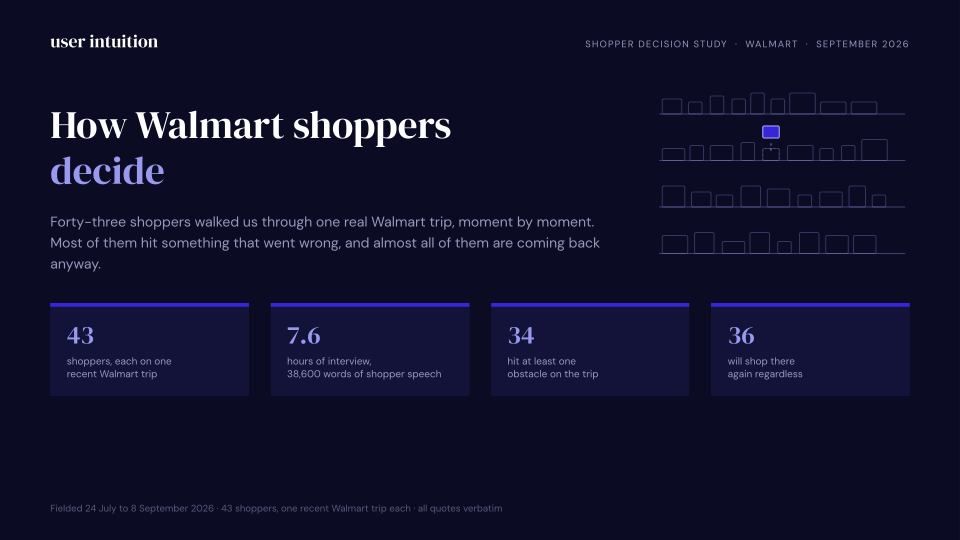
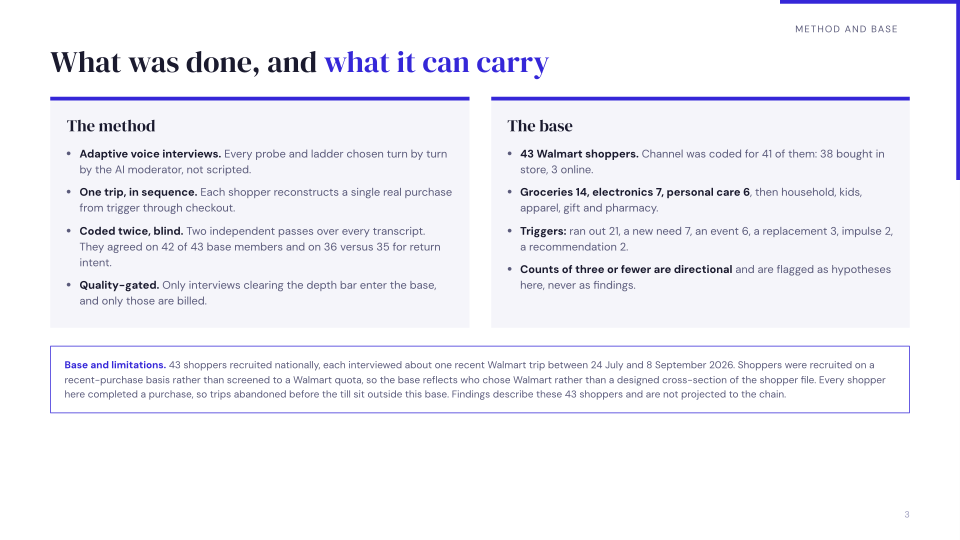
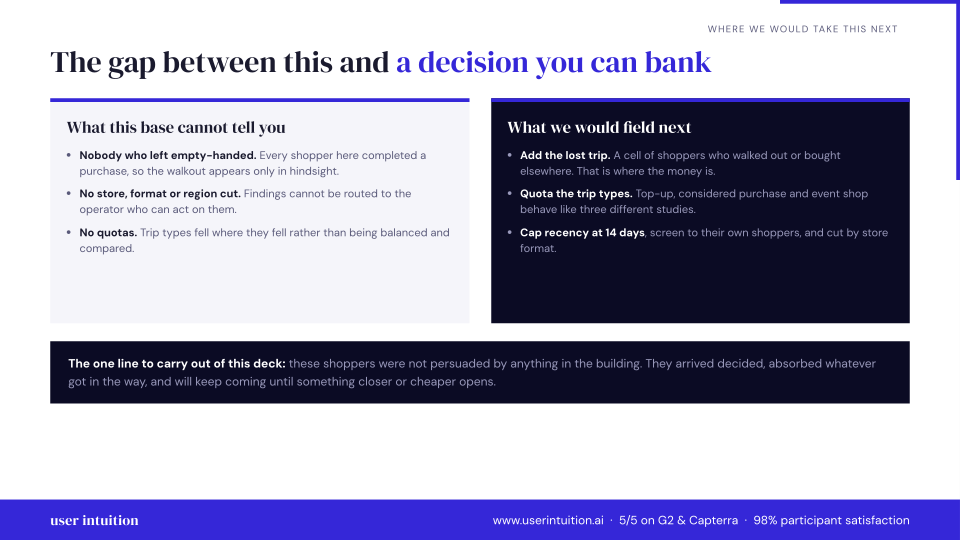
Explore calls and a sample presentation from our 43-participant Walmart shopper study.
Grocery top-up, supercenter
“Basically, because we use those things all a lot We try to always have you know, certain things in the house at all times because we use them very frequently. So we don't like to run out of them.”
What was making you want those specific things right then? Beyond just being out? Was it about being able to make certain meals or something else?
Basically, because we use those things all a lot We try to always have you know, certain things in the house at all times because we use them very frequently. So we don't like to run out of them.
Phone replacement, unplanned and urgent
“It made me feel so safe so relieved, and it brightened my day.”
Sounds like you knew exactly what you want. A Google Pixel 6 Pro. What was it about that phone that made it the right choice for you, especially in that moment?
Yeah. Thank you. So the the the phone had a lot of features. I I heard friends were talking about this phone. So in terms of the camera setting, it can take pictures and refine them into good quality. It has its own internal scanner, like I don't need to download other apps to scan to do scans. And of course, it has high quality for recording, which has been helping me in my meetings. In the office. So it's really amazing, and I love festival the quality of the phone in terms of the camera, because the previous phone I had was a Samsung. And the quality was really frustrating. And it had it has a very good processor speed as well. It's very fast. It's very efficient, and I like it. I like it. I'm enjoying the features.
Sample presentation
Preview three slides, or download the full 15-slide presentation.
Bring your own sample
$30 per quality voice interview
Use our 4M+ vetted panel
$60 per quality voice interview
What researchers say
"After a few studies you've built up this base of consumer conversations you can go back and query anytime. You don't have to re-ask questions you've already explored. New studies build on what you already know, so each one gets more targeted and more valuable. We went from running brand studies once every six months to having a living, breathing picture of how we're doing that anyone on the team can check at any point."
 Eric O., Chief Commercial Officer, Turning Point Brands
Verified review on Capterra
Eric O., Chief Commercial Officer, Turning Point Brands
Verified review on Capterra Frequently Asked Questions
Make your next study build on the last
Bring a question, an audience, and a decision to inform. Start self-serve or discuss an ongoing research program with the team.
Discuss recurring research, client programs, and implementation requirements.
Hear interviews and explore a sample report before starting a study.
Start with a clear objective. Keep researcher judgment at the center.
Related resources
Pillar Guides
Deep-dive guides covering this topic from strategy to execution.
Reference Guides
Reference deep-dives on methodology, best practices, and applied research.
Alternatives & Comparisons
Side-by-side comparisons with competing platforms and approaches.
Related Solutions
Complementary research use cases that pair with this topic.
Industries
See how teams in specific verticals apply this research.
Last updated