
Recruit Consumers for Research With Screening and Interviews Built In
User Intuition helps teams recruit consumers for research from a vetted panel, screen by category, behavior, or segment, and move qualified participants directly into voice, video, or chat interviews.

Walk me through the last time you made this choice. What tipped it?
The deciding reason surfaced four follow-ups deep, not in the first answer.
B2C participant recruitment is software that goes beyond buying general-population sample — it recruits consumers who fit the category, behavior, or life-stage a study needs and routes them into interviews in one workflow. User Intuition is B2C participant recruitment software powered by AI-moderated interviews, combining a consumer research panel of 4M+ participants with screening in one platform — replacing the recruiter-screener-fielding vendor stack. Across 30K+ interviews run on User Intuition — roughly 70% of them B2C — the consistent finding was that sample quality and fielding speed both matter, and neither alone is enough. They compound only when recruitment, screening, and conversation live in the same workflow rather than handed across vendors. A User Intuition B2C study starts at $150, returns results in 24 hours with 98% participant satisfaction, and is backed by 4.9/5 on G2 and 5/5 on Capterra. The output is practical: matched consumer samples, screening transcripts, completion-quality flags, and ready-to-analyze interview sets for consumer insights, brand strategy, and concept testing.
What is the User Intuition consumer research panel?
The User Intuition consumer research panel recruits shoppers, category buyers and target segments from 4M+ vetted respondents across 58 countries, screens them by behavior and category fit, and moves them straight into 20–30 minute AI-moderated interviews that ladder 5–7 levels deep. 200+ panel interviews come back in 24 hours, in 80+ languages, or bring your own customers and interviews run in parallel as they respond.
Who uses the consumer research panel?
Research agencies fielding shopper, brand health, concept and messaging studies for consumer brands, and in-house insights and innovation teams running longitudinal tracking.
How do you recruit consumers for research?
Set screeners for category usage, recency, purchase behavior and life stage. Qualified consumers interview in voice, video or chat in the same workflow, and every finding links back to the recording.
What do you get from a consumer study?
Interviews that pass quality checks, themes with verbatims, segment-level reads, an editable presentation, and every transcript and recording.
Why does consumer research panel recruiting get expensive fast?
Consumer studies fail when broad reach is mistaken for fit. Here's what consumer researchers tell us, and how User Intuition closes each gap.
- Sound familiar?
We asked for lapsed buyers and got anyone who'd heard of the brand.
Behavioral and category-fit screening
Screen by category usage and recency, purchase and switching behavior, brand relationship and life stage, separating recent buyers, lapsed users, switchers, heavy users and category rejecters before they enter the study, with hard quotas so each group fills to plan.
- Sound familiar?
They knew how to pass the screener. They had nothing to say in the interview.
Quality checked after every conversation
A person listens to every panelist's interviews before they join the panel, laddering 5–7 levels deep exposes weak-fit respondents, every session is screened for AI-generated or coached answers, and only interviews that pass are billed.
- Sound familiar?
Recruiting sits with one vendor and fieldwork with another, so we lose a week and all visibility.
Consumer recruiting and interviews in one workflow
Consumers move from screener straight into voice, video or chat interviews, with results in 24 hours and no handoff between sourcing and fieldwork.
- Sound familiar?
Our four-country study ran on four different quality standards.
One standard across 58 countries
Run consumer studies in 80+ interview languages with the same recruiting and quality model in every market, one country per panel launch.
Recruit Consumers for Research in 4 Steps
The workflow is built for consumer, shopper, and brand studies where speed and fit need to move together.
Define the Consumer Audience
Set the segment, category behavior, geography, and screener logic for the exact consumers you need.
Recruit From the Consumer Panel
Source qualified participants from the panel while applying screening logic before respondents enter the study.
Launch Interviews
Qualified consumers move directly into voice, video, or chat interviews in the same workflow.
Review Findings
Analyze traceable, evidence-backed output tied to participant verbatim so teams can act with more confidence.
Consumer Recruiting That Produces Better Evidence
The point is not just to fill quotas. It is to find the right consumers and turn their interviews into usable insight quickly.
Behavior and Segment Screening
Qualify consumers by category use, purchase behavior, brand relationship, or audience segment before they enter the study.
Global Consumer Reach
Recruit across markets and languages while keeping the same screening and quality standards from one study to the next.
Consumer Interview Quality Checks
The platform screens before entry and evaluates the completed conversation after fielding to catch low-signal respondents that screeners miss.
Recruit and Run in One Workflow
Move qualified consumers directly into interviews without exporting sample into another platform or waiting on another vendor handoff.
Why Consumer Recruiting Quality Depends on Better Qualification
The strongest consumer panels separate reachable respondents from the consumers who fit the behavioral question.
What Good Consumer Recruiting Checks
- Category usage and recency
- Purchase behavior and switching patterns
- Brand familiarity and relationship
- Segment, life-stage, and geography fit
- Conversation quality after the interview completes
What This Buys You
- Cleaner sample for consumer and shopper research
- Higher-confidence brand and innovation decisions
- Less budget lost to weak-fit respondents
- Faster cycles for tracking and concept iteration
- Evidence teams can trace to the verbatim
The goal is not broad access alone. It is recruiting the consumers who can answer the category question the business has.
Where Consumer Panels Add the Most Value
These are the study types where recruiting the right consumers changes the quality of the answer.
Consumer Insights
Reach category buyers, switchers, lapsed users, and target segments for richer demand-side understanding.
→Concept Testing
Recruit the audience that will evaluate, buy, or reject the concept being tested.
→Shopper Insights
Talk to shoppers about in-aisle behavior, claims, pricing, and purchase triggers.
→Brand Health Tracking
Run recurring consumer studies with more consistent sample quality and faster turnaround.
→Market Intelligence
Recruit consumers and category participants to understand competitive behavior, unmet demand, and shifts in the market.
→Product Innovation
Interview the right consumers early to shape new offerings, feature priorities, and innovation decisions with less guesswork.
→Why researchers choose User Intuition
User Intuition is an AI-moderated interview platform that gives research teams and agencies the depth of a senior researcher at the scale of a survey, with vetted respondents, your own methodology and evidence you can trace to the verbatim. Quality is built in: a person vets every panelist by hand, every session is screened for fraud, and you pay only for interviews that pass.
Senior-researcher depth
The moderator ladders 5–7 levels deep by default, using Reynolds and Gutman's laddering method, so you hear the reasons behind the reasons.
Your methodology, run as written
Bring your discussion guide and frameworks. Required questions stay pinned in order, word for word if you need it, study rules keep the moderator inside your compliance lines, screeners and hard quotas fill every cell to plan, and you decide how far it probes.
Every finding traces to its source
Click any theme through to the verbatim, the transcript and the recording. Nothing in the deliverable you can’t defend.
Respondents you can stand behind
A 4M+ vetted panel across 58 countries: a person listens to every panelist's interviews before they're accepted, then every session is screened for AI-generated or coached answers and panelists are tracked across studies. Or bring your own: customer lists, your panel provider, or respondents straight from your survey.
Deliverables ready to present
Themes, verbatims and an editable presentation for every study, plus every transcript, recording and screener answer to export into your own tools. Put your own brand on them when you need to.
Survey scale, quality-only billing
200+ panel interviews in 24 hours, with no cap on parallel conversations. Each one is scored on length, depth and coverage, and you pay only for those that pass.
- Isolated workspaces
- Confidential stimulus
- Never used to train AI models
- GDPR & CCPA compliant
- SOC 2 Type II examination underway
- Security →
Consumer Research Panel vs.
Survey Panel vs. Recruitment-Only Tool
| Dimension | User Intuition | Survey Panel | Recruitment-Only Tool |
|---|---|---|---|
| Consumer targeting | Category and behavior-based screening | Often demographic-led | Varies by source |
| Interview execution | Voice, video, chat in-platform | Usually survey-first, qual handled elsewhere | Handled elsewhere |
| Quality evaluation | Checks before and after fielding | Usually entrance checks only | Limited after recruitment |
| Best fit | Consumer insights, brand, concept, shopper, tracking | Large-scale quant and quick polls | One-off sourcing |
| Speed to evidence | 24 hours | Fast sample, slower qual workflow | Fast recruiting, separate fieldwork timeline |
Hear the interviews. See the presentation.
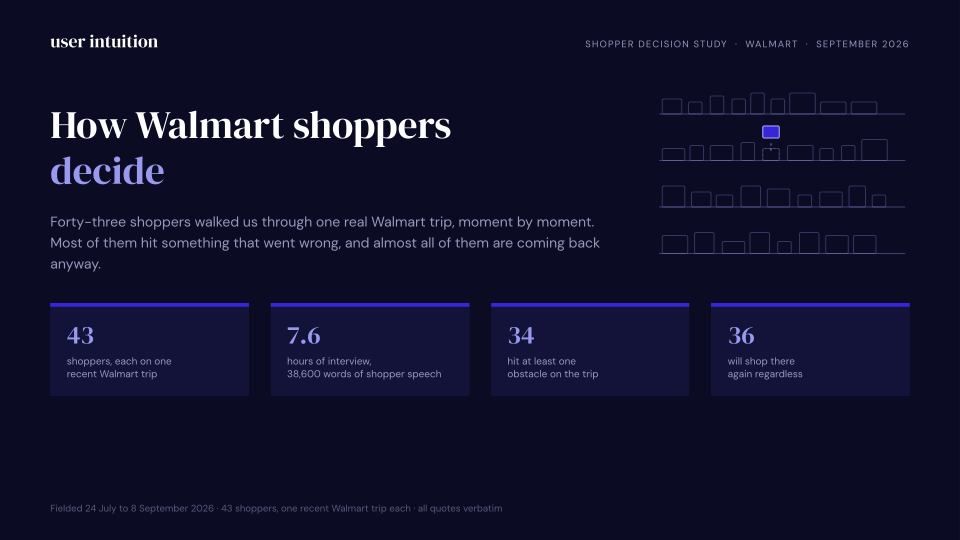
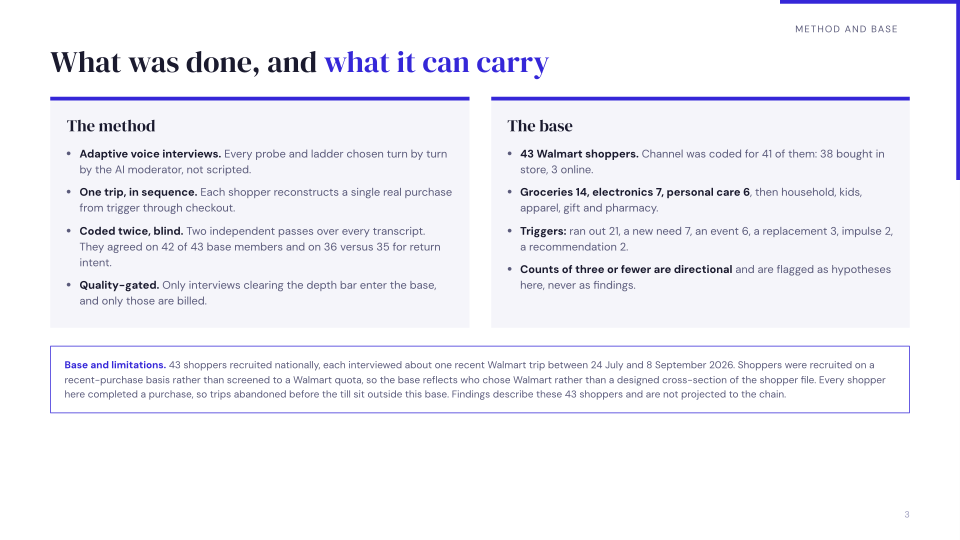
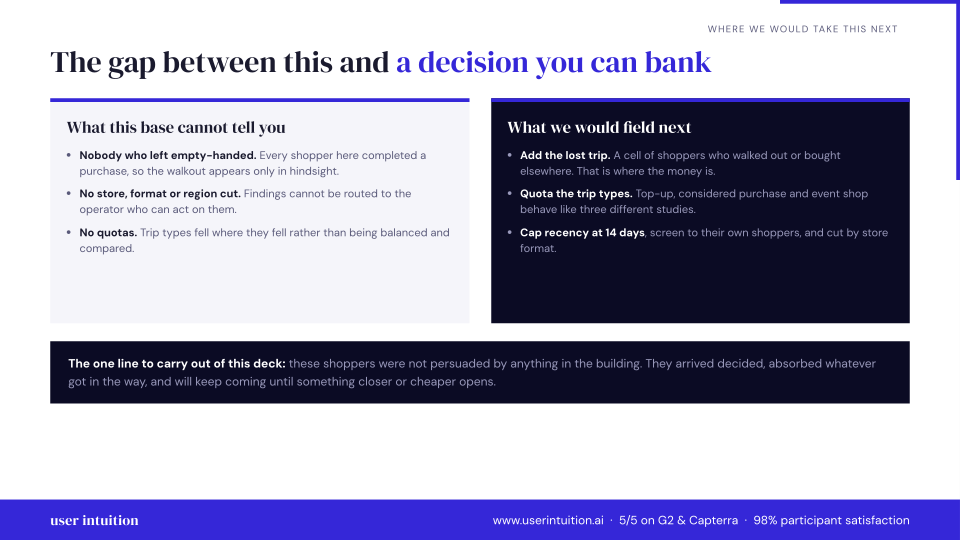
Explore calls and a sample presentation from our 43-participant Walmart shopper study.
Grocery top-up, supercenter
“Basically, because we use those things all a lot We try to always have you know, certain things in the house at all times because we use them very frequently. So we don't like to run out of them.”
What was making you want those specific things right then? Beyond just being out? Was it about being able to make certain meals or something else?
Basically, because we use those things all a lot We try to always have you know, certain things in the house at all times because we use them very frequently. So we don't like to run out of them.
Phone replacement, unplanned and urgent
“It made me feel so safe so relieved, and it brightened my day.”
Sounds like you knew exactly what you want. A Google Pixel 6 Pro. What was it about that phone that made it the right choice for you, especially in that moment?
Yeah. Thank you. So the the the phone had a lot of features. I I heard friends were talking about this phone. So in terms of the camera setting, it can take pictures and refine them into good quality. It has its own internal scanner, like I don't need to download other apps to scan to do scans. And of course, it has high quality for recording, which has been helping me in my meetings. In the office. So it's really amazing, and I love festival the quality of the phone in terms of the camera, because the previous phone I had was a Samsung. And the quality was really frustrating. And it had it has a very good processor speed as well. It's very fast. It's very efficient, and I like it. I like it. I'm enjoying the features.
Sample presentation
Preview three slides, or download the full 15-slide presentation.
Bring your own sample
$30 per quality voice interview
Use our 4M+ vetted panel
$60 per quality voice interview
What researchers say
"A broad consumer study fills almost immediately, but the last time we screened for a specific category buyer it took a few extra days to recruit. They tell you that going in, and since we only pay for the interviews that pass quality, I don't mind the wait."
"Broad U.S. grocery study asked for forty and filled in a few hours. I was skeptical an AI would dig past "I like it." It did. Project pricing also meant I didn't need an annual platform fight just to pilot."
Where your participants come from
The platform rate never changes. What changes is what it costs to reach the person.
| Lane | Recruiting cost | How it's set |
|---|---|---|
| Your own audience | $0 | No recruiting — bring your customers, prospects, or list |
| Consumer panel | $30 per participant | Flat, no markup |
| Specialty & B2B | $50–$500 per interview | Quoted per audience, no markup |
Recruiting is passed through with no markup on every lane. On the consumer panel, $30 per participant covers the incentive, screening, and fraud prevention.
How incidence rate sets your lane and timeline
| Incidence rate | Lane | Timeline |
|---|---|---|
| Under 10% | Specialty & B2B — recruited to order, quoted per audience | Quote within 24 hours, then fielding |
| 10–20% | Consumer panel, $30 per participant | Longer fielding than standard |
| Above 20% | Consumer panel, $30 per participant | First results within 24 hours of launch |
Specialty and B2B audiences are quoted per audience: send your criteria and we'll come back with a quote and feasibility within 24 hours.
Frequently Asked Questions
Related resources
Pillar Guides
Deep-dive guides covering this topic from strategy to execution.
Tools & Tactics
Practical frameworks and platform-specific guides for teams ready to act.
Reference Guides
Reference deep-dives on methodology, best practices, and applied research.
Alternatives & Comparisons
Side-by-side comparisons with competing platforms and approaches.
Related Solutions
Complementary research use cases that pair with this topic.
Recruit the Right Consumers for Research and Interview Them in the Same Workflow
Use one system for consumer panel access, screening, interviews, and evidence-backed analysis instead of splitting recruiting and fieldwork apart.
Consumer panel access, participant screening, interviews, and traceable findings in one workflow.