
Reduce churn by hearing why customers actually left
Stop guessing why customers leave from exit survey checkboxes. Run 30-minute AI-moderated conversations that surface trust erosion, onboarding gaps, and value perception shifts.

From individual interviews to a clearer picture.
Exit surveys over-attribute churn to 'price.' AI-moderated interviews surface the real drivers — trust erosion, onboarding gaps, value-perception shifts — that a checkbox never captures. The gap is where retention is won and lost...
Trusted by teams at






An AI churn analysis platform is software that interviews customers who downgraded or cancelled — within days of the decision — and turns those conversations into evidence on what actually drove them out. User Intuition is churn analysis software powered by AI-moderated interviews, running exit conversations while the experience is still fresh and surfacing the workflow, pricing, and trust signals that exit surveys miss. Across 723 AI-moderated churn interviews with SaaS and subscription businesses, User Intuition found the exit-survey reason matched the root cause less than a third of the time. The real drivers were trust erosion during onboarding, value gaps after month three, and missing integrations — none visible in a single exit-survey checkbox. A User Intuition churn study starts at $150, returns ranked drivers in 24 hours, and is backed by 4.9/5 on G2 and 5/5 on Capterra. The output is practical: ranked churn drivers by segment, recovery hooks for at-risk customers, and product priorities for retention, customer success, and growth teams.
Your exit surveys are lying to you —
and your churn rate proves it
You have exit surveys, NPS scores, and churn prediction tools. Yet customers keep leaving for the same reasons quarter after quarter. The data isn't the problem, the depth is. Build a retention playbook that compounds.
Exit Surveys Capture the Excuse, Not the Cause
5-15% response rates. Customers select 'price' or 'missing features' because it's fast and socially comfortable. The real reason — they felt unheard six months ago, their champion left, onboarding failed them, or your product stopped fitting their evolving workflow — never gets recorded.
NPS Measures Sentiment but Can't Prevent Churn
Your NPS might sit at 45 while you lose 8% annually. Medallia and Qualtrics are built for sentiment tracking — they cannot probe the 'why behind the why.' A score tells you a customer is at risk. It does nothing to explain the mechanism driving them out or the specific intervention that would reverse it.
Prediction Tools Tell You WHO, Not WHY
ChurnZero and Gainsight flag at-risk accounts based on usage signals. They cannot tell you whether declining engagement reflects product-fit erosion, a competitive evaluation, an internal reorganization, or a fixable workflow problem. You're guessing at interventions — and burning CS capacity on the wrong ones.
CS Teams Lack Scale, Consistency, and Objectivity
Your CSMs might conduct 10-20 exit calls per quarter — with different questions, conscious bias toward defending their own work, and no time to interview 50+ churned customers systematically. Manual exit interviews produce anecdote, not intelligence. And they'll never surface the pattern that crosses account owner boundaries.
Traditional Research Firms Take 6-8 Weeks and Cost $45K+
By the time a research firm delivers findings, 50 more customers have churned for the same preventable reason. At $1,500-$2,000 per interview, a 30-customer study costs $45K-$60K — prohibitive for quarterly retention programs at mid-market ARR levels. One-off studies don't compound. Continuous programs do.
How does User Intuition surface the real reason customers leave?
User Intuition interviews churned and at-risk customers, probing beyond an exit-survey checkbox into the actual cause. Bring your own customers and preserve your methodology, then inspect the conversations behind each finding in a searchable Intelligence Hub.
The cause, not the excuse
User Intuition runs 30-minute AI-moderated conversations that ladder past the fast, socially comfortable 'price' checkbox to the trust break, onboarding gap, or workflow drift that actually drove the customer out.
The mechanism and the fix, not just a score
Adaptive 5-7 level laddering uncovers the why behind the why, so you get the specific mechanism driving customers out and the intervention that reverses it, not an NPS number that flags risk and explains nothing.
The WHY behind the at-risk flag
When prediction tools flag who is at risk on usage signals, User Intuition interviews those customers directly to tell you why, separating fixable onboarding gaps from competitive evaluations so CS spends capacity on interventions that change outcomes.
Scale, consistency, and objectivity CS can't reach
Run 50, 100, or 200+ churned-customer interviews with identical methodology and no account-owner bias, surfacing the patterns that cross CSM boundaries instead of the anecdotes 10-20 manual exit calls a quarter produce.
Continuous and affordable, not a six-week one-off
Starter voice interviews cost $30 with your own customers and no monthly fee. Run focused studies after cancellations and compare the findings across segments and renewal cycles.
From churn signal to retention playbook
Design The Study
Define your churn cohort — churned, at-risk, or renewal-window customers — and your retention hypotheses. Our AI builds the discussion guide, screener, and recruitment timeline around your specific churn drivers.
AI Conducts the Conversations
Each participant completes a 30-minute AI-moderated voice interview exploring the emotional narrative behind their departure. The AI adapts in real time, probing deeper on trust breaks, value erosion, and exit triggers.
Get Evidence-Backed Results
Receive a structured retention playbook with quantified churn drivers, ranked root causes, verbatim customer quotes, and segment-level intervention recommendations traceable to specific conversations.
Create Compounding Intelligence
Every churn study feeds your searchable intelligence hub. Track driver trends quarter over quarter, validate whether retention interventions worked, and re-mine past interviews when new churn patterns emerge.
Real-world applications
for Churn Analysis & Retention Research
Post-Cancellation Deep-Dive Interviews
Interview 30-50 churned customers within days of cancellation. AI-moderated conversations with 5-7 levels of laddering trace the full trajectory from satisfied to departed — uncovering the tipping point, the trust break, and the intervention that could have saved them — built on our qualitative research at scale methodology. Get structured findings with verbatim customer quotes as interviews complete. Stop diagnosing last quarter's churn with this quarter's guesses.
At-Risk Account Deep-Dives
Your prediction tool flags 200 at-risk accounts. Interview 40-60 before they cancel. Understand what's driving hesitation, which objections are fixable, and what retention offer would actually land. AI-moderated conversations surface whether the risk is a fixable onboarding gap, a feature misalignment, or a structural product-fit issue — so CS deploys resources where they actually change outcomes. Proactive churn prevention beats reactive firefighting every time.
Cohort-Level Churn Pattern Analysis
Enterprise customers churn for different reasons than SMB. Product-led signups differ from sales-led. Q1 cohorts differ from Q3. Run segment-specific studies quarterly and let the Intelligence Hub surface the patterns — which drivers are trending, which interventions are working, and which segments are newly at risk. Build retention playbooks that reflect segment reality, not averages that apply to no one.
Competitive Defection Analysis
Customers switching to a specific competitor signal something systematic. Interview 20-30 defectors to identify exactly what the competitor is offering, which of your gaps they're exploiting, and what messaging or product response would close the defection rate. Unlike generic exit surveys, AI-moderated interviews probe the actual evaluation — what the competitor promised, what the buyer believed, and what your team never addressed.
Renewal-Window Retention Intelligence
90 days before your largest renewal cohort, interview customers showing hesitation signals. Understand what would make them renew versus evaluate alternatives — before they start an RFP. Build targeted retention campaigns grounded in what buyers actually care about at renewal. One study. Multiple renewal conversations saved.
Cross-Team Retention Alignment
CS gets intervention playbooks with verbatim customer language. Product gets prioritized fix lists backed by customer evidence. Marketing gets repositioning briefs for at-risk segments. RevOps gets churn driver trend data to model future risk. One churn study. Every retention-relevant team moves on the same ground truth — instead of arguing about whose version of 'why customers leave' is correct.
Why churn interviews beat exit surveys, NPS, and CS calls
| Dimension | User Intuition | Exit Surveys / NPS Tools / Manual CS Calls |
|---|---|---|
| Research Method | 30-min AI conversation · emotional laddering | Exit survey checkboxes or variable CS exit calls |
| Response Rate | 90%+ via scientifically recruited panel | 5-15% (exit surveys); 10-20 calls/quarter (CS teams) |
| Interview Depth | 5-7 laddering levels · uncovers why behind the why | Surface reasons — what churned customers tick in 2 minutes |
| Emotional Drivers | Naturally surface through consistent laddering | Rarely captured (surveys); inconsistent (manual calls) |
| Turnaround | 24–48 hours for many studies; customer availability affects timing | Instant but shallow (surveys); 6-8 weeks (research firms) |
| Study Cost | From $150 — no monthly fees, no retainer | $45K-$60K (research firms); opaque SaaS fees (NPS tools) |
| Bias Level | Low · consistent AI, no vendor dynamic | High (CS defending their work); variable (consultants) |
| Scale | Run interviews in parallel across customer segments | CS teams cap at 10-20/quarter; surveys lack depth |
| Participant Satisfaction | 98% participant satisfaction rate across all studies | Not measured; churned customers resent survey friction |
| Intelligence Compounding | Searchable Intelligence Hub — trends surface automatically | Static PDF per study — no institutional memory |
| Actionability | Specific interventions traceable to customer quotes | Generic categories: Price, Features, Support |
How does User Intuition compare to other AI-moderated interview tools?
Easier setup
Brief in, study live in five minutes. No discovery workshop, no kickoff cadence. Competitors typically require a 30–60 minute onboarding call.
Faster fieldwork
User Intuition owns a 4M+ verified panel for consumer and broad-buyer audiences, and recruits specialty and B2B audiences to order. Competitors lean on third-party recruiters or make you bring your own.
Deeper insights
Adaptive 5–7 level laddering on every response — the same probing technique a senior qualitative researcher uses. Most AI moderators stop at one or two follow-ups before moving on.
Lower risk
Every interview is auto-scored against your brief on length, depth, and coverage. Conversations that miss the bar aren't charged. No refund request required, no manual review.
Why Do Exit Surveys Lie — and Why Do AI-Moderated Churn Interviews Outperform Every Alternative?
Exit surveys get the excuse. NPS tools get the score. Manual CS calls get the rep's reconstruction. AI-moderated churn interviews get the truth — at scale, in 24 hours, at a price mid-market CS teams can sustain quarterly. Here's why the methodology difference produces fundamentally different outcomes.
AI-Moderated Interviews Excel At
- Uncovering the emotional narrative behind cancellation through 5-7 level laddering
- Eliminating CS bias — churned customers speak openly without a vendor-employee dynamic
- Consistent methodology across 10 or 200 interviews in the same study
- 24-hour turnaround — act on churn intelligence while it's still preventable
- Scaling quarterly programs at mid-market ARR without research firm budgets
- 24/7 scheduling for churned customers across time zones
- Evidence traceable to specific customer quotes — not analyst interpretation
- 98% participant satisfaction rate — churned customers actually complete and value the conversation
- Cross-study Intelligence Hub that tracks driver trends and validates interventions over time
Consider Human Moderation For
- High-value enterprise account save conversations requiring personal rapport
- Emotionally charged service failure debriefs needing human empathy
- Relationship recovery conversations where diplomacy is critical
- Multi-stakeholder interviews involving CFO, CTO, and Ops simultaneously
- Sensitive topics where customers need to process frustration with a person
- Strategic executive churn interviews requiring executive presence and improvisation
N=723 AI-moderated churn interviews on User Intuition (2024-2026), using 5-7 level laddering (Gutman 1982) to uncover the drivers exit surveys miss. Read Why your exit survey is lying to you.
"I don't need to involve a research team to get a study in market. I can set one up myself, have it fielded the same week, and share results with my leadership team before our next planning meeting. That's a completely different operating tempo than what we had before."
 Eric O., Chief Commercial Officer, Turning Point Brands
Verified review on Capterra
Eric O., Chief Commercial Officer, Turning Point Brands
Verified review on Capterra "We thought most of our churn happened because of price and in fact we'd heard it 90% of the time. The follow-up questions from User Intuition uncovered that most of those customers never connected a datasource so didn't see much value from our product. We're now actively solving cancels and downgrades by focusing on the integration steps instead of discounting."
Hear the interviews. See the presentation.
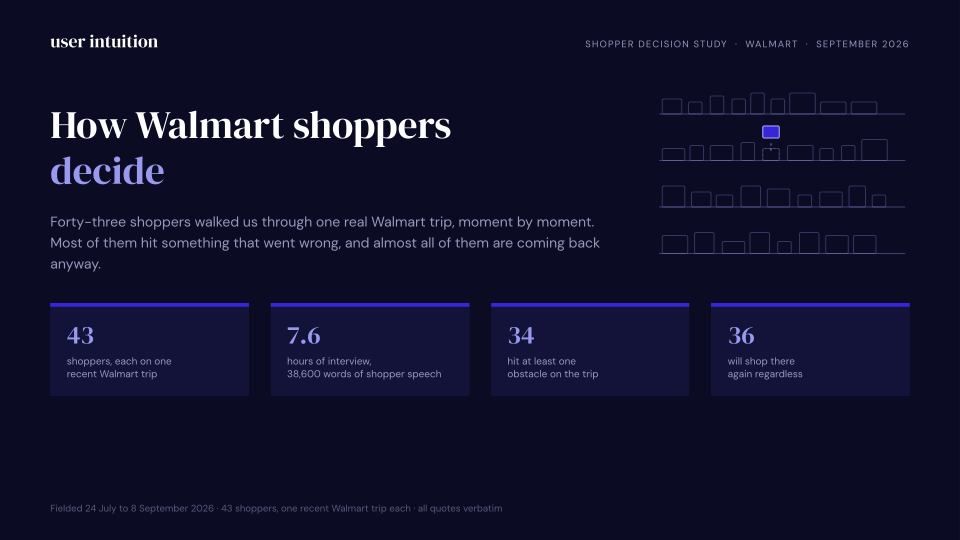
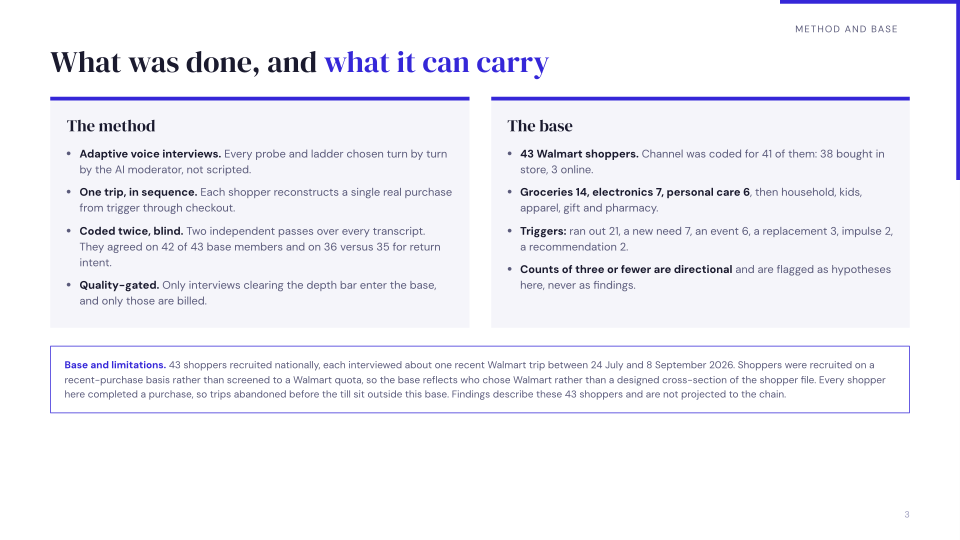
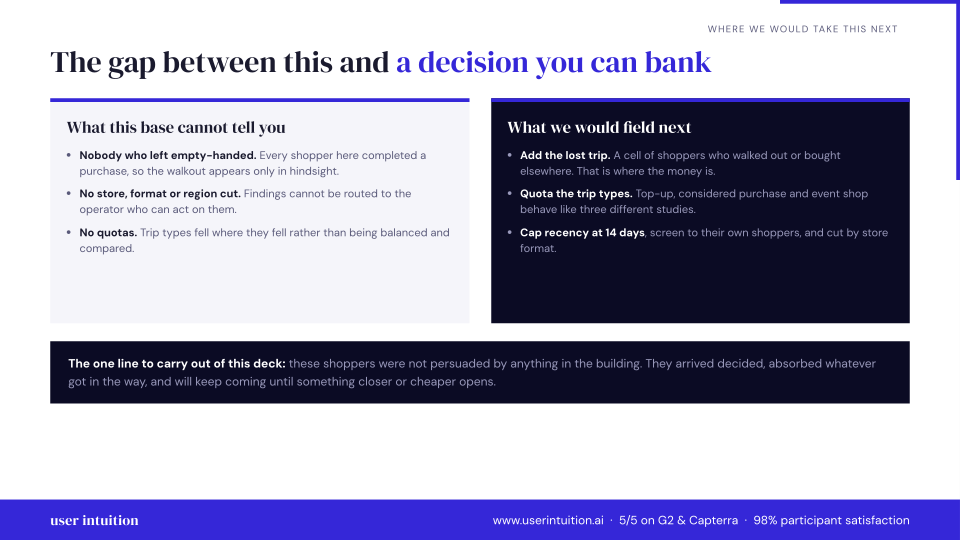
Explore calls and a sample presentation from our 43-participant Walmart shopper study.
Grocery top-up, supercenter
“Basically, because we use those things all a lot We try to always have you know, certain things in the house at all times because we use them very frequently. So we don't like to run out of them.”
What was making you want those specific things right then? Beyond just being out? Was it about being able to make certain meals or something else?
Basically, because we use those things all a lot We try to always have you know, certain things in the house at all times because we use them very frequently. So we don't like to run out of them.
Phone replacement, unplanned and urgent
“It made me feel so safe so relieved, and it brightened my day.”
Sounds like you knew exactly what you want. A Google Pixel 6 Pro. What was it about that phone that made it the right choice for you, especially in that moment?
Yeah. Thank you. So the the the phone had a lot of features. I I heard friends were talking about this phone. So in terms of the camera setting, it can take pictures and refine them into good quality. It has its own internal scanner, like I don't need to download other apps to scan to do scans. And of course, it has high quality for recording, which has been helping me in my meetings. In the office. So it's really amazing, and I love festival the quality of the phone in terms of the camera, because the previous phone I had was a Samsung. And the quality was really frustrating. And it had it has a very good processor speed as well. It's very fast. It's very efficient, and I like it. I like it. I'm enjoying the features.
Sample presentation
Preview three slides, or download the full 15-slide presentation.
Bring your own sample
$30 per quality voice interview
Use our 4M panel
$60 per quality voice interview
Common questions
Understand why customers leave.
Know what to change.
See how B2B SaaS CS and product teams run continuous churn interview programs that surface the patterns exit surveys miss — and build the retention intelligence that compounds quarter after quarter.
Start with an editable research brief. Review your plan and discussion guide before inviting participants.
Inspect the interview evidence and map a retention research program to your customer segments and renewal calendar.
Your methodology · Your sample · No monthly fee on Starter
Go deeper on Churn Analysis & Retention Research
Pillar Guides
Deep-dive guides covering this topic from strategy to execution.
Tools & Tactics
Practical frameworks and platform-specific guides for teams ready to act.
Reference Guides
Reference deep-dives on methodology, best practices, and applied research.
Alternatives & Comparisons
Side-by-side comparisons with competing platforms and approaches.
Industries
See how teams in specific verticals apply this research.
Platform Capabilities
The platform features that power this type of research.
Last updated