.svg)
Features
User Intuition + Zapier: Connecting Voice Interviews to 8,000+ Apps
User Intuition's Zapier integration connects AI-powered voice interviews to more than 8,000 business applications.
Your 4.2 satisfaction score is hiding why customers actually buy, why they leave, and what they really need.
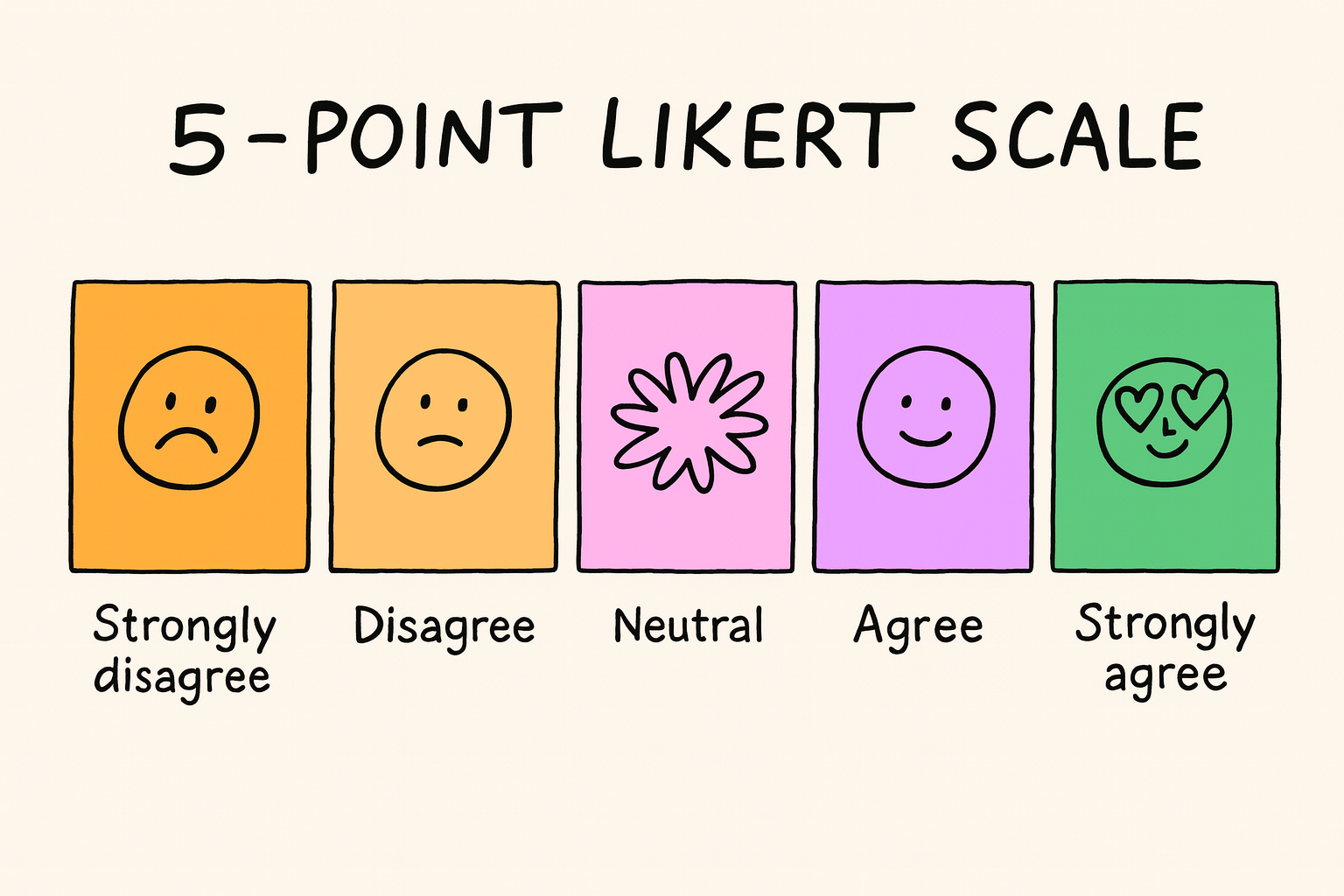
Sales teams accurately identify the primary decision factor in only 40% of losses. The other 60%? They're hidden behind comfortable 4-star ratings, polite exit surveys, and the systematic failure of Likert scales to capture why customers actually buy.
Last quarter alone, companies using traditional satisfaction metrics were blindsided by $2.3 billion in preventable churn—all from customers who rated their experience "above average." These weren't unhappy customers. They were customers whose actual decision drivers remained invisible behind the numerical facade of satisfaction scores.
Here's the uncomfortable truth: while you're celebrating that uptick from 4.1 to 4.2 in your quarterly board deck, your competitors are having actual conversations with customers, uncovering the decision architecture that drives purchasing behavior, and adjusting their strategy based on insights you don't even know you're missing.
When Rensis Likert introduced his scale in 1932, he solved a real problem. For the first time, we could quantify attitudes. We could track opinions over time. We could make subjective feelings objective enough to put in a spreadsheet.
Fast forward to 2025: every customer touchpoint triggers a rating request. Every interaction demands a score. We've built entire industries around Net Promoter Scores, Customer Satisfaction indices, and star ratings. Fortune 500 companies make million-dollar decisions based on movements of 0.1 points in their satisfaction metrics.
But here's what happened: in our quest to make everything measurable, we made the fatal assumption that measurable meant meaningful.
The average enterprise now collects 50% more survey data than five years ago. Yet product-market fit is harder to achieve, customer churn remains stubbornly high, and sales teams still lose 60% of their pipeline to "no decision" outcomes. We're drowning in numbers while thirsting for insight.
The industry doesn't like to talk about this: survey response rates have crashed to 15-20%. When you celebrate that 4.3 satisfaction score, you're actually celebrating the opinions of the small minority of customers who were either thrilled enough or angry enough to respond. The silent majority—the ones whose feedback would actually help you improve—have opted out entirely.
Think about that. You're making strategic decisions that affect 100% of your customers based on feedback from 15% of them. And not a random 15%—the self-selected extremes who don't represent your typical user experience.
The average enterprise purchase now involves 11 stakeholders, takes 6 months, and navigates organizational dynamics that would make a soap opera writer jealous. Your champion rates you 5 stars. The skeptical procurement lead gives you 2. The end users who wanted your competitor average 3. The IT team checking security compliance doesn't even respond to the survey.
Blend those together and you get a meaningless 3.3 that predicts nothing, explains less, and sends your resources chasing shadows instead of solving real problems.
According to Gartner's 2024 B2B Buying Study, 77% of B2B buyers describe their latest purchase as "extremely complex or difficult." Yet we're trying to understand these intricate journeys through the lens of "How satisfied were you on a scale of 1-5?"
Research from the Journal of International Business Studies reveals a troubling reality: satisfaction scales mean different things in different cultures. Americans use the full range of responses. Germans cluster around the middle. Japanese respondents systematically avoid extremes. Mediterranean customers rate higher on average, while Nordic customers rate lower—not because of experience differences, but because of cultural response patterns.
Your Mumbai team might be delivering exceptional service that gets 3s. Your Mexico City team might be underperforming with 4s. The Likert scale doesn't just obscure the truth—it actively misleads you about global performance.
Here's what traditional research doesn't want you to know: customer memory degrades rapidly. Studies from behavioral psychology show that accurate recall of experience details drops by 50% within 48 hours. By the time your quarterly satisfaction survey reaches customers 6-8 weeks after their interaction, they're not reporting their experience—they're reporting their vague memory of their general feeling about your brand.
Modern conversational AI can capture feedback within 48 hours while memories are fresh, emotions are real, and the specific details that drive decisions are still accessible. Traditional surveys arriving weeks later capture shadows and impressions, not actionable truth.
Customer decisions aren't made on satisfaction scales. They emerge from complex decision architectures involving multiple stakeholders, competing priorities, organizational politics, and timing factors that a 1-5 rating will never capture.
When you lose a deal, it's not because your satisfaction score was 3.8 instead of 4.2. It's because:
None of this shows up in a Likert scale. All of it determines who wins and who loses.
Using laddering methodology refined through McKinsey Fortune 500 engagements, modern AI interviewers can systematically move from surface-level satisfaction to the underlying decision architecture that actually predicts behavior.
Instead of "How satisfied were you with our sales process?" (Answer: 4), conversational AI asks:
These conversations reveal the actual leverage points for winning and retaining customers. Not satisfaction levels—decision drivers.
Remember that statistic about sales teams only identifying the real loss reason 40% of the time? This gap exists because traditional feedback mechanisms are designed to be polite, not revealing. Customers give socially acceptable responses to surveys: "Price was too high" or "Went with the incumbent."
But conversational AI gets different answers. Without the social pressure of a human interviewer, customers share the messy truth:
This is the difference between collecting feedback and understanding decisions.
Traditional qualitative research takes 6-8 weeks and costs $27,200 for 20 interviews. The same depth through conversational AI: $1,000 and 48 hours. That's not just iteration—that's transformation.
When product teams can test concepts in 48 hours instead of 6 weeks, they can actually iterate based on customer feedback instead of internal assumptions. When sales teams can understand why they lost yesterday's deal by Monday's pipeline review, they can adjust tactics while the market is still relevant.
The breakthrough of conversational AI isn't just speed—it's the ability to maintain quality at scale. Where traditional research might interview 20 customers quarterly, AI can interview 200 customers continuously, achieving statistical significance without sacrificing conversational depth.
This scale reveals patterns invisible in small samples:
Here's the counterintuitive finding that changes everything: customers report 98% satisfaction with AI interviews—higher than human interviewers. And they share 40% more critical feedback.
Why? Without the social dynamics of human conversation—the need to be polite, the fear of judgment, the interviewer's unconscious reactions—customers feel free to share what they really think. The AI doesn't flinch when they criticize your product. It doesn't get defensive when they praise your competitor. It just keeps asking thoughtful follow-up questions.
This combination—higher satisfaction and more critical feedback—is the holy grail of customer research. Customers enjoy the experience while providing the harsh truths you need to hear.
Traditional approach: Send a survey to lost prospects. Get a 15% response rate. Learn that "price" and "features" were issues. Make no meaningful changes.
Conversational AI approach: Within 48 hours of a loss, while memories are fresh and emotions are real, AI interviewers are uncovering the three meetings where the deal actually died—not the polite excuse given to sales. Response rates exceed 60% because the conversation happens when the experience is still relevant.
Output: "Enterprise deals are failing at the security review stage when our champion can't answer questions about SOC 2 Type II compliance timeline. Here's the specific language successful deals use to navigate this objection, and here's what the CFO needs to hear to approve budget allocation despite the security review pending."
Traditional approach: Exit survey with satisfaction ratings. Learn that churned customers averaged 3.2 satisfaction. No actionable insights.
Conversational AI approach: Structured conversations that trace the entire journey from initial excitement through growing frustration to final departure. The AI explores specific moments, decisions, and tipping points.
Output: "Customers who churn share three common patterns: they don't achieve initial value within 14 days, they contact support more than twice in the first month, and they never activate our integration features. Here's the specific language they use when describing their frustration, and here's what would have saved them."
Traditional approach: In-app ratings and occasional user surveys. Get feature request lists with no context.
Conversational AI approach: Contextual conversations at key moments in the user journey. The AI explores not just what users want, but why they want it, what problem they're trying to solve, and what success looks like for them.
Output: "Users aren't actually asking for more features—they're struggling to discover the capabilities we already have. The mental model they bring from competitor products causes them to look in the wrong places. Here's how they describe what they're trying to accomplish, and here's the navigation pattern that would match their expectations."
Here's what makes conversational AI fundamentally different: you can have the same conversation topics at different time periods without the repetitiveness of surveys. Each conversation feels fresh and contextual to the participant, while you get consistent longitudinal data.
Quarter 1: Understand baseline decision criteriaQuarter 2: Measure how competitive positioning has shiftedQuarter 3: Track whether your new narrative is resonatingQuarter 4: Validate that improvements are changing perceptions
Same insights framework, completely different conversation each time. No survey fatigue. No memorized responses. Just authentic dialogue that evolves with your business.
User Intuition doesn't just collect feedback faster—we fundamentally change what's possible in customer understanding. Our AI interviewers conduct natural conversations that adapt to each participant, probe systematically deeper using proven laddering techniques, and capture the full context of customer experiences.
Within 48 hours of any customer event—a closed deal, a churn, a support ticket, a product milestone—our AI can engage in meaningful dialogue that uncovers not just what happened, but why it happened and what it means for your business.
Our approach comes from McKinsey-influenced methodology proven with Fortune 500 companies. This isn't technology looking for a problem—it's proven research methodology enhanced by AI capabilities.
Every conversation follows rigorous qualitative research principles:
The result: insights that meet the quality standards of traditional research while delivering at the speed and scale of modern business.
Raw conversations are just the beginning. User Intuition transforms dialogue into decisions through:
Instead of "Customer satisfaction: 4.2/5," you get: "Three specific integration concerns are blocking enterprise deals in the security review phase. Here's the exact language that successful deals use to address these concerns, and here are the proof points that resonate with technical evaluators."
Don't try to revolutionize everything at once. Pick the one area where understanding "why" would most change your strategy:
Run conversational research alongside your existing metrics for one quarter. The contrast will be stark.
The value of conversational research isn't abstract—it's measurable:
Traditional satisfaction survey insight: "Customers want better onboarding"Cost of acting on this: Redesign entire onboarding flow, hope it helps
Conversational AI insight: "Customers expect to see value in the first session but don't achieve it until day 12 because they can't find the integration settings"Cost of acting on this: Move one button, measure immediate impact
The specificity of conversational insights means smaller, targeted improvements with measurable outcomes. You're not guessing what might help—you know exactly what will.
Moving from Likert scales to conversations requires new capabilities:
This isn't just a technology shift—it's an evolution in how organizations understand and respond to customers.
While most companies still celebrate marginal improvements in their NPS scores, a vanguard of organizations has already made the shift. They're having thousands of customer conversations monthly, understanding decision architectures instead of satisfaction levels, and adjusting strategy based on insights captured within 48 hours, not quarters.
These companies aren't just collecting better feedback—they're building fundamentally different relationships with their markets. They know why customers buy, why they leave, and what they need before customers themselves can articulate it clearly.
The question isn't whether conversational AI will replace satisfaction surveys. That shift is already happening. The question is whether you'll lead that transformation in your market or be disrupted by competitors who do.
That 4.2 satisfaction score on your dashboard? It's not just incomplete—it's actively misleading you. It's hiding the security concerns that will lose your next enterprise deal. It's obscuring the onboarding friction that will drive next quarter's churn. It's masking the competitive narrative that's already winning in the market.
Every day you continue optimizing for higher satisfaction scores instead of deeper customer understanding is a day your competitors get further ahead. They're not tracking satisfaction—they're understanding decisions. They're not measuring happiness—they're uncovering the architecture of choice.
The death of the Likert scale isn't coming. It's here. The only question is whether you'll acknowledge it before or after it costs you your market position.
Ready to understand what your satisfaction scores are hiding? User Intuition helps teams have meaningful conversations with customers at scale - delivered in 48 hours, not 6 weeks. Discover why User Intuition achieves a98% participant satisfaction while uncovering 40% more critical feedback are winning in their markets.