.svg)
Features
User Intuition + Zapier: Connecting Voice Interviews to 8,000+ Apps
User Intuition's Zapier integration connects AI-powered voice interviews to more than 8,000 business applications.
Organizations lose 70% of qualitative research value within 18 months. Here's how to choose tools that build lasting intelligence
Consider a troubling statistic: organizations lose an estimated 70% of their qualitative research value within 18 months of collection. This happens not because the insights become less relevant, but because they become functionally inaccessible. Filed in forgotten folders, trapped in departed employees' memories, or buried in project-specific repositories, hard-won customer understanding simply evaporates from organizational consciousness.
This insight attrition represents one of the most significant yet overlooked inefficiencies in modern business. When a product team conducts user research in January that could directly inform a marketing initiative in September, but no one remembers it exists, the organization has effectively paid for that research twice. Multiply this pattern across hundreds of studies and dozens of teams, and the cumulative waste becomes staggering.
The challenge has intensified as qualitative research itself has expanded. What once meant a handful of focus groups per quarter now encompasses continuous user interviews, voice-of-customer programs, win-loss analyses, and ongoing customer advisory interactions. Organizations generate more qualitative insight than ever before, yet retain less of it in usable form.
The fundamental problem lies in how organizations approach qualitative data management. Most treat it as a filing problem when it is actually a knowledge architecture problem. Documents get stored, but insights remain unconnected. Individual studies exist in isolation, unable to inform one another or reveal patterns that only emerge across multiple research efforts.
Traditional approaches to qualitative insight storage fall into several categories, each with distinct limitations. Understanding these limitations is essential for organizations seeking to maximize the long-term value of their research investments.
Platforms like Dovetail have emerged to address the growing volume of qualitative research data. These tools provide centralized storage for interview transcripts, user research notes, and video recordings. They offer tagging capabilities, search functions, and organization features designed specifically for UX and customer research teams.
Dovetail and similar repository platforms represent a genuine improvement over scattered file storage. They acknowledge that qualitative research requires specialized management approaches different from general document storage. Researchers can tag insights, create collections, and theoretically make findings discoverable across the organization.
However, these platforms face an inherent structural limitation: they are archives, not engines. Every piece of data in the system must be manually collected through separate research efforts, then uploaded and organized. The repository itself cannot generate new insights or conduct research. It merely stores what humans have already gathered and processed.
This creates two significant constraints. First, the insight accumulation rate depends entirely on manual research throughput. Organizations cannot accelerate learning without proportionally increasing human research effort. Second, the repository remains essentially static between active research periods. No new understanding emerges unless someone conducts additional studies and adds the results.
For organizations conducting periodic research projects, this model can work adequately. But for those seeking continuous customer understanding, the manual dependency becomes a bottleneck. The repository captures what happened but cannot keep pace with evolving customer needs or market dynamics.
EnjoyHQ, now integrated into the UserZoom platform, represents another approach to qualitative insight management. These platforms focus on aggregating research findings from multiple sources, creating a unified view of customer understanding across studies and methodologies.
The aggregation model addresses the fragmentation problem directly. Instead of insights scattering across different tools and team folders, everything flows into a central system. This consolidation creates genuine value for organizations struggling with research silos.
Yet aggregation platforms share the fundamental limitation of pure repositories. They excel at organizing research that already exists but contribute nothing to generating new research. There is no integrated capability for conducting voice interviews, no AI-powered data collection, no mechanism for the platform itself to gather fresh customer perspectives.
This means the system's value depends entirely on the research volume that external processes produce. If an organization's research capacity constrains their insight generation, the aggregation platform cannot help. It remains a downstream tool, valuable for organization but unable to influence the upstream flow of customer understanding.
Many organizations, particularly those without dedicated research operations, default to general-purpose knowledge management platforms. SharePoint sites, Confluence spaces, and internal wikis become de facto repositories for customer insights, alongside product documentation, meeting notes, and operational procedures.
This approach offers apparent advantages: no additional software cost, familiar interfaces, and integration with existing workflows. Teams simply save their research outputs wherever they store other documents, applying the same organizational logic to customer insights as to everything else.
The inadequacy of this approach becomes apparent quickly. General knowledge management platforms lack any specialized capability for qualitative data. They cannot synthesize themes across studies, track sentiment evolution over time, or link related insights automatically. Search functions treat customer research the same as any other document, missing the contextual connections that give qualitative data its power.
Perhaps more importantly, insights scattered across generic systems suffer severe discoverability problems. When a product manager needs to understand customer perspectives on a specific pain point, they face the daunting task of searching through hundreds of documents with no confidence they have found everything relevant. In practice, most give up and simply conduct new research, perpetuating the cycle of redundant studies and wasted investment.
Traditional survey platforms like Qualtrics store substantial customer data, leading some organizations to view them as insight repositories. After all, these systems contain direct customer feedback, often in significant volume.
However, survey platforms fundamentally organize data by study rather than by insight. Each survey exists as a standalone dataset, analyzable in isolation but not designed to connect with other research efforts. The platform can tell you what customers said in a specific survey but cannot synthesize perspectives across multiple data collection efforts over time.
This study-centric architecture makes sense for survey methodology, where individual studies answer specific questions. But it prevents the cumulative knowledge building that maximizes qualitative research value. Last year's brand perception survey and this quarter's product feedback study exist as separate entities, even when common themes or connected insights span both.
The result is data abundance without knowledge accumulation. Organizations may conduct dozens of surveys annually yet struggle to articulate how customer perspectives have evolved or what patterns persist across research efforts.
A fundamentally different approach has emerged with platforms designed as customer intelligence systems rather than research repositories. These platforms integrate data collection, analysis, and knowledge management into unified systems where each research interaction automatically enriches the broader understanding.
User Intuition exemplifies this intelligence platform architecture. Rather than storing completed research, the platform functions as an active intelligence hub that captures and synthesizes customer insights continuously. Voice interviews conducted through the platform feed directly into a centralized repository, creating a searchable institutional memory that compounds with every conversation.
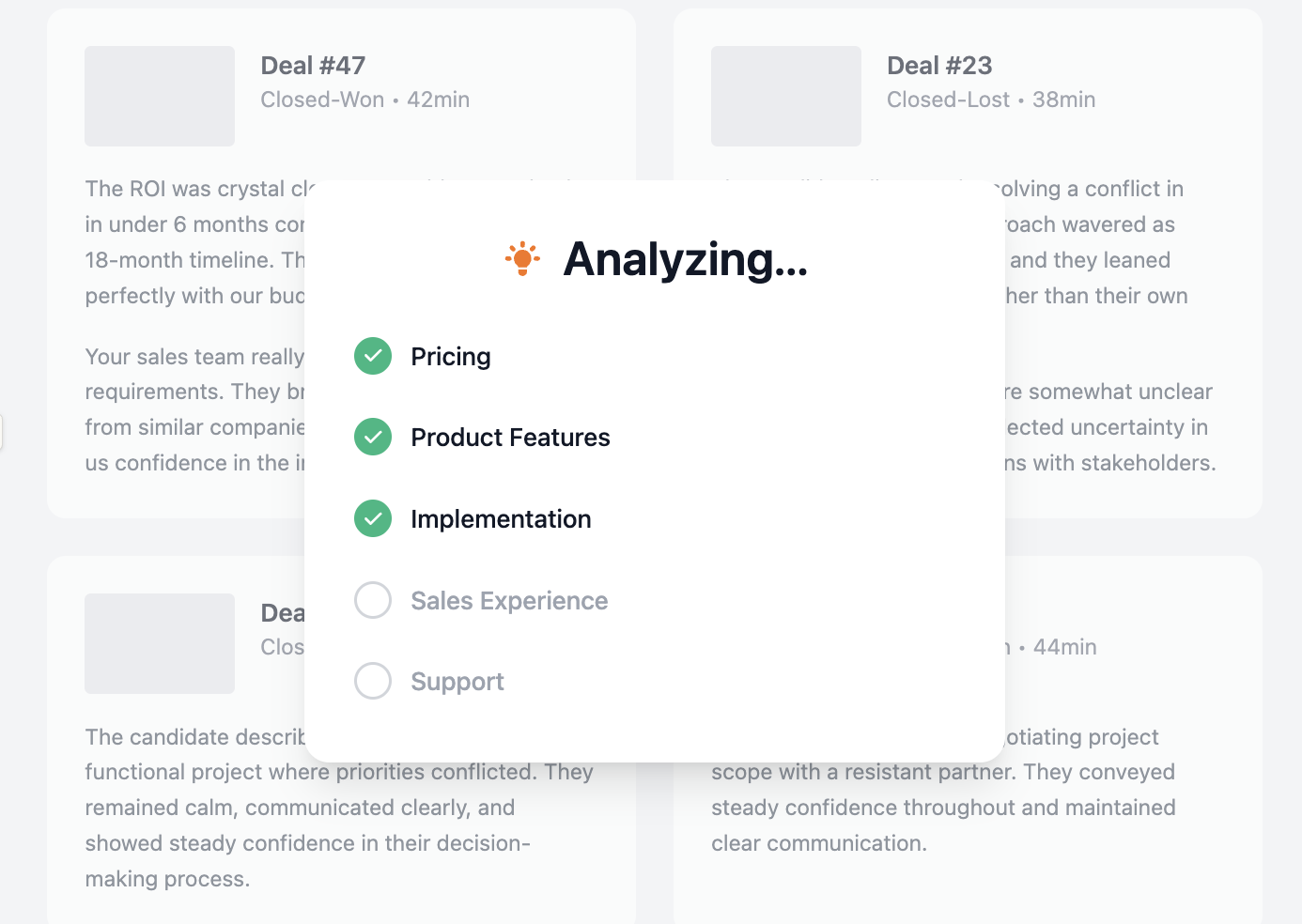
This integration eliminates the manual handoffs that constrain traditional approaches. When an AI interviewer conducts a customer conversation, the resulting transcript, identified themes, sentiment patterns, and key quotes flow automatically into the knowledge base. No uploading, no tagging, no organizational overhead. The insight generation and retention happen as a unified process.
The compounding effect proves particularly valuable over time. Each new interview not only yields its own findings but enriches the broader intelligence database. Patterns invisible in individual studies emerge across accumulated conversations. Teams can query not just what customers said recently but how perspectives have shifted, what themes persist, and how different segments vary in their views.
Cross-team accessibility represents another significant advantage. When insights flow automatically into a centralized, searchable system, sales teams can access product feedback, marketing can understand customer language patterns, and executives can query customer sentiment directly. The intelligence becomes an organizational asset rather than a research team artifact.
Organizations assessing tools for long-term qualitative insight retention should consider several key dimensions beyond basic storage capability.
Active versus passive knowledge accumulation distinguishes platforms that generate insights from those that merely store them. Passive systems depend entirely on external research processes for their content. Active systems contribute to insight generation, accelerating the accumulation rate and ensuring continuous knowledge growth.
Cross-study synthesis capability determines whether insights connect across research efforts. Can the platform identify that customers mentioned similar concerns in three different studies over two years? Can it track how sentiment on a specific topic has evolved? Systems lacking synthesis treat each study as isolated, limiting the strategic value of accumulated research.
Accessibility across teams shapes whether insights actually inform decisions. Research trapped in specialized tools that only researchers use delivers limited organizational value. Platforms designed for broad accessibility, with intuitive search and clear presentation, multiply the impact of every insight captured.
Real-time integration affects how quickly new research becomes discoverable. Systems requiring manual processing create lag between data collection and availability. Platforms with automatic integration ensure that yesterday's interview can inform today's decision.
Temporal analysis capability enables longitudinal understanding. Can the platform show how customer perspectives have changed over quarters or years? This dimension proves essential for strategic planning, competitive positioning, and tracking the impact of business initiatives on customer perception.
Beyond platform capabilities, organizations must consider how their chosen tools shape research methodology itself. Storage systems optimized for traditional research models may inadvertently perpetuate those models' limitations.
Traditional qualitative research assumes periodic, intensive studies. You conduct a dozen interviews, analyze them thoroughly, and file the results until the next study. Tools designed for this paradigm reinforce it, treating research as a series of discrete projects rather than a continuous process.
Intelligence platforms that integrate research generation with knowledge management enable fundamentally different approaches. When insights flow automatically into a cumulative system, research can become continuous rather than periodic. Organizations can maintain ongoing customer conversations that build understanding progressively, rather than conducting sporadic deep dives separated by information gaps.
This shift has profound implications for insight retention. Continuous research naturally produces more complete knowledge bases. The gaps between studies, where organizational memory typically fades, shrink or disappear entirely. Customer understanding stays current, and the accumulated intelligence reflects the full arc of customer perspective evolution rather than snapshots from occasional studies.
Organizations transitioning to more sophisticated insight retention approaches face practical implementation decisions. The most important is recognizing that tool selection shapes not just storage efficiency but research capability and organizational culture around customer understanding.
Starting with a pure repository may seem lower risk, but it commits the organization to a manual-dependent model that constrains future scaling. Every insight in the system requires human effort to generate and capture. As research needs grow, headcount must grow proportionally.
Intelligence platforms require greater initial commitment but offer sustainable scaling. The automated generation and capture capabilities mean that expanding research volume need not require proportional team growth. Organizations can increase customer conversation throughput without the linear cost increases that characterize traditional research.
Cultural adoption also differs significantly. Repository systems require researchers to maintain discipline around uploading, tagging, and organizing findings. This burden can lead to inconsistent usage and incomplete capture. Integrated platforms where insight retention happens automatically achieve more consistent participation and more complete knowledge bases.
Perhaps the most significant consideration in tool selection is the strategic value of cumulative intelligence versus project-based storage. Organizations that build true customer intelligence systems gain advantages that extend beyond operational efficiency.
Competitive differentiation increasingly depends on customer understanding depth. When rivals can match your products, match your pricing, and match your go-to-market strategies, intimate customer knowledge becomes a sustainable advantage. Intelligence platforms that accumulate insights over years create proprietary understanding that competitors cannot replicate.
Organizational resilience improves when knowledge exists in systems rather than solely in people. Employee turnover, the traditional enemy of institutional memory, matters less when customer intelligence is captured in searchable, accessible platforms. New team members can access years of customer perspective within days, accelerating effectiveness and preserving organizational learning through personnel changes.
Decision confidence increases when leaders can query accumulated evidence rather than relying on recent research or intuition. Strategic choices grounded in longitudinal customer intelligence carry different weight than those based on a single study or general impressions.
The tools organizations choose for qualitative insight retention determine not just how efficiently they store research but how effectively they learn from customers over time. Repository and aggregation platforms address the storage problem but leave knowledge accumulation dependent on manual processes and external research capacity. Generic systems prove inadequate for the specialized demands of qualitative data. Traditional survey platforms organize data by study rather than by insight, preventing cumulative understanding.
Intelligence platforms that integrate research generation with knowledge management represent a fundamentally different approach. By automatically capturing, synthesizing, and connecting insights across conversations, these systems enable cumulative learning that compounds over time. Organizations build proprietary customer understanding that becomes more valuable with each research interaction.
For organizations serious about maximizing the long-term value of their qualitative research investments, the question is not merely where to store insights but how to build systems where customer understanding grows continuously and remains accessible to inform every decision. The distinction between storage and intelligence may ultimately determine which organizations truly understand their customers and which merely study them periodically.
The most practical metrics include insight reuse rate (how often past research informs new decisions), time-to-insight for recurring questions (whether teams can find relevant historical data quickly), and research redundancy (how frequently teams conduct studies on topics already explored). Organizations with effective retention systems typically see 40-60% of new research questions answered or informed by existing intelligence, compared to under 10% for those relying on traditional storage approaches.
Research repositories store completed research and require manual input for every piece of data they contain. They organize and make searchable what humans have already gathered. Customer intelligence platforms integrate research generation with knowledge management, automatically capturing, analyzing, and synthesizing insights as conversations occur. The key distinction is whether the system passively stores or actively contributes to knowledge accumulation.
Yes, though the transition requires intentional planning. Most intelligence platforms can import historical transcripts, research reports, and documented findings. However, the real value emerges from new research conducted through the integrated system. Organizations typically run parallel systems during transition, with the intelligence platform capturing new research while historical data remains accessible in legacy systems or gets migrated progressively.
Organizations conducting regular customer research typically see compounding value within three to six months. The inflection point occurs when accumulated conversations reach sufficient volume for cross-study pattern recognition, usually between 50 and 200 interviews depending on topic diversity. Unlike repositories that remain static between studies, intelligence platforms that generate continuous research reach this threshold faster and continue building value without gaps.
AI contributes at multiple levels. In research generation, AI interviewers can conduct conversations at scale, accelerating the rate of insight accumulation. In analysis, AI identifies themes, sentiment patterns, and connections across conversations that manual review would miss. In retrieval, AI-powered search understands contextual queries rather than just keyword matching, making historical insights genuinely discoverable. The combination transforms retention from a storage problem into an intelligence capability.
The critical factors are centralization, searchability, and permission structures. Insights must exist in a single system rather than scattered across team-specific tools. Search must understand research context, not just document text. And access must be broad enough that relevant stakeholders can find what they need without researcher intermediation. Intelligence platforms designed for organizational scale typically include role-based access, intuitive search interfaces, and automatic categorization that maintain accessibility as volume grows.
This represents one of the strongest arguments for systematic insight retention. In organizations relying on human memory and scattered documentation, departing researchers take significant institutional knowledge with them. Studies suggest 30-50% of qualitative insight value walks out the door with employee turnover. Intelligence platforms that automatically capture and synthesize findings preserve this knowledge in the system, making it accessible to successors immediately rather than requiring years of rebuilding.
Consolidation generally improves retention effectiveness. When insights scatter across specialized tools for different methodologies, cross-study synthesis becomes difficult or impossible. Organizations benefit most from platforms that can accommodate multiple research types within a unified intelligence system. That said, some specialized tools (usability testing platforms, survey tools) may remain necessary for specific data collection needs, with findings flowing into the central intelligence repository.