.svg)
Guides
Best Voice AI Tools for Consumer Research in 2026
Five voice AI platforms compared on methodology and participant quality. Satisfaction ranges from 85% to 98%
Why the best customer intelligence teams use identical research mechanics for opposite business problems.

When a SaaS company loses a $50,000 annual contract, the post-mortem typically involves spreadsheet forensics: usage metrics, support tickets, billing history. When a prospect chooses a competitor after a three-month evaluation, the analysis looks remarkably similar: feature comparisons, pricing breakdowns, competitive positioning matrices.
Both scenarios represent critical intelligence gaps. Both generate urgent questions from leadership. Yet most organizations treat them as separate research problems requiring different methodologies, different teams, and different tools.
The reality challenges this assumption. Churn analysis and win-loss analysis share identical research mechanics. They ask the same fundamental question: "Why did this relationship change?" The difference lies not in methodology but in mission—one looks backward to prevent future losses, the other looks sideways to win future deals.
Understanding this parallel transforms how sophisticated organizations approach customer intelligence. When teams recognize that churned customers and lost prospects require the same investigative rigor, they stop treating customer research as separate initiatives and start building systematic intelligence operations.
Consider the decision journey of a customer contemplating cancellation. They experience a triggering event—a failed integration, a competitor demo, a budget review. They evaluate alternatives, weighing switching costs against perceived benefits. They construct a narrative justifying their decision, one they'll share with colleagues and, eventually, with your team if you ask.
Now consider a prospect in the final stages of evaluation. They experience a triggering event—a product demo, a reference call, a pricing proposal. They evaluate alternatives, weighing implementation costs against perceived value. They construct a narrative justifying their decision, one they'll share with stakeholders and, if you're fortunate, with your sales team during a debrief.
The structural similarity isn't coincidental. Both scenarios involve the same cognitive processes: comparative evaluation, risk assessment, narrative construction, social validation. Research from behavioral economics demonstrates that loss aversion operates identically whether someone is leaving a relationship or declining to enter one. The psychological mechanics remain constant even as the business context shifts.
This parallel extends to the intelligence value of each conversation. A churned customer who switched to Competitor X provides the same competitive intelligence as a lost deal to Competitor X. The former reveals product gaps that drive existing customers away; the latter reveals positioning weaknesses that prevent new customers from choosing you. Both perspectives illuminate the same competitive landscape from different vantage points.
Yet organizations persist in treating these as separate research domains. Product teams own churn analysis. Sales teams own win-loss. Different tools, different processes, different reporting lines. The result: duplicated effort, inconsistent methodology, and fragmented insights that never achieve critical mass.
The organizational separation of churn and win-loss analysis stems from practical constraints rather than strategic logic. Traditional research methods—phone interviews, surveys, manual analysis—require specialized skills and significant time investment. When research takes weeks and costs thousands per interview, organizations naturally assign ownership to whoever feels the pain most acutely.
Customer success teams inherit churn analysis because they own retention metrics. They need to understand why customers leave to improve their playbooks, identify at-risk accounts earlier, and justify headcount for expansion. Sales teams inherit win-loss analysis because they own revenue metrics. They need competitive intelligence to refine positioning, improve qualification, and close more deals.
This division creates predictable inefficiencies. Customer success conducts 15 churn interviews revealing that customers consistently cite integration complexity as a primary departure driver. Three months later, sales conducts 20 win-loss interviews discovering that prospects frequently choose competitors offering simpler integrations. The insights point to the same product gap, but they never converge into a unified recommendation with sufficient weight to drive prioritization.
The fragmentation compounds over time. Different teams develop different interview guides, asking similar questions with different phrasing. They use different analysis frameworks, categorizing feedback into incompatible taxonomies. They report to different executives, who interpret findings through different strategic lenses. What should be a coherent intelligence operation becomes a collection of isolated research projects.
Traditional research economics reinforce these silos. When each interview costs $300-500 and requires 2-3 weeks from recruitment to analysis, teams make pragmatic tradeoffs. Customer success might interview 10 churned customers per quarter. Sales might interview 15 lost deals. Neither achieves the sample size needed for statistical significance. Neither can afford the velocity needed to influence decisions in real-time.
The opportunity cost extends beyond direct research expenses. When insights arrive 4-6 weeks after a customer churns or a deal closes, they document history rather than inform strategy. Product teams can't validate hypotheses quickly enough to maintain development velocity. Sales teams can't adjust positioning mid-quarter when competitive dynamics shift. The intelligence arrives too late to change outcomes.
Progressive organizations are reconceptualizing churn and win-loss as components of a single customer intelligence system. Rather than separate research initiatives, they represent different data streams feeding the same analytical engine. This shift requires rethinking both research mechanics and organizational structure.
The mechanical unification starts with recognizing that both scenarios benefit from identical research methodology. Deep, qualitative conversations that explore decision-making processes, emotional drivers, and competitive considerations. Systematic analysis that identifies patterns across dozens or hundreds of conversations. Rapid turnaround that delivers insights while they're still actionable.
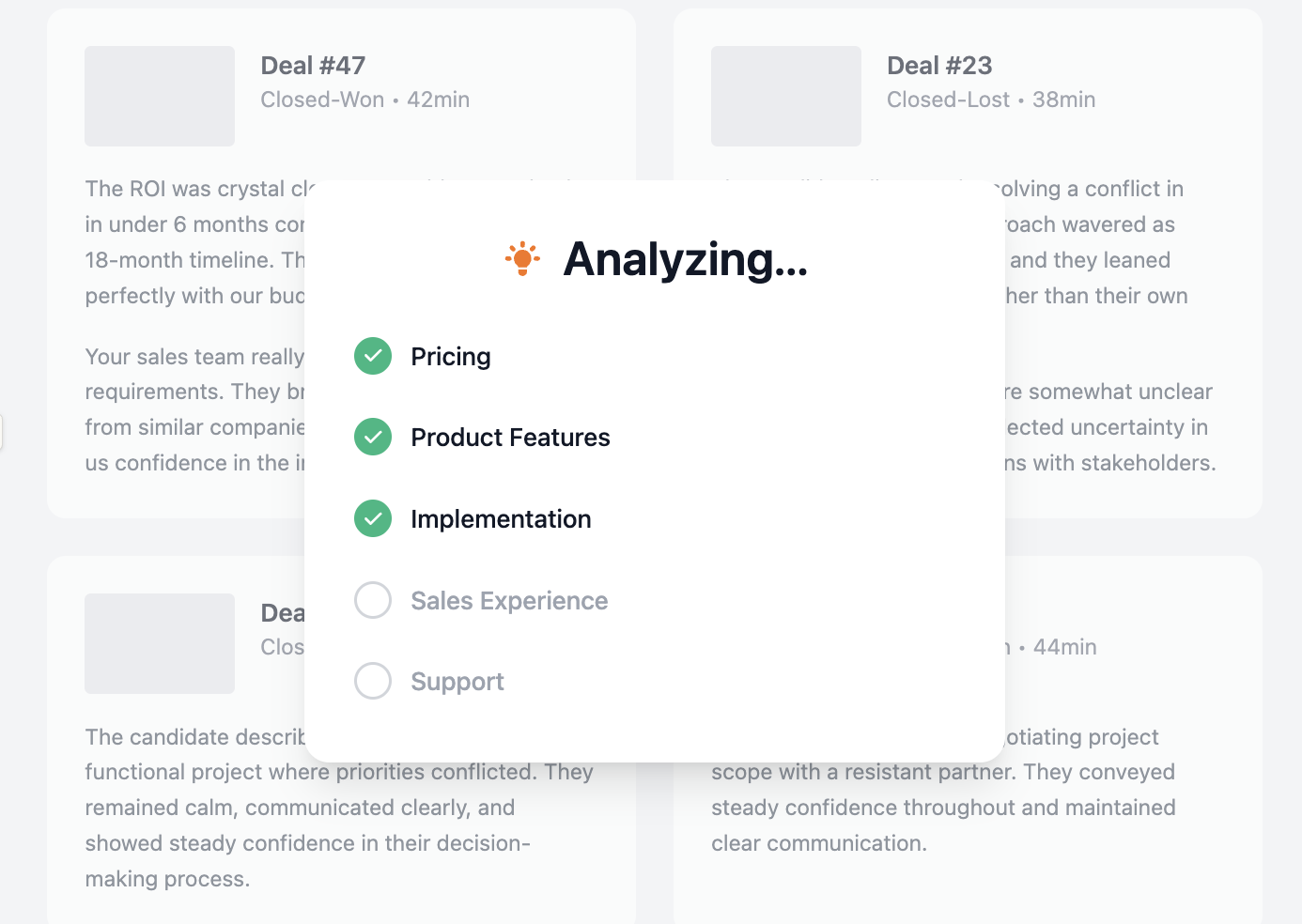
Modern AI-powered research platforms make this unification economically viable. User Intuition, for instance, uses the same conversational AI methodology for both churn and win-loss analysis. The platform conducts natural, adaptive interviews that feel like conversations with a skilled researcher, whether speaking with a churned customer or a lost prospect. The same analytical engine processes both types of conversations, identifying themes, extracting quotes, and generating insights.
The economic transformation is substantial. Traditional churn interviews might cost $400 per conversation and take 3 weeks from recruitment to report. Win-loss interviews carry similar costs and timelines. Organizations conducting 40 churn interviews and 60 win-loss interviews annually spend $40,000 and wait months for insights. AI-powered approaches reduce costs by 93-96% while delivering results in 48-72 hours. The same budget that funded 100 interviews can now support 1,500, transforming sample sizes from statistically questionable to genuinely robust.
But the real value emerges from analytical integration. When churn and win-loss data flow into the same system, patterns become visible that fragmented research obscures. A software company using unified customer intelligence discovered that customers citing "lack of advanced features" during churn conversations and prospects choosing competitors for "more sophisticated capabilities" were describing the same product gap. Neither data stream alone achieved significance, but combined they represented 34% of all negative feedback—enough to justify major product investment.
The velocity advantage compounds over time. With 48-72 hour turnaround, teams can conduct research continuously rather than in quarterly batches. A customer success team can interview every churned customer within days of cancellation, when memories are fresh and emotions are honest. A sales team can interview every lost deal within a week of closure, capturing competitive intelligence before it becomes stale. The cumulative intelligence builds week over week, creating a real-time view of customer sentiment and competitive positioning.
Unifying churn and win-loss analysis requires more than adopting new research tools. It demands organizational changes that align incentives, clarify ownership, and establish processes for translating insights into action.
The ownership question proves particularly contentious. Customer success teams resist ceding control over churn analysis. Sales teams protect their win-loss processes. Product teams want access to all customer intelligence but lack bandwidth to manage research operations. The solution isn't to assign ownership to a single team but to establish a shared intelligence function that serves multiple stakeholders.
Leading organizations create customer intelligence roles that sit at the intersection of product, sales, and customer success. These teams don't own outcomes—retention rates, win rates, product roadmaps—but they own the research infrastructure that informs those outcomes. They design interview protocols, manage research platforms, analyze patterns across data streams, and distribute insights to decision-makers.
The interview design itself benefits from unification. Rather than separate churn and win-loss guides, sophisticated teams develop a single "relationship change" protocol that adapts based on context. Core questions remain consistent: What triggered your evaluation? How did you assess alternatives? What factors proved most important? Which concerns almost changed your decision? The conversational AI adjusts follow-up questions based on whether the participant is discussing cancellation or competitive selection, but the fundamental inquiry remains constant.
This consistency enables powerful comparative analysis. When a SaaS company asks both churned customers and lost prospects to rank decision factors, they can identify whether pricing concerns matter more during initial purchase or renewal. When they explore emotional drivers, they can distinguish between the frustration that drives cancellation and the uncertainty that prevents purchase. These comparative insights prove impossible when different teams ask different questions using different frameworks.
The analytical integration requires thoughtful data architecture. Churn and win-loss conversations generate different metadata—customer tenure and lifetime value for churn, deal size and sales cycle length for win-loss—but the qualitative content follows similar patterns. Modern research platforms tag themes consistently across both data streams, enabling queries like "show me all feedback about integration complexity from the past quarter, regardless of source." This unified view reveals patterns that siloed analysis misses.
The reporting cadence shifts from quarterly reviews to continuous intelligence. Rather than waiting for enough churn interviews to justify a presentation, teams share insights weekly or even daily. A spike in competitive losses to a particular vendor triggers immediate investigation. A new churn theme reaching statistical significance prompts rapid product team consultation. The intelligence operates more like a monitoring system than a research project.
The most valuable output of unified customer intelligence isn't improved churn rates or higher win rates, though both typically improve. The real dividend is comprehensive competitive intelligence that informs strategy across the entire customer lifecycle.
Consider how competitive dynamics appear through fragmented research. Win-loss analysis reveals that Competitor A wins 40% of head-to-head deals, primarily on pricing and ease of implementation. That intelligence helps sales teams adjust positioning and qualify prospects more carefully. But it misses a crucial question: do customers who choose you over Competitor A subsequently churn at higher rates?
Unified intelligence answers that question definitively. When the same analytical system processes both win-loss and churn data, it can track cohorts over time. A B2B software company discovered that customers won against Competitor A on pricing arguments churned at 2.3x the rate of customers won on product superiority. The insight transformed their sales strategy: they began disqualifying price-sensitive prospects earlier rather than celebrating discounted wins that predicted future churn.
The competitive intelligence extends beyond individual competitors to market positioning. When customers churn to build in-house solutions, that signals different strategic concerns than when they churn to established competitors. When prospects choose newer entrants over you, that indicates different positioning weaknesses than when they choose established market leaders. Unified intelligence reveals these patterns clearly because it processes sufficient volume to identify meaningful segments.
The longitudinal view becomes particularly powerful. A company tracking both churn and win-loss data over 18 months can identify how competitive dynamics evolve. Perhaps Competitor B initially won deals on advanced features but now wins primarily on pricing, suggesting their go-to-market strategy has shifted. Perhaps customers who initially cited lack of Feature X during churn now cite poor customer support, indicating that product investments addressed the original concern but revealed a new weakness.
These insights inform product strategy with unusual precision. Rather than building features based on sales requests or customer success escalations, teams can identify which capabilities matter most across the entire customer journey. A feature that prevents churn but doesn't influence initial purchase decisions receives different prioritization than one that drives both acquisition and retention. The unified view reveals these distinctions clearly.
Organizations implementing unified customer intelligence face a measurement challenge. Traditional metrics—churn rate, win rate, research completion rate—fail to capture the systemic value of better intelligence operations.
The most meaningful success metric is decision velocity: how quickly insights translate into action. A product team that receives churn analysis 6 weeks after customers cancel can't iterate rapidly. A sales team that gets win-loss analysis 4 weeks after deal closure can't adjust positioning mid-quarter. When research turnaround drops from weeks to days, decision cycles accelerate proportionally.
One enterprise software company tracked the time between identifying a product gap through customer research and shipping a solution. Before implementing unified intelligence, the median cycle time was 7 months—2 months to accumulate sufficient research, 1 month to analyze and prioritize, 4 months to develop and ship. After unification, the cycle time dropped to 4 months. The research phase compressed to 2 weeks, analysis to 1 week, leaving more time for actual development.
Sample size provides another meaningful metric. Organizations conducting traditional research might complete 100 customer interviews annually across churn and win-loss combined. The statistical power of 100 interviews is modest—enough to identify major themes but insufficient for nuanced segmentation or trend analysis. When unified intelligence operations scale to 500 or 1,000 annual interviews at comparable cost, the analytical possibilities expand dramatically.
The confidence level of insights increases with sample size in predictable ways. With 100 interviews, you can identify that "poor customer support" appears as a theme in 15% of conversations, but the confidence interval is wide—the true rate might be 10% or 20%. With 500 interviews, that confidence interval narrows substantially. You can segment by customer size, industry, or tenure and still maintain statistical significance. You can track monthly trends and distinguish signal from noise.
Cross-functional alignment offers a softer but equally important success metric. When product, sales, and customer success teams reference the same customer intelligence in their strategic discussions, organizational friction decreases. Debates about prioritization shift from opinion-based to evidence-based. Rather than sales claiming customers want Feature X while product insists they need Feature Y, both teams examine the same research showing that 23% of churned customers and 31% of lost deals mentioned Feature X while only 8% mentioned Feature Y.
The ultimate success metric is business impact: improved retention, higher win rates, faster growth. These outcomes result from countless decisions informed by better intelligence, making direct attribution challenging. But the directional impact becomes clear over time. Companies implementing unified customer intelligence typically see churn rates decline 15-30% and win rates improve 10-25% over 12-18 months. The improvements stem not from any single insight but from systematic, continuous intelligence that compounds over time.
The path to unified customer intelligence encounters predictable obstacles. Understanding these challenges helps organizations navigate implementation more successfully.
The most common barrier is organizational inertia. Customer success teams have conducted churn interviews a certain way for years. Sales teams have their win-loss process. Suggesting unification threatens established workflows and metrics. The resistance isn't malicious—it's the natural human tendency to preserve working systems even when better alternatives exist.
Overcoming this inertia requires demonstrating value rather than mandating change. Progressive organizations run parallel pilots: conduct unified research on a subset of churn and win-loss cases while maintaining existing processes. When the unified approach delivers insights faster, cheaper, and more actionably, adoption follows naturally. One B2B software company ran a 90-day pilot covering 30 churned customers and 40 lost deals. The unified research cost 94% less than their traditional approach and delivered insights in 72 hours instead of 4-6 weeks. The results spoke clearly enough that other teams requested access voluntarily.
Data privacy and consent present technical challenges. Churned customers and lost prospects have different relationships with your company, requiring different consent frameworks. Customers who cancelled might reasonably expect their data to be deleted rather than used for research. Prospects who never became customers might question why you're contacting them at all. Navigating these concerns requires thoughtful communication and clear opt-out mechanisms.
Leading platforms address these concerns systematically. User Intuition's research methodology, for instance, includes explicit consent workflows, clear data retention policies, and transparent communication about how insights will be used. Participants understand they're contributing to product improvement and customer experience enhancement, not being subjected to sales outreach disguised as research.
The analytical challenge of unified intelligence shouldn't be underestimated. Combining churn and win-loss data requires careful framework design to avoid false equivalencies. A customer who churns after 3 years isn't directly comparable to a prospect who never bought, even if both cite the same product gap. The former had extensive product experience; the latter formed impressions from demos and documentation. Sophisticated analysis accounts for these differences while still identifying meaningful patterns.
The solution involves context-aware analysis that weights feedback appropriately. Comments from long-tenured customers about missing features carry different implications than similar comments from prospects. The former indicate genuine product gaps that matter in practice; the latter might reflect competitive positioning weaknesses or inadequate demonstration of existing capabilities. Unified intelligence systems tag feedback with relevant context, enabling nuanced interpretation.
The convergence of churn and win-loss analysis represents a broader shift in how organizations approach customer intelligence. As AI-powered research platforms eliminate the economic and temporal constraints of traditional methods, the distinction between different types of customer research becomes increasingly artificial.
The next evolution extends beyond churn and win-loss to encompass the entire customer journey. New customer onboarding interviews. Mid-lifecycle satisfaction checks. Expansion opportunity exploration. Renewal conversations. Each represents a different inflection point in the customer relationship, but all benefit from the same research mechanics: deep, qualitative conversations analyzed systematically at scale.
This comprehensive approach transforms customer intelligence from periodic research projects into continuous relationship monitoring. Rather than waiting for customers to churn or deals to close, organizations maintain ongoing dialogue throughout the lifecycle. The research becomes less about understanding why relationships end and more about understanding how to strengthen them continuously.
The analytical sophistication will increase correspondingly. Current unified intelligence systems identify themes and patterns across hundreds of conversations. Future systems will predict outcomes based on early signals, recommend interventions based on similar historical cases, and track the effectiveness of those interventions over time. The intelligence becomes not just descriptive but prescriptive.
The organizational implications extend beyond research teams. As customer intelligence becomes faster, cheaper, and more comprehensive, it influences how companies structure themselves. The traditional separation between pre-sales, implementation, and customer success teams assumes discrete phases with distinct objectives. Unified intelligence reveals that customer needs and concerns flow continuously across these phases, suggesting more integrated organizational models.
Some forward-thinking companies are already restructuring around this insight. Rather than separate sales and customer success teams with different metrics and incentives, they're creating unified customer teams responsible for the entire lifecycle. These teams use continuous intelligence to guide customers from initial evaluation through long-term value realization, with research insights informing every interaction.
Organizations considering unified customer intelligence face a practical question: where to start? The answer depends on current research maturity and organizational readiness.
For companies conducting minimal churn or win-loss research currently, the starting point is establishing any systematic research operation. Begin with one stream—typically churn analysis, since churned customers are easier to identify and contact. Implement an AI-powered research platform that can scale economically. Conduct 20-30 interviews to establish baseline themes and demonstrate value. Once the first stream produces actionable insights, expand to win-loss using the same methodology.
For companies with established but siloed research operations, the starting point is demonstrating the value of integration. Run a pilot that combines 3 months of churn and win-loss data into a unified analysis. Identify patterns that weren't visible in isolated research. Present findings to cross-functional leadership showing how integrated intelligence informs better decisions. Use the pilot results to justify broader organizational changes.
For companies ready to fully commit to unified intelligence, the starting point is organizational design. Create a customer intelligence function with clear ownership, adequate resources, and executive sponsorship. Implement research infrastructure that supports both churn and win-loss analysis using consistent methodology. Establish processes for translating insights into action across product, sales, and customer success. Measure success based on decision velocity and business impact rather than research volume.
Regardless of starting point, the key is recognizing that churn analysis and win-loss analysis aren't separate research problems requiring different solutions. They're different manifestations of the same fundamental question: why do customer relationships change? Organizations that answer this question systematically, continuously, and comprehensively build competitive advantages that compound over time.
The mechanics are identical. The mission differs. But the intelligence value of understanding both perspectives together exceeds the sum of isolated insights. That's the case for unified customer intelligence—not as theoretical best practice but as practical competitive necessity in markets where customer understanding determines success.